

AARE blog

Teachers truly know students and how they learn. Does AI?

Time-strapped teachers are turning to advanced AI models like ChatGPT and Perplexity to streamline lesson planning. Simply by entering prompts like “Generate a comprehensive three-lesson sequence on geographical landforms,” they can quickly receive a detailed teaching program tailored to the lesson content, complete with learning outcomes, suggested resources, classroom management tips and more.

What’s not to like? This approach represents a pragmatic solution to educators’ overwhelming workloads. It also explains the rapid adoption of AI-driven planning tools by both schoolteachers and the universities that train them.  

And what do we say to the naysayers? Don’t waste your time raging against the machine. AI is here! AI is the future! 

Can AI know students and how they learn?

But what does wide-scale AI adoption mean for the fundamental skills and knowledge that lie at the heart of teaching – those that inform the Australian Professional Standards for Teachers? Take Standard 1.3, for example, “Know Students and how they learn”. This standard requires teachers to show that they understand teaching strategies that respond to the learning strengths and needs of students from diverse linguistic, cultural, religious, and socioeconomic backgrounds. Can AI handle this type of differentiation effectively? 

Of course! Teachers simply need to add the following phrase to the original prompt: “The lesson sequence should include strategies that differentiate for students from culturally and linguistically diverse backgrounds”. Hey presto! The revised lesson sequence now incorporates strategies such as getting students to write a list of definitions for key terms,  using scaffolding techniques, implementing explicit teaching, and allowing students to use their home languages from time to time

Even better, AI can create a worksheet that includes thoughtful questions such as, “What are some important landforms in your home country?”, “What do you call this type of landform in your home language?” and so on. With these modifications, we have effectively achieved differentiation for a culturally and linguistically diverse classroom. Problem solved! 

Can AI deal with the mix?

Or have we? Can AI truly comprehend the complexities of diversity within a single classroom? Consider this scenario: you are a teacher in western Sydney, where 95 per cent of your class comes from a Language Background other than English (LBOTE). This is not uncommon in NSW, where one in three students belongs to this category. 

Your class comprises a mix of high-achieving, gifted and talented individuals—some of whom are expert English users, while others are new arrivals who have been assessed as “Emerging” on the EALD Learning Progression. These students need targeted language support to comprehend the curriculum. 

Your students come from various backgrounds. Some are Aboriginal Australian students, while others come from Sudan, China, Afghanistan, Nepal, and Bangladesh. Some have spent over three years in refugee camps before arriving in Australia, with no access to formal education. Others live in Sydney without their families. Some are highly literate, while others have yet to master basic academic literacy skills in English.

Going beyond

In this context, simply handing out a worksheet and expecting students to write about landforms in their “home country” can be an overwhelming and confusing task. For some students, being asked to write or speak in their “home language” while the rest of the class communicates in English may trigger discomfort or even traumatic memories related to the conflicts they have escaped. Recognising these nuances is essential for effective differentiation and raises important questions about whether AI can sufficiently navigate the complexities of such diverse classrooms. 

Teachers must go beyond merely knowing their students’ countries of origin; they need to delve into their background stories. This includes appreciating and encouraging the language and cultural resources that students bring to the classroom—often referred to as their virtual schoolbag. Additionally, educators must recognise that access to material resources, such as technology and reading materials, can vary significantly among students. Understanding how students’ religious backgrounds may influence their perspectives and engagement with the content is equally important. Only by taking these factors into account can teachers create a truly inclusive and responsive learning environment.

Then there’s the content itself. Teachers need to critically evaluate the content they plan to teach by asking themselves several important questions. That includes: What are my own biases and blind spots related to this subject matter? What insights might my students have that I am unaware of? What sensitivities could arise in discussions about this content concerning values, knowledge, and language? Most importantly, how can I teach this material in a culturally and linguistically responsive  manner that promotes my students’ well-being and achievement?

One overarching concern

All of these questions point to one overarching concern: Can AI truly address all of these considerations, or are they essential to the inherently human and relational nature of teaching?

Australian linguist and emeritus professor of language and literacy education at the Melbourne Graduate School of Education Joseph Lo Bianco says the benefits of AI have been significantly overstated when it comes to addressing language and culture effectively in classroom teaching. 

Although AI excels at transmitting and synthesising information, it cannot replace the essential interpersonal connections and subjectivity necessary for authentic intercultural understanding. The emotions, creativity, and personalised approaches essential for meaningful teaching and learning are inherently human qualities. 

AI, an aid not a replacement

While AI tools like ChatGPT and Perplexity offer impressive efficiencies for lesson planning, they cannot replace the nuanced understanding and relational dynamics that define effective teaching in culturally and linguistically diverse classrooms. Teachers need to recognise that AI can aid in differentiation but lacks the capacity to fully comprehend students’ individual experiences, histories, and emotional landscapes. The complexities of student backgrounds, the significance of personal narratives, and the critical need for empathetic engagement cannot be reduced to algorithms. 

As we embrace AI in education, we must remain vigilant in advocating for a pedagogical approach that prioritises human connection and cultural responsiveness. Ultimately, teacher AI literacy should encompass not just the technical skills to integrate AI into classrooms but also the profound understanding of students as whole individuals, fostering an inclusive environment that values each learner’s unique contributions. In this way, we can harness the power of technology while ensuring it complements the irreplaceable art of teaching.


Sue Ollerhead is a senior lecturer in Languages and Literacy Education and the Director of the Secondary Education Program at Macquarie University. Her expertise lies in English language and literacy learning and teaching in multicultural and multilingual education contexts. Her research interests include translanguaging, multilingual pedagogies, literacy across the curriculum and oracy development in schools. 
Our nationally-leading music courses are now under threat

The NSW Education Standards Authority (NESA) curriculum review puts music courses at risk, not just in NSW, but across Australia. NSW has twice the number of students taking music than any other state. That makes it a leader.

The proposed changes fall short of research, best practice, and teacher expectations. This is despite NESA’s claims of strengthening post-school pathways and fostering lifelong learning, . 

Worst of all, the “revamped” Music 1 course—the country’s most popular Year 12 offering — severs meaningful ties to further study or the music industry.

The back story

NSW has historically enjoyed the leading music curriculum in the country, when measured by innovations and research internationally.NSW modernised its senior music syllabuses in the 1980s and embraced integrated learning: students performed, composed improvised alongside traditional literacy and aural skills. This inclusive approach reflects real-world diversity and career pathways. It was strengthened in the 90s and in 2000 by a focus on multiculturalism, contemporary Australian music, and student specialisation.

“Music 1” is by far the most popular course. It’s a music-for-everyone course. You don’t need to have studied an instrument privately for years to take Music 1. You can be a Chopin-loving pianist, a shredding guitar soloist, or an Electronic Dance Music producer. You can study any music of the last 1,000 years. You can elect to specialise in performing, composing, or musicology. Or you can balance each of those learning experiences. 

Envy of the nation

This broad choice has made us the envy of the nation. Dr Emily Wilson, senior lecturer in Music Education at the University of Melbourne, usually speaks jealously when she talks about our courses, because she says that at around 7% of the total HSC candidature, it’s twice the rate of student engagement compared to Victoria and Queensland. 

“Music 2”, in its own words, “focuses on the study of Western art music”. Even this more traditional course was really cutting-edge for its time. It insisted all students learn to compose, even if their specialisation was in performance. And in the HSC year , it focuses on contemporary Australian Music rather than classical or romantic repertoire. Music Extension can only be taken by Music 2 students, with a Western art music focus. It has allowed these students to do a further specialisation in one area of their choice.

These courses were far from perfect. They feature outdated elements like requiring song submissions via written scores. Also, the obsolete “Concepts of Music” highlighted the need for more authentic approaches to music theory and literacy. Pedagogical breakthroughs in other countries would benefit NSW. These include  the extensive research and practice in informal learning, and culturally responsive pedagogy.

The problem at NESA

Concerns about NESA’s reform began early. Educators experienced disappointment with the new K-6 and 7-10 syllabuses. They regressed from evidence-based integrated approaches and added rigid content. The opaque process was marked by non-disclosure agreements and vague public feedback summaries. By NESA’s own admission, it left educators guessing how their input shaped the final drafts.

The NSW syllabuses since the 1990s had been based on Swanwick and Tillman’s 1986 Curriculum Spiral model . NSW used to pride itself on a continuum from year 7 to year 12, with skills  built on at each stage of learning. The proposed changes erase the continuity in the senior curriculum, performing, listening, and composing in years 7-10.

NESA relies on a workforce with varied professional backgrounds – rather than subject experts with deep teaching experience. That leads to poor decisions and leaves specialists grappling with flawed syllabuses. Meaningful consultation—such as face-to-face sessions across the state, not just online updates—would boost teacher morale. That’s particularly true in rural areas, where the process currently feels like a steamroller, pushing ahead despite clear deficiencies.

NESA’s shortcomings in understanding music education have been replicated in the recent release of an equally poorly researched and written drama course. All of the evidence (in the syllabuses themselves) suggests this is because of NESA’s intransigent position toward making the Arts subjects fit into the same template and nomenclature as the more “important” subjects such as maths, English, and science.

Attacks on Music 1 – Time Travelling, backwards

Music 1 has been the leading music course in the country because of its breadth of choice and inclusion. The draft syllabus destroys the diversity and inclusivity of the existing course, while at the same time making it weaker against its own evidence base.

Gone are the wide range of topics that can be studied, and in their place a restrictive list of mandatory “Focus Areas”. While many have incorrectly thought of Music 1 as “the pop course”, it actually served as a conduit for many classically-trained musicians in public schools that could not afford to run both courses. Sadly, that is most of them. Under the new mandatory list, this is impossible. Now songwriters, DJs, producers, and other contemporary musicians will be forced to study topics of little interest to them or relevance to their future careers. It is an aggressive narrowing of the curriculum which experts believe will lead to widespread disengagement from the course. Prescribed topics were part of the early music syllabuses for the 1950s Leaving Certificate, carried over to the first HSC music syllabuses, then relinquished in the 1980s in line with leading research and practice.

The proposed examination includes the introduction of a two-hour aural exam with increased weighting. The composition and musicology electives are being binned, reminiscent of the 1970s.

Attacks on Music 2 and Extension

The proposed Music 2 examination allocates 40 marks each to written and performance exams, with restrictive performance options and limited topic choices. That curbs students’ ability to pursue their interests. The composition component, worth 20 marks, mandates a duet, trio, or accompanied solo within a narrow focus on recent Australian art music. While these changes may aim for equity, they undermine the syllabus’s flexibility and breadth. Similarly, the Extension examination now limits specialisations, requiring either two performance pieces (including an ensemble) or two compositions, alongside another 50-mark written aural exam focused on unspecified ‘prescribed’ repertoire—an approach reminiscent of rigid external testing. NESA’s pushing of written exams is a return to post-Sputnik debates about legitimising music in the curriculum in the 1950s

We assume – we hope –  NESA does not realise that it is repeating the mistakes of 70 years ago.

What does the research base really tell us?

The current curriculum reform, meant to be based on the Geoff Masters review Nurturing Wonder and Igniting Passion, diverges significantly from its recommendations. The report called for simplifying an overcrowded curriculum but the new music syllabuses introduce more content points and prescriptive structures. It advocated integrating knowledge and skills, yet the new syllabuses prioritise what Elliott & Silverman term “verbal knowledge”—written knowledge about music—over musical knowledge, assessed through music-making. 

Instead of flexibility, the new syllabuses impose mandated content, reducing teachers’ ability to adapt to their students. As Fuller notes, what works best may not work best for music education. Carter critiques NESA’s focus on the HSC, which pressures teachers to prioritize exam preparation over broader learning. Hughes highlights NSW’s fixation on maintaining standards and traditional benchmarks, with assessment driving curriculum changes. Teachers, however, recognise the importance of holistic approaches, and research confirms that successful teaching builds on students’ understanding of the subject.

A restrictive, exam-focused syllabus will inevitably result in restrictive, exam-focused teaching.

We need transparent curriculum reform led by experts

NSW is the biggest education system nationally and has led the way with senior secondary music enrolments for many years. This is due to its focus on active music making and promoting choice for students. That in turn places value on the musical interests of students, their autonomy, agency and inclusion. 

We asked our Melbourne colleague Emily Wilson what she made of the new draft syllabuses and she said “Following a recent major review of the Victorian Certification of Education Music Study Design, we now have ‘Music Inquiry’, a project-based music subject explicitly positioned as music-for-everyone, moving Victoria closer to the existing NSW HSC Music 1 course.

Every student a stakeholder

“We have been looking to NSW for almost 35 years to lead the way with a progressive curricula. It’s important that this continues so that senior secondary music curricula keeps pace with the ever increasing rate of change in the music industry and broader society. Every Australian student and music teacher is a stakeholder in the NSW HSC Music Syllabus.”

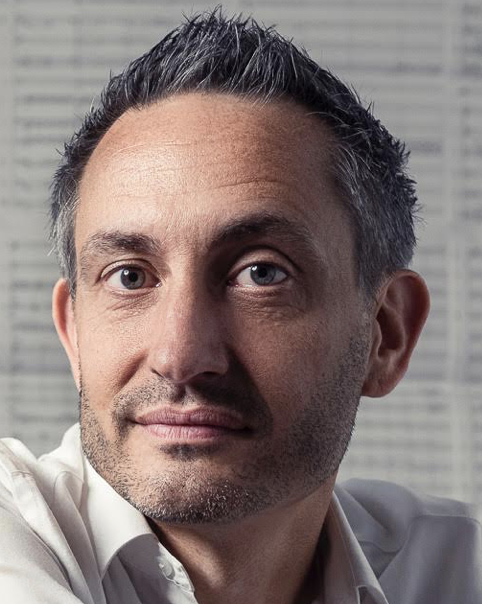
James Humberstone is a senior lecturer in music education at the Sydney Conservatorium of Music, The University of Sydney. He specialises in teaching music pedagogies, technology in music education, and musical creativities. James publishes traditional research focusing on music teacher worldview, technology and media in music education, and artistic practice as research. He is also a composer and producer whose music is performed in major venues around the world.


After a career as a music teacher and head teacher in NSW schools, and Chief Examiner of HSC Music in NSW, Jennifer Carter worked as a Senior Registration Officer at the NSW Education Standards Authority. She was a sessional lecturer for primary music and secondary music preservice teachers and has presented at music conferences both nationally and internationally. Her PhD thesis researched secondary classroom music teachers and the development of music syllabus documents.

What schools should do now the manosphere thinks it’s back in charge

The men who helped Trump sweep to victory through inspiring young men to vote, such as billionaire investor Elon Musk and podcaster Joe Rogan, hold a network of power and influence that might further exacerbate  the undermining of women and girls’ rights and safety during a second Donald Trump presidency and beyond. 

Given the existing reach of far-right, misogynist figures in Australian schools, it’s also important to consider potential implications for Australian education. 

Here in Australia, pre-election polling found Australian men were more likely to indicate support for Trump than women. More starkly, while a lower figure than those American young men who voted for Trump, a significant 43% of Australian men under 30 indicated their support for Trump over Harris. While some data indicate Trump’s appeal to young men is based on economic policy and job prospects, it’s impossible to ignore the appeal of strongman politics, misogyny and male supremacy. 

This type of misogyny is highly influential. Now no longer restricted to online spaces, it is likely that we will see boys and young men emulating and repeating Trump’s views and attitudes. Taking this alongside the polling data from Australia that  indicate broad support for Trumpian politics, policies and persona, there will likely be waves of influence in Australian schools that will require policy, curriculum and leadership-level response. 

Urgent need for training in critical thinking about the manosphere

Trump has a history of endorsing conspiracy theories. During his campaign, he affiliated himself with anti-abortion and anti-vaccine activist and conspiracy theorist, RJK Jr, who said Trump had promised him control of public health agencies, ‘because we’ve got to get off of seed oils and we’ve got to get off of pesticide.’ 

For boys and young men consuming manosphere content and vulnerable to its misinformation, the emboldening effect of Trump’s election will have very real impacts on their understanding of key global issues, as well as girls’ and women’s safety.

This will make curriculum attention to critical thinking an essential and urgent priority. Critical and creative thinking has long been a general capability included in the Australian Curriculum. Now we need to pay specific attention to equipping young people with skills to identify misinformation and resist pervasive conspiracy theories; and increase all students’ critical digital literacy skills to understand how the manosphere exploits and manipulates their feelings and beliefs. 

Brazen disregard for truth

Trump’s brazen disregard for truth and fact mirrors other manosphere figures, such as Tate, Trump and Joe Rogan. Both Trump and Rogan have claimed that Invermectin cures COVID and that vaccines alter your genes, among other conspiracies.Trump’s presidency is also a threat to climate action, which significantly regressed under his previous term. Joe Rogan and fellow manosphere figure Jordan Petersen have also faced criticism by scientists for their public climate change denialism. A conversation that took place on X between Trump and Musk was also widely condemned for being seeped in climate misinformation. The outcome of the election has also clearly emboldened white supremacists in the US, and is likely to do the same for such groups in Australia. This is especially concerning given their visibility has been already growing here in recent years..

Trump and manosphere support in Australia 

Our research has indicated that figures of the manosphere—a term used to describe online groups, individuals and forums who represent anti-feminist and anti-women ideas—have influenced how boys behave towards women and girls in Australian schools. Andrew Tate is one of the most infamous members of the manosphere, a public misogynist charged with rape and human trafficking. 

Once the election results were becoming clear, Tate announced that he is ‘moving back to America’—a clear endorsement of the election result and the permission provided for men like him to thrive in Trump’s America. 

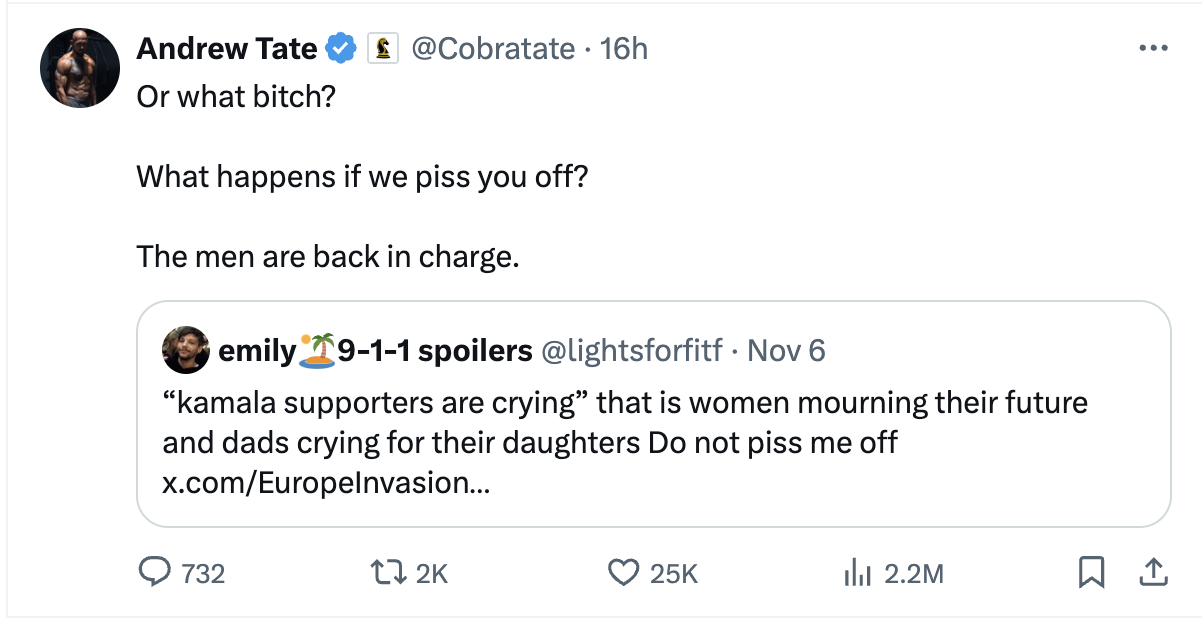
Tate later proudly boasted that ‘the men are back in charge’. He was making it clear women’s grievances were irrelevant now a male supremacist president was reinstalled. 

These statements align with the comments posted by prominent far-right leader and activist Nick Fuentes, who posted on X ‘Your body, my choice. Forever’. This vile sentiment very quickly became a viral meme, across all the major social media sites. It was even printed on T-shirts and readied for purchase. Australian women have also reported being on the receiving end of the ‘’your body, my choice’ statement as well as experiencing an increase in violent and misogynist messages from men online since Trump’s election win. 

In a climate of increasing hostility and endemic levels of violence against women, the affirmation of male supremacist ideas and attitudes by the election of a misogynist to public office presents a very real threat to women’s safety in Australia. 

Viral misogyny 

Tate’s influence on other manosphere creators and sympathisers and the viral spread of his misogynistic ideas is part of a phenomenon known as ‘networked misogyny’. The endorsement of Trump by high-profile figures such as Rogan and Musk provide an example of how figures of the manosphere work to support each other and provide access to power. For example, Musk used his significant profile on X to ‘amplify right-wing conspiracy theories, spread misinformation and promote the Republican candidate.’ 

Algorithms presenting manosphere content such as Andrew Tate’s to boys and young men regardless of whether they search for it. There is now a strong body of research documenting the ways that this content shapes how boys and young men treat women. This includes sexist and derogatory comments and behaviour. It also includes a refusal to accept the gender wage gap is real and opposition to gender equity. 

Inaccurate beliefs

These beliefs are key parts of grievance politics that were key to Trump’s success, and feed inaccurate beliefs about disadvantage and lack of opportunity. These ideas find homes in the minds of boys and young men, who in return begin to see women and girls as barriers to their success. 

It is crucial we increase all students’ critical digital literacy skills to understand the malign influence of the manosphere. With Australia heading into an election year in 2025, this need is more critical than ever. 

Stephanie Wescott is a lecturer in Humanities in Social Sciences in the School of Education, Culture and Society, Monash University Faculty of Education. Her research explores socio-political phenomena and their intersections with education policy and practice.

Steven Roberts is a professor of Education and Social Justice in the School of Education, Culture and Society at Monash University Faculty of Education. He is a sociologist and has published widely in the areas of Critical Studies of Men and Masculinities and Critical Youth Studies.

Dramatic setback: Why the newly drafted senior drama syllabus falls short of a quality creative arts education

The NSW Education Standards Authority (NESA) just released new draft senior Creative Arts syllabuses for Year 11 and Year 12 students, including the drama syllabus. The announcement comes as part of raft of changes following the NSW Curriculum Review, ambitiously titled Nurturing Wonder and Igniting Passion

Among the new draft syllabuses, the subject of senior drama received its first major revamp since 2009. This means that the current opportunity for enhancing drama curriculum is momentous.

This curriculum review represented a potential step towards elevating the status of drama in schools and society. Drama is, after all, is one of the most important subjects in preparing students for the world of work.  The draft review fails drama and drama students.

Your chance to evaluate

Teachers, academics and other stakeholders now have the chance to evaluate the proposed drama syllabus in a formal consultation period that ends on 20 December 2024.

However, the interim reaction among stakeholders is mostly negative. Educators are dissatisfied and disappointed. The refined content reduces rather than strengthens the learning opportunities necessary for delivering a quality drama (and creative arts) education. This issue starts at a policy level and extends well beyond the decision-making practices of any school leaders and teachers

A dramatic cut 

The elimination of the HSC Group Performance examination is the most significant notable change. What’s in its place? An internally assessed rather than externally examined ensemble piece. This shift devalues the Group Performance as a major work that requires students to collaborate to devise an original piece of theatre. 

For many teachers and students, this component of HSC drama is the preeminent experience because of the intellectual demand and corroboration of knowledge and skills in making, performing and appreciating drama. It is also a vital means to valuing actor-audience relationships and honouring communication and storytelling through the relay of meaning in real time.

The devaluing of this core component of the existing drama syllabus is a threat to the craft of drama. It produces an overreliance on prescribed content and leaves fewer legitimate opportunities to showcase the dramatic arts as intended through style or form, role and character, and structure and action. 

It also signals cost-cutting measures. Facilitating external examinations across the state of NSW is not inexpensive. But that doesn’t mean it’s not worthwhile. 

Elimination of choice

Additionally, the proposed drama syllabus eliminates choices for the Individual Project. This component of the drama course requires students to communicate a directorial vison for a key text through deep exploration and application of specialised knowledge and skills. Current project options are Director’s Folio, Portfolio of Theatre Criticism, Costume Design, Lighting Design, Promotion and Program Design, Set Design, Scriptwriting, Video Drama, and Performance. 

However, the draft syllabus cuts Director’s Folio, Lighting Design and Video Drama. These projects are three critically important parts for sustaining any theatrical tradition and the entertainment industry more broadly. 

A reduction of choice might seem small. But we cannot underestimate the value of enabling students to choose which content to pursue to nurture their creative abilities. Giving students choice in drama specifically provides a scope and flexibility that is rare among most subjects. It provides learning benefits such as skills in time-management, self-regulation, creative autonomy, and risk-taking. In a society that looks to encourage higher order thinking and creative skills, such a move is retrograde at best.

Missing the texture

The draft syllabus now states that “All Individual projects, excluding performance, will be submitted electronically to reflect industry practice and support best practice in marking processes” (see p. 9). Now, projects are packaged and posted, then sent through the mail for external examination. This process is necessary because the projects are tactile in nature; for example, costume design projects tend to use carefully chosen and delicate fabric swatches. 

Limiting the Individual Project to digital submissions impedes creative and aesthetic possibilities available to students and is a disservice to the art form. The justification that this change aligns with “industry practice” relies on using software programs that many schools simply cannot afford to purchase. And the point about “best practice in marking processes” is debatable. 

Eroding the arts by curriculum design

Unfortunately, arts subjects are usually first on the chopping block in schools (and universities). 

Recent research also reveals a worrying decline in the proportion of NSW public secondary students participating in creative arts courses in Years 10, 11 and 12. This includes dance, drama, music, visual arts, visual design, and photographic and digital media. 

But any view that arts subjects appear less popular or that students are abandoning arts subjects overlooks that they are ranked lowly in the status spectrum of school subjects. They are deliberately positioned as optional extras – ‘peripheral’ as opposed to so-called ‘core’ learning areas. This subject hierarchy means that students are rarely equipped to make informed choices about studying arts subjects (or not) due to a lack of quality learning experiences within arts subjects. 

Indeed, this curriculum context remains devastatingly unjust given a vast majority of Australian school students still have little or no access to quality arts education. It also neglects the inherent value and human need for the arts and goes against a growing body of research about the benefits of arts education. If we learnt one thing from the recent Pandemic, it was the need for all of us to engage and consume arts content in a time of isolation.

‘Revival’ of the arts in Australia?

Ironically, the federal Labor Government (2022) initiated changes on a policy front that position the arts as an important agenda. Specifically, the national policy, Revive, outlines five pillars designed to enhance the cultural ambitions of Australia over the next five years and beyond. They are:  

  • First Nations First;  
  • A Place for Every Story;  
  • Centrality of the Artist;  
  • Strong Cultural Infrastructure; and  
  • Engaging the Audience.  

These pillars provide a timely policy framework for rethinking the role of the arts in society and education, particularly for nurturing the lives, livelihoods, and wellbeing of people across the country

A degree of scepticism

However, this policy warrants a degree of scepticism. The focus on ‘revival’ conveys a need to restore resources and strategies that are deficient given deliberate attempts to erode them

The gap between national policy aspirations and the proposed curriculum changes to creative arts subjects such as drama has severe potential consequences for what students have the opportunity to learn in school, and the future possibilities available to them outside of school, in terms of employment or otherwise. 

The hearings of 2024 NSW Inquiry into Arts Education continually demonstrated the ongoing diminishment, paucity and degradation of the Creative Arts in schools; despite the wealth of talent in both staff, pupils, and the wider community. As educators we can choose to either focus on basic skills creating industrial automatons, or recognise the Arts as a key skill to empower articulate, inventive, and engaged future citizens. When students study the Creative Arts they succeed across all aspects of their education, and beyond.

Matthew Harper is an early career researcher in the Teachers and Teaching Research Centre at the University of Newcastle. Matt has collaborated with colleagues on a range of research exploring student aspirations, quality teaching in schools and higher education contexts, and curriculum and pedagogy theory and development. His doctoral research compared secondary mathematics and drama in the Australian schooling context.

David Roy is a lecturer and researcher in Education and Creative Arts at the University of Newcastle (AUS); and was formerly a teacher for 17 years. He uses his research to inform inclusion and equity practices across Australia, with a particular focus on children with a disability, policy, and engagement with the Arts.

Aboriginal cultures and histories: ‘Deep truths’ about content in the new syllabuses

 As many in the curriculum ‘engine room’ know, curriculum development is a complex collaborative process that is dependent on a range of factors. 

Some of those factors include:  legislative frameworks of governments, curriculum reviews, policy cycles, inquiry recommendations, political priorities, funding, sources of evidence, community partnerships, education sector capacity and the available and accessed expertise of the developers. All of these make a very real impact on what the children of families across this continent experience each business day when they enter a school and its various learning environments. 

Curriculum development from outside the ‘engine room’ can be a difficult space to engage with. Specialist mechanisms and user experiences can change with each batch of syllabus output.  There is usually a period of some apprehension for educators and system representatives as consultation phases on draft syllabuses take place and eventually give way to published syllabuses, ready for implementation. 

Deep time history does not appear

Scrutiny of the new NSW History 7-10 Syllabus (2024) reveals that, indeed, as Michael Westaway, Bruce Pascoe and Louise Zarmati wrote in the Conversation, the concept of deep time history does not appear. 

Efforts by NESA to future-proof syllabus content could likely be one reason (think ‘Big History’) for this decision. Another might be due to evidence from various fields that deep time history is less compatible with some Aboriginal and Torres Strait Islander representations of time as cyclic rather than linear. 

Mize (2024) suggests deep time ‘is a colonialist construct that risks both reinforcing white-supremacist epistemologies and occluding non-white ways of relating to the environment’ (pp.143-4).

The claim by authors Westaway, Pascoe and Zarmati that, ‘the only Aboriginal history taught to NSW students would be that which reflects the destruction of traditional Aboriginal society’ quickly gains our attention and invites us to look more closely. In doing so we notice that some Aboriginal and Torres Strait Islander Histories and Cultures content familiar to Stage 4 history teachers in NSW, has been relocated instead into the new HSIE Kindergarten to Year 6 Syllabus (2024). 

Some educators would argue that this relocation may compromise the depth of study for students, while others may welcome the early exposure as a means of normalising learning about Aboriginal cultures and histories. 

Compromising depth or early exposure

There are, though, explicit references to Aboriginal and Torres Strait Islander Peoples’ histories and cultures in Stage 4, within Historical context 1(core): The ancient past

More significant than all of this, is the fact that NESA has in the new NSW History 7-10, Geography 7-10 and Human Society and its Environment (HSIE) K-6 syllabuses, achieved a first in mainstream curriculum history in NSW – and likely in Australia. It embeds Aboriginal Cultures and Histories in the outcomes of the new syllabuses, rather than solely, as in past syllabuses, in content. 

This has produced strategically located, high-quality continua of learning about Aboriginal cultures and histories in new NSW history and geography syllabuses from kindergarten to year 10; at once sequential, complementary and avoiding duplication. 

What the peak advisory body says

Additionally, NSW AECG Inc. as ‘the peak advisory body regarding Aboriginal Education and Training at both State and Commonwealth levels’ has expressed its support for the new History, Geography and HSIE syllabuses developed by NESA. 

Supporting this work, NESA has continued its practice of engaging Aboriginal and Torres Strait Islander teachers to draft Aboriginal and Torres Strait Islander histories and cultures in the new syllabuses. This was first introduced in 2016 when new Stage 6 English, Mathematics, Science and History syllabuses were developed. 

Targeted consultations

The practice, evidence of NESA’s decolonising of curriculum process, was coupled with targeted consultations with Aboriginal education stakeholders on draft representations of Aboriginal and Torres Strait Islander histories and cultures.  This was for the purpose of cultural quality assurance of content. 

Potentially alleviating some of the concerns expressed by Westaway, Pascoe and Zarmati, the new NSW History 7-10 content related to Aboriginal Histories and Cultures is well complemented by the new Geography 7-10 Syllabus, with examples below:

GE4-APC-01

Explain Aboriginal Peoples’ Custodianship, care and management of Country

GE5-APC-01

analyses how Aboriginal Peoples’ Custodianship of Country supports environmental management and enhances Community wellbeing

Curriculum reviews: national and state

Curriculum reviews are enormous investments and are extraordinarily influential. For NSW, there have been two reviews of consequence in recent years.

Firstly, ACARA made its most recent Australian Curriculum (Version 9.0) available in 2022 with flexibility for jurisdictions to implement and/or incorporate in state or territory curriculum. Despite the high quality of the many representations of Aboriginal and Torres Strait Islander histories and cultures in Version 9.0 and the potential for ACARA to be international leaders for Truth Telling and Reconciliation, the outcome of the representation of Aboriginal and Torres Strait Islander histories and cultures, appears very uneven across Learning Areas, with the majority optional. 

Secondly, in 2020 the NSW Curriculum Review Final Report resulted in procedures being introduced by NESA to progress further curriculum renewal (adopting the term ‘reform’) of the majority of syllabuses from Kindergarten to10.

Disappointingly restrictive

For Aboriginal education stakeholders, Recommendation 5.3 was significant but disappointingly restrictive, containing Aboriginal histories and cultures content to HSIE, ‘Develop a curriculum that specifies what every student should know and understand about Aboriginal cultures and histories, and incorporate this curriculum into Human Society and its Environment’. 

This limitation of Recommendation 5.3 was despite the successes of the representations of Aboriginal and Torres Strait Islander histories and cultures content across a range of Key Learning Areas beyond HSIE such as in English, Mathematics, Science, Technology, PDHPE and Languages syllabuses developed between 2016 and 2019. If anything, it is the disciplinary limitation inherent in this recommendation that, if acted on, will become a regrettable ‘step backwards in education’ making non-HSIE syllabuses out of step with the increasingly inclusive research produced by higher education that curriculum authorities rely upon for curriculum content. 

Shared end-goals of the representation of Aboriginal and Torres Strait Islander knowledges in school curriculum 

Among the many tensions for curriculum and assessment authorities, and communities that underpin the representation of Aboriginal and Torres Strait Islander knowledges, skills and understandings in school-based curriculum is the ambiguity surrounding a shared end-goal. While this will be always be a work in progress as Australian history continues to mature around its reconciliation, Truth Telling and reparations negotiations, the question remains, ‘how do curriculum and assessment authorities and communities start to frame an end-goal of representation of Aboriginal and Torres Strait Islander knowledges in school curriculum?’. 

For example, with Aboriginal and Torres Strait Islander students comprising 6.5% of Australia’s school student population in 2023 (ABS, 2024) is it a fair ask to anticipate curriculum planning in the future ensures each mainstream syllabus has approximately 6.5% of content reserved for Aboriginal and Torres Strait Islander knowledges? This may seem an outrageous suggestion for some, but it is starting to become a reality in the new NSW HSIE syllabuses.

The measure of success

Ultimately, the measure of success is when all school students across the nation successfully comprehend, value and respectfully utilize knowledges, skills and understandings gained by exposure to culturally and academically rigorous and assessable representations of Aboriginal and Torres Strait Islander histories and cultures across subjects in all Key Learning Areas.  

Christine Evans is a Wiradjuri woman and Pro Vice-Chancellor (Indigenous Education) at the University of New South Wales. In her role she contributes to enhancing opportunities for the representation of Indigenous knowledges in curriculum and in professional development using culturally responsive methods. Earlier in her career she was a secondary Visual Arts teacher/head teacher in NSW public and independent schools. Christine held the role of Chief Education Officer, Aboriginal Education, at NESA for several years and, in 2016, introduced a new model for the representation of Aboriginal and Torres Strait Islander histories and cultures in NSW school curriculum.

The header image comes from the AIATSIS guide to evaluating and selecting education resources

Is arts learning an emerging priority for your primary school?

We know that learning the arts improves both student engagement and well-being. Students develop self-esteem, capacity to collaborate and share their emotions, all part of learning to  communicate and developing socialisation skills

The COVID-19 lockdowns in Australia forced families and teachers to rethink how children might learn, in new online contexts where the usual teacher/student and student/student relationships were disrupted by emergency remote learning and teaching. Our research was particularly concerned with approaches to teaching the arts online which enabled and facilitated connection and communication between students, and between teachers and students.

The whole family got involved

Anecdotally we heard about some innovative approaches adopted by primary teachers to engage students in online learning in the arts. In some cases whole families participated in the arts learning activity. While in some situations families had limited technology available at home some students took the opportunity to be fully engaged in an arts learning activity for most of a day, enjoying the opportunity to focus on something they loved without having to change what they were doing upon the ring of a bell.

Our research showed that teachers and parents had expressed hope that online arts learning could facilitate positive online learning experiences, particularly for those students who had encountered challenges in a face-to-face environment. Here is what we have found.

During the online learning periods music and visual arts were the most commonly studied artforms, dance and drama were next. Media arts was the least reported artform. For many students and teachers  online arts learning was an overwhelmingly negative experience. But, for some, the arts online experience was remarkably positive and social.

Sharing their work with others

Parents and teachers equally endorsed reasons children enjoyed activities with highest scores being for these reasons: sharing their work with other students; learning was fun and showing something they had made. 

Parents reported that students did not create something with other students, talk or send messages to other students while engaged in online arts learning activities. But, some teachers found their students did so. Both parents and teachers indicated students watched other students present their work. Parents and teachers reported examples of students exploring visual arts making techniques using materials around the home to create collages, paintings and puppets. Some students responded to dance and drama online learning activities by recording their own movement sequences and creating short drama scenes using imagined television interview scenarios. One activity involved students bringing their siblings and parents into the activity to self-tape a recreation of a moment from a movie for which they overlaid the recorded film soundtrack.

Recreating ET

One parent and their child particularly enjoyed recreating a classic moment from ET using family bicycles. Mobile phones were a useful device for students to record sounds in their own garden. Students then recorded themselves talking about the sounds using elements of music such as pitch, dynamics and texture. While students completed these tasks individually teachers found ways to share students’ work through online classes and gallery platforms. Students engaged with each other’s artworks through conversations in online classes.

The post-pandemic return to school and face-to-face teaching and learning saw both parents and teachers reporting that students were highly motivated to resume face-to-face arts learning. Students were keen to connect in person with their peers and teachers. They were motivated to collaborate on arts projects like music and drama. Students were actively seeking creativity in the classroom. The arts online did not necessarily create positive experiences for many students and teachers. But it did increase students’ recognition and eagerness to explore the arts in their classrooms. Many students had renewed enthusiasm upon returning to school. But some did not, and still may not have returned to school.

Through the emerging priorities program research into primary arts learning online we worked with teachers and artform researchers from across the country to develop digital exemplars of arts online learning activities that teachers can use with students in Years 1 and 2. Each activity scaffolds elements of the personal and social capability, one of the general capabilities in the Australian curriculum.

The museum of me

These digital exemplars recognise the complexity of teaching since the pandemic. They include ways to involve students who may be learning online with students who are in the classroom. Visual arts includes the museum of me where students collect, draw and talk about items that are important to them. The dance and music learning activities can be used separately or interconnected through the use of a song and dance movement from Ghana. The drama learning activities involve short scenarios in which students learn to observe and make characters and develop character status. The media arts activity uses the drama learning activity to explore how to use camera angles to represent character status.

The exemplars in each of the five art subjects: dance, drama, media arts, music and visual arts include links to online videos and downloadable lesson plans to assist teachers engage students through arts learning. How to give feedback is modelled for students across learning activities in each artform using three stems: One thing I appreciated – ; One thing I discovered -; One thing I am wondering -. For each artform the elements of the personal social capability and signature pedagogies are identified. The EPP Arts Learning Online digital resources are available online as a free resource. They provide 10 hours of online self-paced learning for teachers, pre-service teachers and interested parents and caregivers. The researchers are keen to receive feedback from people testing out the activities. The opportunities to provide feedback are embedded in the digital resource.

This research project was funded through the Commonwealth Department of Education Emerging Priorities Program.

Linda Lorenza is a senior lecturer in the CQUniversity School of Education and the Arts. She is Head of Course for the Bachelor of Theatre,  teaching theatre, acting and drama. Lorenza is a qualitative researcher and arts practitioner whose interests are in the performing arts, arts education, and applied arts in health and rehabilitation contexts. She is a chief investigator, with Don Carter, on the Emerging Priorities Program research into arts online learning.

Don Carter is an associate professor in the UTS School of International Studies and Education, he specialises in working with teachers to investigate innovative writing pedagogies to improve student performance and outcomes across the curriculum. Carter is a chief investigator, with Linda Lorenza, on the Emerging Priorities Program research into arts online learning.

Arts education: we fail our students with so many tests

The Impoverishment of Standardised Learning 

In today’s educational climate, with its intense focus on raising standardised test scores, it seems like we have lost sight of nurturing the extensive human potentials of both our students and teachers. There is an ongoing fixation with individualised student-centred approaches, along with drilling basic competencies in reading, writing and maths. Approaches are increasingly narrowed to “teach to the test” to accommodate these high-stakes metrics.  The need to develop foundational skills is necessary, although rigid, utilitarian approaches can be ideological and problematic in many ways .

This includes the risk of depleting our capacities for original creative thinking, empathetic cross-cultural understanding, ethical reasoning and collaborative problem-solving. We fail to cultivate the diverse cognitive, emotional and social capabilities if education becomes transactional.

Human beings can’t truly flourish and thrive if it’s just about prescribed knowledge, regurgitated on exams or for tests,

Different ways of knowing

Current education approaches may allow students to complete well on tests (although various indicators suggest otherwise such as recent NAPLAN results), but it is not clear how it serves students to envision innovative solutions to complex issues or what Eisner alludes to as being able to  reconcile competing perspectives. The unprecedented socio-ecological challenges we face as a global society – from climate crises to technological disruption, systemic injustices and societal fragmentation – demand different  ways of knowing, being and doing that many of our current precision education approaches neglect.  Moving from individualised notions of education we need collaborative leaders able to synthesize insights across domains, embrace diverse worldviews and to ethically co-create inclusive, transformative possibilities. 

The Generative Power of Learning In and Through the Arts 

This is where facets of arts education across all levels of schooling provides powerful pathways for societal progress and human flourishing. An ever growing body of research reveals that learning in and through the arts awakens the full spectrum of human ways of knowing, exploration mindsets and personal growth preparing young people for success, both in school and in life while also enriching individual and community wellbeing.  Learning in the arts involves direct engagement with arts practices, developing skills and techniques in specific art forms, whereas learning through the arts involves using artistic methods as tools to understand and explore other academic subjects or concepts. 

Authentic self-expression

There is Ample evidence  to  support both intrinsic and instrumental benefits of the arts. That has been documented – for example Ewing’s arguments in   The Arts and Australian education: Realising potential ,  as well as the repository provided by the National Advocates for Arts Education (NAAE). And more, recently in the UK by National Society for Education in Art and Design (NSEAD) and The benefits of Art, Craft and Design education in schools A Rapid Evidence Review by Pat Thomson and Liam Maloy.   Within this evidence we continue to see how the arts through participatory inquiry and hands-on creation processes promote imaginative visioning, authentic self-expression, interpretive depth, cross-cultural understanding, empathy, and the persevering practice of manifesting new ideas into realised form. We also saw the power of the arts during the peak of the COVID wave .

Crucial experience

Engaging in arts practices and processes also nurtures innovative confidence in students, empowering them to develop unique perspectives and collaborative abilities. Students gain crucial experience exploring real-world complexity through multiple creative lenses, as well as synthesizing original interpretations that honour and amplify their authentic voices, visions and cultural identities. 

Unlike standardised testing environments that encourage regurgitation of prescribed “right” answers, collaborative and individual artmaking allows diverse individuals and communities to experience firsthand how engaging differing viewpoints through dialogue, cooperative creation and respectful exchange can generate multiple and new understandings and possibilities that transcend any single worldview. 

Promoting Teacher Agency to Guide Expressive Flourishing 

Teaching we know is an increasingly complex task. There are many imposed requirements that can impact how we might imagine the role of educators in adopting teaching approaches that are linked to learning in and through the arts.  It is also not clear in current education systems if we are encouraging or intentionally nurturing teachers’ own capacities to be creative and design immersive experiences that awaken students’ expressive capacities, intrinsic motivations and unique potentials to unveil new possibilities.

We know it is it possible for teachers through their facilitation of exploratory creative practice, that they can model the vital human dispositions that involve what Maxine Greene refers to as wide-awakeness or  what Biesta refer to as engaging in a conversation with the world. Though the arts we can support teachers to adopt practices like open-mindedness, ethical reasoning, self-actualization and comfort with ambiguity that become classroom norms.

Similarly with the current trend for teachers to work with colleagues as a member of a professional learning community (PLC), are they able to work cooperatively to design innovative, arts-integrated lessons to awaken students’ imaginative visioning abilities, critical consciousness, changemaking impulses and self-actualizing identities as bold co-creators of more beautiful realities.

Overcoming Barriers to an Arts-Driven Future 

Of course, such a radical shift that I’ve alluded to here, as have others before me, faces considerable systemic barriers in the form of ingrained institutional inertia, standardised testing regimes, and entrenched industrial mindsets around education’s purposes. Adopting arts-driven, creative inquiry-based teaching approaches will no doubt provoke fears and resistance from those invested in existing power structures and conventional teaching philosophies.

Dan Harris in a previous post in this blog has  spoken about the tensions between arts policy and education policy. However, as intensifying social and ecological pressures converge into existential crises, the vital necessity for human flourishing will only grow more urgently apparent. We know that intentionally integrating the arts provides an inclusive, expressive pathway for focusing on key aspects of education as well as promoting basic competencies. 

Collaborative wisdom

When prioritised, arts education provides the vital spark illuminating a way to both cultivate students’ and teachers’ expressive talents, ethical vision and skills for imaginatively co-creating new sustainable systems and worlds.

There are options here to nurture the collaborative wisdom so urgently needed to navigate our era’s unprecedented planetary tests and initiate long overdue systemic transformations. Yet the evidence related to the power of arts education seems to be ignored or sidelined and instead the focus of education remains on testing.  

Mark Selkrig is an associate professor in the Faculty of Education at the University of Melbourne. His research and scholarly work focus on the changing nature of educators’ work, their identities and lived experiences of these events. He has been the recipient of awards for publications in this field and acknowledged for his leadership, outstanding work and advocacy for arts development and education. Mark is on Twitter @markselkrig and LinkedIn.

STEM: What universities could do right now to help first-in-family men succeed

Men from working-class and minority backgrounds are rarely represented in STEM disciplines.   For those who  choose to attend university, we know very little about their experiences or what motivates them.  

Our new data reveals a desire to secure steady employment and break a generational cycle of poverty were contributing factors.

The First-in-Family Males Project

We draw on data from The First-in-Family Males Project where we examined the experiences of males from working-class backgrounds entering higher education. First-in-family students are defined this way: those whose immediate family members have never attended university.

As an equity group, first-in-family students are often from working-class backgrounds, associated with manual labour, vocational trades, or low-skilled jobs.  Reflecting international trends, we know males from first-in-family backgrounds are the least likely to attend higher education in Australia.  The young men in this study attended schools in communities where only a select few would end up pursuing higher education.

Working-class young men in STEM

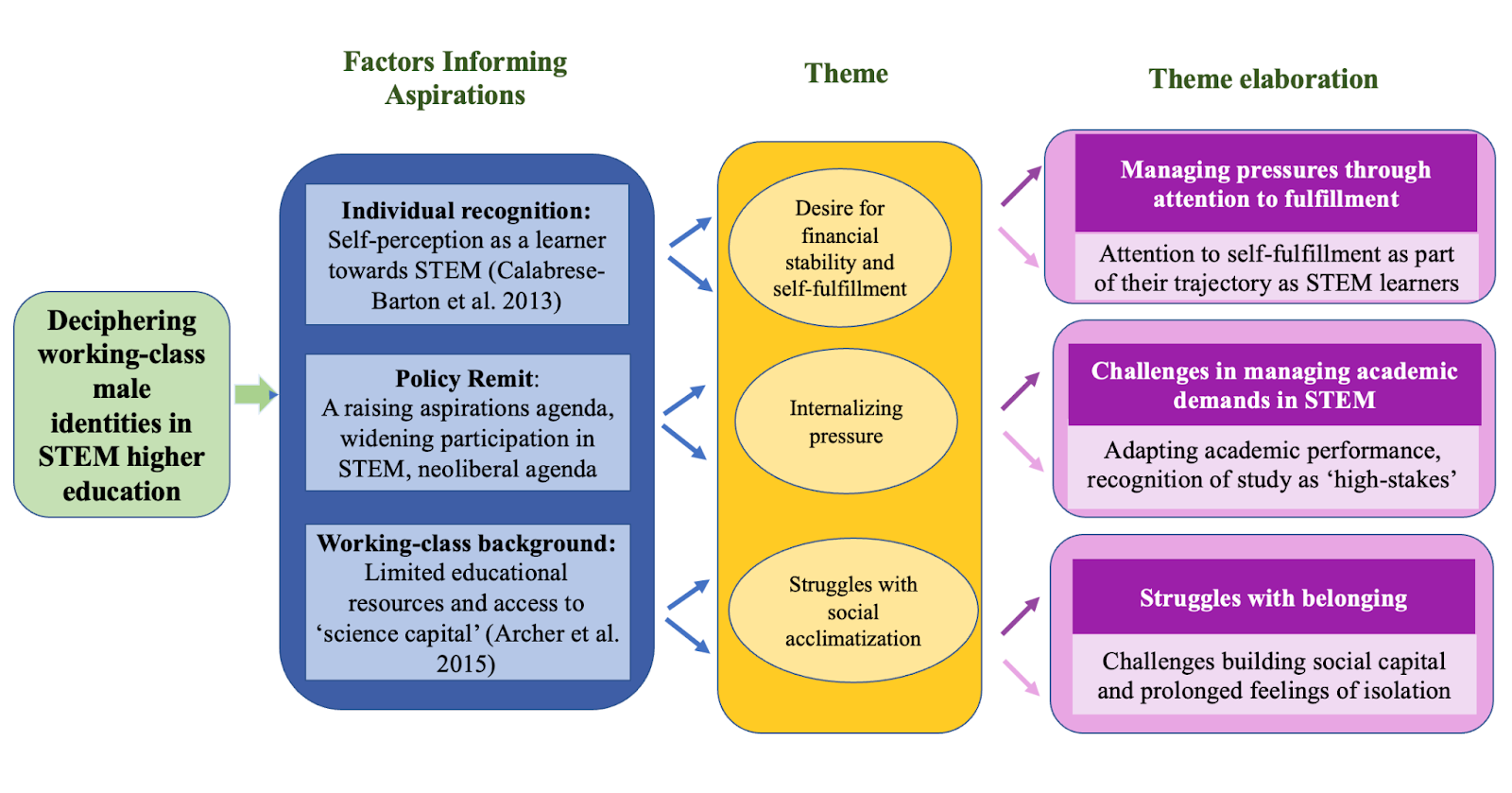
Within our project, one third of the participants enrolled in science subjects. That suggests masculinity still has a strong association with STEM.  Participants pursued a variety of different STEM-related degrees (e.g., advancedaths, forensic science, civil engineering, IT, etc).  STEM is often characterised as rigorous and competitive. We wanted to see how the aspirations of these young men were formed and maintained as they navigated the systems. When we analysed our results, we identified three key themses influencing their  aspirations: 1) desire for financial stability and fulfilment; 2) internalising pressure; 3) struggles with social acclimatisation to university.

Desire for financial stability and fulfilment

Within studies of the production of  working-class masculine identities, research shows  how these young men have a strong desire to secure forms of reliable employment so they can be the breadwinner. This desire has often kept this population away from university which can sometimes be seen as a more financially risky pathway.   In an increasingly post-industrial economy, traditional forms of working-class male employment are becoming  scarcer.  This is changing how young men see their post-compulsory education options.  

We also saw a desire to uphold the role of breadwinner and  a strong focus on employability with the young men in our study.

“I want to help my family out in the future.”

David: [With STEM] I’ve heard that there will be a lot of jobs available… I come from a poor family, so I want to help my family out in the future. … I guess I’m the one in the family that has to succeed in life I guess, help them out in the future, get us out of where we are right now financially. It’s mostly about the finances, so if I can help out with that, that’s what I want to do.

Besides the desire for financial stability, the first-in-family working-class young men we spoke with focused on self-fulfilment in what they chose to study. As Ruir, who studied in sport science, said:

I don’t want to just look for work because they pay a lot of money. I want something that pays a decent amount of money…. I want to have a secure job. I just don’t want to, like, struggle. I just want to be comfortable…I want something that pays a decent amount of money – but I enjoy waking up to it everyday.

Furthermore, some of the participants’ motivations seemed influenced by the suffering they saw with the older men in their family.

Levi: Without disrespecting my dad, I see him doing a career he doesn’t like. I use that as my motivation…

Internalising pressure

Many students in STEM disciplines find university to be stressful because of to its competitive nature. Students from low socioeconomic backgrounds are often very aware of the financial investment in their degrees and anxious about translating their degrees into secure employment. This adds a significant additional stress.  Data from The First-in-Family Males Project suggests there are various pressures shaping the experience of these young men.  Vuong, studying maths, said money contributed to a feeling of pressure: ‘The money that I – the debt that I have’ where he also said if he did withdraw from university, ‘I’d feel like a failure. I’d feel like my entire world would come toppling down.’   Another student, Ruir, noted:

I feel … pressure … to get my life, the highest I can get.

Isaac describes the pressures of university studies as always present:

Probably, just the 24 … Not 24/7, but constant thinking about uni all the time, and worry, not worrying, but thinking I got to do this, this, this, I still go to do that. I got this coming up. There’s just constant thinking about it all the time. It’s not bell to bell, start the day, do my school work, go home, that’s it.

According to Levi, he describes STEM higher education as:

I definitely think it has been emotional both stress – mix or at … times very stressful. Other times it’s just – it feels like everything’s falling into place and then something else is thrown at me. I definitely think it’s a lot of, it’s up and down, up and down and…

Struggles with social acclimatisation to university

Echoing research on the first-in-family student experience, many felt a struggle to feel a sense of belonging in higher education.  Isolation was a significant theme in the data.  For the boys studying STEM – a field which is still largely dominated by males from middle-class and elite backgrounds – the social context can feel very foreign and unsettling.  In considering how they negotiated a sense of loneliness, we note two main contributing factors: 1) how very few students from their disadvantaged secondary schools attended university and 2) the competitive academic nature of STEM which created social hierarchies anddivisions.

  Highlighting his class disadvantage, Vuong did struggle with the academic demands in STEM. He recognised how he was one of the only students from his secondary school to attend university and thought, ‘if I did this well, and I can match up with these types of students who did a much more higher end type learning in their schools or whatever. [But]and I came from a disadvantaged school’.

Another participant, David, suffered both socially and academically, leading him to eventually drop out:

I was way too behind, so if I maybe prepared better if I prepared better for uni…people … friends. That would make it a lot easier – sporting friends.  

David felt having friends with similar interests would have helped him feel a stronger sense of belonging.

What this tells us about young men in STEM

As policies continue to foreground how educators need to be engaged in raising aspirations for young people from disadvantaged backgrounds, it is important to ask what happens when aspirations are raised and how working-class young people who are first-in-family navigate their studies with limited resources.  

Educational success requires ample resourcing and a lack of resourcing leads to considerable additional pressures.   

The road is not an easy one

The data suggests that for the select few working-class males who choose higher education, the road is not an easy one.  This raises questions about the role of universities in helping students from disadvantaged backgrounds and what support mechanisms would have made the difference. Scholarships would help greatly. Institutions should also acknowledge these young men are in a dramatically different atmosphere compared to their secondary schools.  More targeted and personalised support for non-traditional students has proven effective in many higher educational contexts though, at the same time, many of the participants were reluctant to reach our for assistance.    

To conclude, as these young men navigate the challenges of their STEM degrees, they carry the weight of both personal and generational aspirations, making their success not just a matter of academic achievement but a testament to their resilience in the face of systemic barriers.  

From left to right: Garth Stahl is an associate professor in the School of Education at the University of Queensland. His research interests lie on the nexus of neoliberalism and socio-cultural studies of education, identity, equity/ inequality, and social change. Shaneeza Fugurally is a Masters candidate in the School of Education at the University of Queensland. Yating Hu is a PhD candidate in the School of Education at the University of Queensland. Tin Nguyen is a Masters candidate in the School of Education at the University of Queensland. Sarah McDonald is a lecturer based at the Centre for Research in Education & Social Inclusion in UniSA Education Futures, University of South Australia. Her research interests are in gendered subjectivities, girlhood, social mobility, social barriers, and inequalities in education. 

Science and writing: Why AERO’s narrow views are a big mistake

Will narrow instructional models promoted by AERO crowd out quality teaching and learning?

A recent ‘practice guide’ from the Australian Education Research Organisation (AERO), on ‘Writing in Science’ raises significant questions about the peak body’s narrow views on teaching and learning. Is AERO leading us in the wrong direction for supporting teachers to provide a rich and meaningful experience for Australian students?

The guide  explains the nature of simple, compound and complex sentences in science. It  provides student writing with feedback  teachers could provide to improve the writing. There are suggestions for teachers to generate and unpack exemplar sentences and lists of nouns and adjectives, provided by practice exercises. 

Yet a close reading shows these analyses fall well short of best practice in analysing science writing. Further, this advice is missing any comprehensive linguistic account of grammar as resource for meaning in text construction;any critical perspective on the function different kinds of texts to make sense of science, and; any attention to the commitment of teachers of science to developing science ideas. 

We are world leaders

Yet, Australian researchers in literacy are world leaders in thinking about the functions of text in generating meaning across different genres and writing to learn in science

AERO has ignored such research. It  sacrifices what we know about engaging and meaningful teaching and learning practice on the altar of its ideological commitment to impoverished interpretations of explicit teaching. 

While the practice guide is  useful for alerting teachers to the importance of explicit attention to writing in science, it could do better by drawing on our rich research base around meaningful pedagogies –  (which include explicit teaching elements) that engage students and enrich science teachers’ practice.  

This story of ignoring a wealth of sophisticated Australian and international research to enforce a simplistic instructional model is repeated across multiple curriculum areas, including science and  mathematics. AERO’s ‘evidence based’ model of a ‘science of learning’ is based exclusively on studies involving one research methodology. It uses experimental and control conditions that inevitably restrict the range of teaching and learning strategies compared to those found in real classrooms. 

The research findings of the community of Australian and International mathematics and science education researchers who have worked with students and teachers over many decades to establish fresh theoretical perspectives and rich teaching and learning approaches have been effectively silenced. 

What underpins this narrowing?

What underpins this narrowing of conceptions of teaching and learning that seems to have taken the Australian education system by storm? AERO bases its instructional model almost entirely on the theoretical framing of Cognitive Load Theory (CLT), particularly the research of John Sweller who over four decades has established an impressive body of work outlining the repercussions of limitations in working memory capacity. 

Sweller argues that when students struggle to solve complex problems with minimal guidance, they can fail to develop the schema that characterise expert practice. His conclusion is that teachers need to provide ‘worked examples’ that students can follow and practice to achieve mastery, an approach aligned with the ‘I do’, ‘we do’, ‘you do’ advocacy of AERO and the basis of the mandated pedagogy models of both New South Wales and Victoria. 

The argument that students can lose themselves in complexity if not appropriately guided is well taken. But this leap from a working memory problem to the explicit ’worked example’ teaching model fails to acknowledge the numerous ways, described in the research literatures of multiple disciplines, that teachers can support students to navigate complexity. In mathematics and science this includes the strategic setting up of problems, guided questioning and prompting, preparatory guidance, communal sharing of ideas, joint teacher-student text construction, or explicit summing up of schema emerging from students’ solutions. 

What really works

The US National Council of Teachers of Mathematics identifies seven, not one, effective mathematics teaching practices some but not all of which involve direct instruction.  An OECD analysis of PISA-related data identified three dominant mathematics teaching strategies of which direct instruction was the most prevalent and least related to mathematics performance, with active learning and in particular cognitive engagement strategies being more effective. 

Sweller himself (1998) warned against overuse of the worked example as a pedagogy, citing student engagement as an important factor. Given these complexities, AERO’s silencing of the international community of mathematics and science educators seems stunningly misplaced. 

This global mathematics and science education research represents a rich range of learning theories, pedagogies, conceptual and affective outcomes, and purposes. The evidence in this literature overwhelmingly rejects the inquiry/direct instruction binary that underpins the AERO model. Further, the real challenge with learning concepts like force, image formation, probability or fractional operations has less to do with managing memory than with arranging the world to be seen in new ways. 

To be fair, the CLT literature has useful things to say about judging the complexity of problems, and the strong focus on teacher guidance is well taken, especially when the procedures and concepts to be learned are counter-intuitive. However, CLT research has mainly concerned problems that are algorithmic in nature, for which an explicit approach can more efficiently lead to the simple procedural knowledge outcomes involved. 

The short term advantage disappears

Even here, studies have shown that over the long term, the short-term advantage of direct instruction disappears. The real issues involved in supporting learning of complex ideas and practices are deciding when to provide explicit support, and of what type. This is where the teacher’s judgment is required, and it will depend on the nature of the knowledge, and the preparedness of students. To reduce these complex strategies to a single approach is the real offence of the AERO agenda, and of the policy prescriptions in Victoria and NSW. 

It amounts to the de-professionalisation of teachers when such decisions are short-circuited. 

Another aspect of this debate is the claim that a reform of Australian teaching and learning is needed because of the poor performance of students on NAPLAN and on international assessments such as PISA and TIMSS. While it is certainly true that we could do much better in education across all subjects, particularly with respect to the inequities in performance based on socio-economic factors and Indigeneity, our relative performance on international rankings is more complex than claimed

Flies in the face of evidence

To claim this slippage results from overuse of inquiry and problem-solving approaches in science and mathematics flies in the face of evidence. In both subjects, teacher-centred approaches currently dominate. An OECD report providing advice for mathematics teachers based on the 2012 PISA mathematics assessment revealed Australian students ranked ninth globally on self-reporting memorisation strategies, and third-last on elaboration strategies (that is, making links between tasks and finding different ways to solve a problem). The latter strategies indicate the capability to solve the more difficult problems. 

While it may be true some versions of inquiry in school science and mathematics may lack necessary support structures, this corrective of a blanket imposition of explicit teaching is shown by the wider evidence to represent a misguided overreaction. 

How has it happened, that one branch of education research misleadingly characterised as ‘the’ science of learning, together with a narrow and hotly contested view of what constitutes ‘evidence’ in education, has become the one guiding star for our national education research organisation to the exclusion of Australian and international disciplinary education research communities? 

Schools are being framed as businesses

It has been argued AERO ‘encapsulates politics at its heart’ through its embedded links to corporate philanthropy and business relations and a brief to attract funding into education. Indeed, schools are increasingly being bombarded with commercial products. Schools are being framed as businesses. 

The teaching profession over the last decade has suffered concerted attacks from the media and from senior government figures. Are we seeing moves here to systematically de-professionalise teachers and restrict their practice through ‘evidence based’ resources focused on ‘efficient’ learning? Is this what we really want as our key purpose in education? In reality, experienced teachers will not feel restricted by these narrow versions of explicit teaching pedagogies and will engage their students in varied ways. How can they not? 

If the resources now being developed and promoted under the AERO rubric, as with ‘Writing in Science’, follow this barren prescription, we run the danger of a growing erosion of teacher agency and impoverishment of student learning.

We need a richer view of pedagogy

What we need, going forward, is a richer view of pedagogy based on the wider research literature, rather than the narrow base that privileges procedural practices. We need to engage with a more complex and informed discussion of the core purposes of education that is not proscribed by a narrow insistence on NAPLAN and international assessments. We need to value our teaching profession and recognise the complex, relational nature of teaching and learning. Our focus should be on strengthening teachers’ contextual decision making, and not on constraining them in ways that will reduce their professionalism, and ultimately their standing.  


Russell Tytler is Deakin Distinguished Professor and Chair of Science Education at Deakin University. He researches student reasoning and learning through the multimodal languages of science, socio scientific issues and reasoning, school-community partnerships, and STEM curriculum policy and practice. Professor Tytler is widely published and has led a range of research projects, including current STEM projects investigating a guided inquiry pedagogy for interdisciplinary mathematics and science. He is a member of the Science Expert Group for PISA 2015 and 2025.

The truth about the pay rise for the oppressed

The Federal Government’s “good social and educational policy, and even better political move” of a fully funded pay rise (worker retention payment) for the early childhood education and care (ECEC) sector becomes the latest example of the continued oppressive workload and undervaluing of the ECEC sector in Australia. 

The worker retention payment 

In August this year the Albanese government announced it would be providing a fully funded 15% increase for the ECEC workforce implemented over two years – and that will function as a grant.  Early conditions shared by the government included a fee growth cap of 4.4% to ensure that families did not incur further fee increases to support wage increases.

Other details would come much later.

Guidelines and applications opened last week for a grant payment through the Department of Education (DoE) and Grant Connect.  

Here’s what we understand about the grant so far:

  • The first pay increase of 10% must be passed on to eligible employees. The 10% cannot be manipulated for any employee who is already paid above award. 
  • Eligible employees are those paid under two approved awards – the Children’s Services Award 2010 and the Teachers Award 2020.  Trainees paid under other awards are not eligible for this pay increase. 
  • The amount of grant monies each service receives is based on gross labour costs detailed in grant applications. These are then applied to each service’s weekly child care subsidy submission hours. The government are yet to release a fully explained formula for payments.
  • Each employer must provide a Fair Work approved workplace instrument with their grant application; for example, an Individual Flexibility Arrangement.

Full details of the Worker Retention Payment can be found on the Department of Education website

Complications of gendered undervaluation

The Fair Work Commission is currently undertaking a gender undervaluation review case with results due mid-2025. Following on from the decision from the review of the Aged Care Award 2010 etc, the Children’s Services Award is currently being considered in this case. The decision from the previous review noted:

The basis upon which the ERO (equal remuneration order) rates were determined closely parallel the work value reasons upon which we are proceeding in this matter: the high female composition of the industry in question, the significance of the work being ‘caring’ work, the disguising of the level of skill and experience required to perform the work, the gender-based undervaluation of the work, and the need to remedy the extent to which assumptions on the basis of gender had inhibited wages growth. 

A substantial increase is well overdue

This decision justifies the benchmark rate fixing process for the Aged Care Award and is highly reflective of the gendered composition and undervaluing experienced in the ECEC sector. A substantial increase in wages is well overdue and the latent expertise of the skills and value of the sector need to be heard. However, there are serious financial implications for services that opt in to this grant before the gender undervaluation decision has been made. 

If a service has opted in to the grant and the outcome of the gender undervaluation case results in a well-deserved increase in the Children’s Services award – services will not be able to increase fees to cover the wage increase beyond the 4.4% cap.This will place many services, particularly small ones, under great financial strain. 

The disconnect

The disconnect between what is being decided should happen for the ECEC sector and the means to which it is being implemented is alarming. Complex industrial relations and financial decisions need to be made by providers. Furthermore, Approved Providers and/or Directors will be responsible for administering grant monies, reporting usage and researching, paying for or writing workplace instruments to meet the conditions of the grant. 

State and Federal governments are fully aware of the complex and diverse nature of the ECEC sector. The vast differences in ECEC service budgets, licensed numbers, business structures and contexts within more than 17,000 services in Australia is widely understood. Yet little consideration appears to be given to the continued impact of how partial remedies to gender pay inequity are being implemented. 

It is clear that small centres of either private or not for profit nature, will experience heavy burdens associated with the administration, financial, mental, ethical and emotional load of the grant’s implementation. 

Posing questions about problems

Can we afford this grant? What other costs will require fees to rise more than the capped fee growth of 4.4% allowed under the grant terms? Will the grant continue beyond the projected two-year timeframe? What will happen if we become ineligible for further payments but have binding workplace instruments to continue paying above award rates? Will we lose our team if we don’t opt in to this grant to offer them higher wages? Will we lose families if we increase fees to cover a self-funded 10% pay rise? How much wage related on costs such as superannuation, workers compensation, leave entitlements, payroll tax will be covered by the grant?  How will our budget afford 10-15% above award costs when we are closed for public holidays, two weeks at Christmas and New Year when we cannot submit CCS hours? 

Pay rise of the oppressed

These practical and rational questions about a political action ostensibly designed to lift the value and living conditions of the ECEC workforce, asserts further notions of oppression by systems of power over our sector. 

As the decision in the Aged Care Award suggests, the skills and experience of care work is disguised based on gender. So too is the overly complicated nature of the grant. It disguises continued mistrust and undervaluing of the ECEC sector by the government. This mistrust and undervaluation reinforces that ours is a sector bereft of true professional autonomy and agency.

Freire’s notion of a critical pedagogy encouraged the oppressed to problem pose about their experiences to transform themselves from oppression.  The fact is our sector is truly oppressed by neoliberal ideologies that value education as financial, human capital-based outcomes rather than democratic and ethical ones. As Freire maintains, it is necessary to admit that oppression exists and locate what that oppression is, for liberation to be possible.  

Crumbs of progress

The reality of the ECEC sector is that we are so oppressed by these systems that even when the oppressive discourses transform into promises of better conditions with great uncertainty, the oppressive powers condition us to accept, navigate and move on. We lower our expectations and continue to accept higher workloads and bad deals for ourselves. The cycle of oppression goes around and around as we accept crumbs of progress from disingenuous and politically motivated offers. How do we heal from internalised and externalised oppression? How do we do this whilst holding on to our ethical and democratic beliefs that our workforce deserves more than the uncertainty of a temporary fiscal stop gap to hold the crucial ECEC system in place?

Melissa Duffy-Fagan is the owner and approved provider of a ECEC centre in Lambton, Newcastle. She is a sessional academic at the University of Newcastle. Her doctoral studies, completed in 2023, explored the themes of leadership, professional identity and quality policy. Find her on LinkedIn.