Noella Mackenzie and Martina Tassone explore the Simple View of Reading (SVR) in this third post to celebrate Book Week. This describes reading at a single point in time: decoding x listening/ linguistic comprehension = reading comprehension(D x LC = RC).
Some advocates have used the SVR as the justification for an emphasis on phonics and decoding first (and fast). This has led to the idea that listening comprehension and reading comprehension happen after decoding. There also seems to be a misunderstanding that decoding guarantees a reader will identify each word in isolation. And then, that reader will be able to bring these words together and understand what has been read.
The opaque nature of the English language makes this almost impossible.
In many cases the meaning of a word (in context) determines the pronunciation of the word, rather than the other way around, e.g. I read on the train in the mornings. I read my book on the train yesterday.
Correct pronunciation does not guarantee meaning
There are many homonyms in the English language. For example, ‘plane’ could be a straight line joining two points OR a level of existence. It could also be a level surface OR an aeroplane. It could also be an open area of land OR a wood working tool.
Despite this, the SVR is often cited as the justification for the use of synthetic phonics programs in the early years of school, and a focus on decoding as the most important problem-solving approach to an unknown word across all grades.
Building on the Simple View of Reading
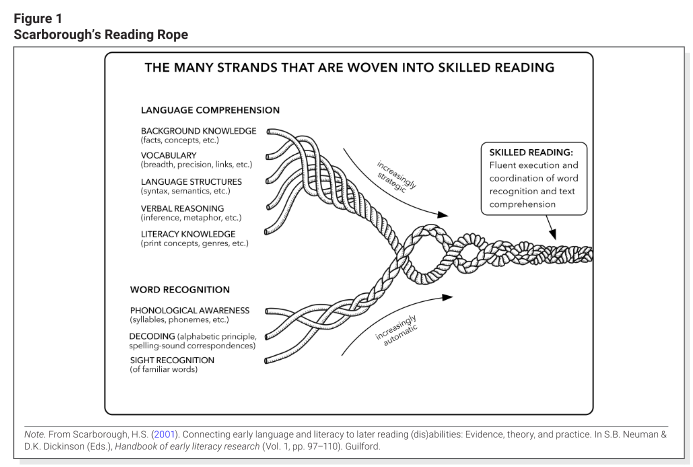
The SVR has formed the basis for more complex understandings of reading. For example, The Reading Ropediagram (Figure 1) expands the three elements of the SVR and explains the complexity of skilled reading.
(2) cannot parse the syntactic and semantic relationships among the words, or
(3) lacks critical background knowledge or inferential skills to interpret the text appropriately and ‘read between the lines’”
The Reading Rope is often used in teacher professional learning sessions, although the language comprehension elements are not always given the same emphasis as the word recognition elements. As a result, word recognition or decoding instruction is often prioritised. That’s despite the fact that reading comprehension requires language comprehension which is made up of background knowledge, vocabulary, language structures (syntax and semantics), verbal reasoning and literacy knowledge. Word recognition should be taught in conjunction with language comprehension if reading comprehension is the goal.
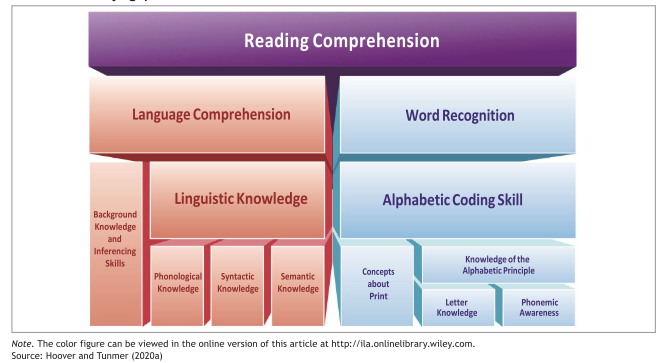
This framework includes ‘background knowledge’ and ‘inferencing skills’ as well as ‘phonological, syntactic and semantic knowledge’. The CFRF also demonstrates the complexity of the reading process.
Numerous other models have been developed from the SVR including the Active View of Reading(AVR).The AVR highlights the ‘key self-regulation skills’ required to manage all aspects of reading. Motivation and engagement are identified as key self-regulatory skills. These are overlooked in some other reading models, but other researchers have identified the importance of seeing reading as not just a technical activity but one that needs to engage hearts and minds.
The SVR does not suggest that reading is a simple process and it is not a model of reading instruction. In the next post we will explore the Science of Reading (SoR) and unpick some of the confusions associated with it.
Noella Mackenzie is an adjunct associate professor at Charles Sturt University. Her areas of research and expertise include the teaching and learning of literacy. Martina Tassone is a senior lecturer in teacher education at the University of Melbourne. Her research interests include literacy teaching, learning and assessment in the early years of schooling.
This morning Noella Mackenzie and Martina Tassone helped us navigate the reading jungle
We start this afternoon’s post with evidence-based instruction (EBI) and then move to a discussion of phonics/phonemic awareness.
The term ‘evidence-based’ is used widely. It can be appealing even if it is not clear how the evidence being referenced was collected or analysed. Reading related science is complex. Evidence coming from science needs to be viewed from different perspectives and time, so the full picture to emerge. The evidence-based movement includes ‘a focus on behaviourist theory, quantitative research, randomised controlled trials, meta-analyses, hard numerical data and high stakes standardised testing’. It often ignores ‘structural inequalities in pursuit of better outcomes’.
Some claim evidence to support a particular approach. Others use different evidence to claim that the same approach does not work. A common assumption is that if something works with students from one cohort it will work with all students.
Huge differences
Any parent who has more than one child will point out the huge differences, even between two siblings. When they walk, talk, learn to feed themselves, sleeping patterns etc, etc. Take, for example, a class of 25 children who come into school together, from 25 different homes. They may vary in gender and in age, of up to 18 months. They bring more differences than can be counted and qualified.
In terms of preparedness for school, there will be a huge range of prior experiences socially and culturally. There will also be a huge range of experience in terms of oral and written language exposure. To assume all children should start at the same point with the same instruction is naive. (For more on EBI read EduResearch Matters posts by Nicole Brinker and Tom Mahoney. These provided comprehensive discussions of this vexed topic.)
The topic that is the most talked about in the current era is that of phonics or phonemic awareness instruction. While all agree that phonics is necessary for reading, the amount and methods are up for debate. Australia’s National curriculum includes the teaching of phonics. But it also recognises that when reading, children will draw on a range of sources. That includes their knowledge of letters and sounds, what makes sense and knowledge of how language works.
Children who can already read when they start school
Let’s start with the children who can already read when they begin school. It is important for teachers to first check that any children who arrive at school with the ability to read, are able to problem solve unknown words, within text, using phonological information. Children who can already demonstrate the ability to apply phonological information effectively should focus on a wide range of engagements with texts.
Focused, systematic, and explicit phonics lessons should be aimed at children who are just starting to discover, or are still learning, how letters and sounds (phonemes) work in reading and writing. It may be difficult initially to identify those children who we will refer to as typically developing readers. These children make up the majority of most classrooms. Most will need daily focused phonics lessons for the first year of school.
Analytic phonics (also referred to as analytical phonics or implicit phonics) refers to an approach that focuses on teaching the sounds (phonemes) associated with particular letter patterns within the context of a whole word.
Embedded phonics
Embedded phonics, integrates phonics instruction into the context of reading authentic texts, rather than being taught as separate, isolated skills. Recent research conducted in Melbourne illustrated the affordances of explicit phonics instruction integrated into a rich literacy environment. It showed the clear benefits for students when phonics was taught in context.
Analytic and embedded methods may be described as contextualised approaches and are often integrated. All approaches to phonics instruction can be systematic and all involve explicit instruction.
Phonics instruction through writing is often overlooked and yet provides the potential for children to explore letter sound relationships from a different perspective than when reading. Instead of going from letter to sound they go from sound to letter. What can I hear? What letters could I use to make that sound?
A concern expressed by some, is how long focused phonics or phonemic awareness (PA) instruction should continue.
We know learning to read does not require being able to identify 44 phonemes or demonstrate proficiency on phoneme deletion and substitution tasks. How do we know that? Because until very recently no one who learned to read had to do these things. Instruction in sub-skills such as phonemic awareness is justified to the extent it advances the goal of reading, not for its own sake.
Problems with the way phonics is sometimes referred to by advocates of the Science of Reading have also been identified (more on the SoR in a future post)
The idea that a certain level of PA is prerequisite for reading, and that PA training should continue until the student becomes highly proficient at PA tasks regardless of how well they are reading is emblematic of problems that have arisen within the Science of Reading approach. It is an overprescription that reflects a shallow understanding of reading development, yet has become a major tenet of the “science of reading”.
An integrated approach
In 2000, The National Reading Panel (NRP) in the US suggested systematic phonics instruction, although important, “should be integrated with other reading instruction to create a balanced reading program”. The NRP even warned against phonics becoming a dominant component in a reading program. The 2005 Rowe Report on the Australian National Inquiry into the Teaching of Reading stated the importance of systematic phonics instruction. But it also noted it was equally important that . . .
Has this started you thinking and perhaps questioning what you may have read about phonics and evidence-based instruction in the media? Tomorrow we explore the Simple View of Reading and how that’s influenced much of the reading research over recent times.
Noella Mackenzie is an adjunct associate professor at Charles Sturt University. Her areas of research and expertise include the teaching and learning of literacy. Martina Tassone is a senior lecturer in teacher education at the University of Melbourne. Her research interests include literacy teaching, learning and assessment in the early years of schooling.
To celebrate Book Week, EduResearch Matters is publishing a six part series on reading by Noella Mackenzie and Martina Tassone.
A jungle is a land covered with dense forest and tangled vegetation, usually in tropical climates. The jungle metaphor describes the current landscape in regard to science and reading. The huge amount of research published in the last two decades, the media interpretations or misinterpretations of selected findings, and claims the reading science is settled, are akin to a dense forest. The policies and mandates teachers dealing with are like tangled vegetation. The tropical climate refers to the heat in the debate. In this series of blog posts we try to make sense of the jungle and its dense forests and tangled vegetation, challenge the notion that the science is settled, and take some of the heat out of the debate.
Learning to read
Ever since humans have been writing they have also been reading. A person who could read often taught a learner to do what they themselves could already do. The instructors had no formal training and no access to theories or methods. In wealthy households there may have been a governess or master tutor to teach children to read. But in many households, a literate parent or friend provided the reading instruction. The most common text used for instruction was probably the bible. And these instructors were not teaching 25 students in a classroom. Instead, they were probably teaching highly motivated individuals, who saw being able to read as a way out of their current situation.
In the current climate, we need to consider a range of questions:
Why is the teaching of reading such a hot topic in the current era?
Is learning to read a natural process?
Is reading simple or complex?
Is there a right way to teach reading?
What is the role of phonics, and is there a right way to teach phonics?
What does reading research have to say about learning to read and reading instruction?
What is the Science of Reading?
What does evidence-based actually mean?
What impact has the media had on the debates about reading?
We will respond to these, and many other questions, in a series of 6 blog posts, in an attempt to remove some of the mystery and heat from this topic.
Both authors have taught many children how to read and have decades of combined classroom teacher experience before moving into academic and researcher roles. Both continue to work with classroom teachers in classrooms. Let’s start!
Learning to read is not natural
It’s not a hard wired skill like learning to talk, although a great deal of learning might happen quite organically within the home and community before formal instruction begins. Children who hear stories read aloud and songs and rhymes repeated often, develop an ear for the sounds of written English.
From a young age, many are able to recognise some of the differences between spoken and written language, even if they cannot explain the differences. The child who picks up a book and recites using the patterns and rhythms of picture story books is showing knowledge of written language but does not speak to people in these written language patterns.
In today’s world most people send their children to school to learn to read, but some families choose to homeschool with a parent taking on the instructor role. These parents often have no formal training, although they do have access to resources and curriculum guides. They often respond to their children’s need to learn to read in the same way that they respond to their need to learn to do many other things, (e.g. walk, feed themselves, dress themselves, take turns, share, ride a bike). Children add reading to their set of skills at a time that works for them.
Different stages, different ages
Parents instinctively understand that children learn in different ways and at different ages. School starting age varies greatly across countries. In Australia, while we are having debates about how children learn to read at ages 5 or 6, in some countries children do not start formal schooling (or reading) until 7 or 8 years of age (e.g. Finland). Families who homeschool do not feel the same pressure as teachers in schools. So, what does research tell us about reading?
It is difficult to research foundational educational processes that are as complex as reading. In contrast, it is easy to test the effectiveness of letter learning based upon a particular approach to teaching letters. Short-term gains are also easiest to measure and control for, while long term learning is much more challenging to measure and to control for. Additionally, teaching and learning are sensitive to differences among teachers, students and settings.
What works with one mightn’t work with another
Even medical researchers agree that what may work in one situation with patient X, despite being faithfully repeated with patient Y, can have a different effect altogether.
The complexity of the reading act has led to multiple disciplines investigating or researching reading using different theoretical frameworks and methodological approaches, some focused on the process of reading, others on the practice of reading and still others on reading instruction. For example, research highlights brain maturation and reading experience.
Reading is a learned skill that is likely influenced by both brain maturation and experience…results suggest that children who are better readers, and who perhaps read more than less skilled readers, exhibit different development trajectories in brain reading regions. Understanding relationships between reading performance, reading experience and brain maturation trajectories may help with the development and evaluation of targeted interventions.
In the next post we will continue the discussion of evidence and evidence-based reading instruction.
Noella Mackenzie is an adjunct associate professor at Charles Sturt University. Her areas of research and expertise include the teaching and learning of literacy. Martina Tassone is a senior lecturer in teacher education at the University of Melbourne. Her research interests include literacy teaching, learning and assessment in the early years of schooling.
If you belong to a social media group for teachers, you’ve inevitably seen a post that goes like this: Jane, a twenty-something early career teacher writes…
“I’ve been teaching for three years but am burnt out and ready to quit. I’m thinking I could get a job writing classroom resources for teachers. Where can I apply?”
These 30 words capture the impact of a flawed ideology that has been shaping education in Australia for several decades. A new job market for teachers has been created as a result of governments regarding schools as production lines with standard inputs and outputs.
We need to talk about the n word (neoliberalism) on teaching
Neoliberalism is a market-driven approach to education policy. It sees economic rationalism and general business principles applied to the way the schooling is managed. The story goes that education can be streamlined, neatly packaged and marketed like any other commodity. Standardising the way schools operate – making the curriculum and the delivery of teaching, learning and assessment more similar than different across locations – will ensure equality of access and produce better outcomes, particularly for disadvantaged students. Think tanks describe this as ending the lesson lottery. With “commonsense” messaging that appeals to policymakers and voters alike, neoliberalism exercises power by framing teachers and students as human capital. It sets out to measure and monitor their productivity and performance. In some parts of the world, teachers might be understood to be tailors of distinction. In Australia they are more likely to be cast as sweatshop machinists under quality control.
One flow-on effect is that teachers’ work has been expanded to include new administrative, accountability and reporting activities. At the same time the core business of educating and caring for young people has also become more complex and relationally demanding. Another flow-on effect is that when experienced teachers lament the loss of professional trust and creative agency over the course of their careers and the competing demands on their time, policymakers defer to the market for scalable responses that tell teachers what to do and how to do it.
Enter stage right, edupreneurism! (education entrepreneurism)
From edu-tech platforms that deliver content and assess learning “wholly online” to large consulting firms generating templated lessons, the market is now flooded with quick fixes at teachers’ fingertips. The quality of commercial solutions offered is variable and the burden of proof is very low.
The term “evidence-based” is widely used. But it serves as little more than faddish advertising language that has been recruited for commercial gain. In fact, some of the biggest brands in education have achieved market dominance despite defying educational research and never being properly evaluated.
While teachers want time to design innovative learning experiences, this aspect of their work has been identified as outsourceable. Lesson creation is a growth industry.
At what cost to teaching?
The cost is more than financial: consultants are cashing in on standardising projects. The quality of instruction is being compromised. And young teachers like Jane are exiting the profession to take up alternative employment writing lesson content from home.
Academic critiques of neoliberalism argue its key messages and mechanisms strip teachers and students of the material, social and cultural qualities that we know are determinants of educational outcomes in settler colonial countries like Australia. Schools remaininequitably funded and under-resourced and disparities in Australian 15-year-olds’ OECD PISA performance based on student background persist. Equally important, research shows that neoliberal policy moves are reducing teachers’ job enjoyment, negatively impacting their health and wellbeing, and contributing to attrition. Teachers are stressed, burnt out and leaving the profession in droves.
Ultimately, education has turned on itself and real economic and educational progress is being undermined.
Questions
It’s time to ask tough questions. Questions about the purpose and direction of education policy in Australia. Questions about the impact on teachers and students.
Who is in the driver’s seat and can they be trusted to deliver the sort of equitable and excellent education we want for young people?
Right now, it seems that for every issue that neoliberalism might solve, it sustains and creates several more.
Carly Sawatzki is a teacher educator and educational researcher at Deakin University. She supports teachers of mathematics to teach differently, by helping them to connect students’ classroom learning with the real world. Carly is internationally recognised for her thought leadership on young people’s financial education.
Carly Sawatzki is a teacher educator and educational researcher at Deakin University. She supports teachers of mathematics to teach differently, by helping them to connect students’ classroom learning with the real world. Carly is internationally recognised for her work on young people’s financial education.
There have long been debates over homework and children’s resistance to doing it. It is seen to lead to fights at the kitchen table after school. This may stem from time-poor working families or parents and carers unsure of how to do it in the ‘right’ way.
As teachers, and parents, we too have struggled with homework. We decided to research this further. Homework is widely used in primary school. There is also a continuing debate in the media. But there is a limited body of research to explain the purpose, evidence for the practice or explanation of the power dynamics which underpin current homework approaches.
Homework doesn’t always lead to increased learning
Homework is generally given to revise learning concepts taught within the classroom. But studies have shown homework does not always add to increased learning and could, in fact, have the opposite effect. Teachers have reported that designing quality tasks, along with marking homework was time-consuming. It also proved difficult to meet the needs of the diverse students in their classes. Don’t we know it! Similarly, parents have shared concerns detailing the pressure of homework and how its expectations can create tensions within the home.
Since current practices are not working, what if the purpose of homework was to help children and their parents enjoy and engage in learning together, rather than purely consolidate learning and preparing for the next test?
Grej of the Day
We found a case study which offers a potential alternative to homework, all the way from Sweden. ‘Grej of the Day’ is an approach to homework that seeks to connect learning between school and home. Mikael Hermansson, teacher of the year in Sweden 2015, may have an idea here that works!
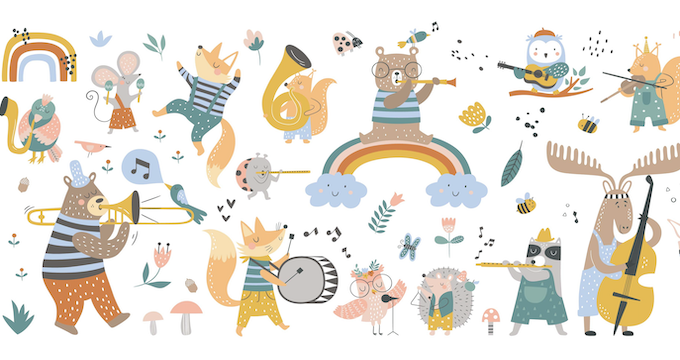
When using Grej of the Day in the classroom, children are given a clue (for example a giraffe playing a tuba below) to guess what it is about. Children take the clue home to discuss with their families then bring ideas back to school the next day. The class learns from all the ideas shared then have an 8-minute micro lesson from the teacher, who shares one WOW fact. For each topic a pin is put on a world map to show where it was from. Homework is then for children to retell what they learnt to their parents.
We saw this innovative approach, thought about the diverse learners we see in the classrooms, and wondered how it could support children in Australia.
What we found
We conducted an international online survey, which received 2025 responses from 16 countries. 240 teachers gave us further details as to how and why they use ‘Grej of the Day’ in their classrooms. Our initial analysis shows teachers reported mostly positive changes in the classroom to children’s behaviour and engagement in learning. Fewer parents reported a lack of interest.
We found three main benefits to using Grej of the Day:
Cultural appropriateness: Potential to engage children from diverse backgrounds in meaningful ways inclusive of their home languages, time, skills and knowledge to learn new things beyond a narrow curriculum. Teachers have discussed that they can ‘use Grejs to cross bridges, to understand each other better, to learn about other religions, values, points of view and customs’.
High engagement: Children were excited to participate in their learning and do homework. A huge step if you have a child who hated school! Micael Hermannson saw this in his own class where he found he was able to take a difficult group of children, who he could not reach, to being the class of the year in Sweden. Suddenly children wanted to be at school and learn. One teacher highlighted this ‘GoTD can absolutely be a way to support the [sic] diversity. I remember this student who really had a hard time at school and suddenly he said, ‘Now I know more than my mum, I think I`m going to become a teacher…’.
Authentic learning: When discussing the impact GoTD has had to support authentic conversations to add to and build on the learning in school with families, teachers explained that parents suddenly became keen about homework, ‘There is a high participation. I have had parents waiting outside the classroom to find out whether they had solved the riddle’.
A way forward?
We are excited to present this case study as a potential paradoxical way forward that is authentic and enjoyed by children, teachers, and parents alike. Possibly it is a way that we can all enjoy homework and harness its true potential? The results from our case study pose the question to teachers and policy makers. Is it time for us to rethink homework in schools to make it an equitable playing field that values diverse funds of knowledge, ideas, and ways of learning?
Have you considered an answer to our Grej of the Day clue yet? What does the giraffe have in common with a tuba?
Monique Mandarakas (left) is a casual lecturer at the University of Southern Queensland. She has a background from both early childhood and primary teaching. Her research includes parent and family engagement in education and the support of pre-service teachers. This research is supported by her current PhD study. Melissa Fanshawe is an associate professor in the School of Education at the University of Southern Queensland. She has over twenty-five years experience within Queensland schools as a teacher, deputy and principal. She is a Senior Fellow of the Higher Education Academy and has won several teaching awards.
The use of “Evidence-Based-Practice” (EBP) as a discourse harms teachers. I’m not the first person to say that here. Nicole Bunker, in a previous post, describes the landscape of Australian education as awash with the dominance of the “what works” agenda.
She says that the all-encompassing desire to impose EBP has become an oppressive force upon teachers. It promotes a narrow base of evidence in relation to “what works”. It removes teachers from the position to make judgments of what is best in their contexts. And it obscures the structural problems that perpetuate inequity in Australian schools. This is something that teachers need to push back against.
I want to add to the discussion surrounding this issue for teachers. I’d like to propose communities of practice (CoPs) can serve as an important opportunity for teachers to challenge the oppression of EBP. It can also be a means of supporting teachers to reclaim their voice and agency in education.
Ideas about “what works” in education always get caught up in ideologies of how schools should function and how teachers ought to teach. This is rarely acknowledged. As a result, EBP becomes more of a legitimation tool to enforce reform and discourage critique rather than move the project of Australian education forward to a more desirable future. We cannot expect that “what works” in one school community will inevitably achieve the same result in another. Teachers therefore need to be given opportunities to engage with evidence that considers its appropriateness to their context. By ignoring the importance of context, EBP ideologies ultimately limit the ability for teachers to engage in this important work of navigating and challenging “evidence”, as policy continues to favour “top-down” mandate approaches.
It attempts to redefine what it means to be a teacher
EBP also attempts to redefine the very nature of what it means to be a teacher. It places itself within a paradigm that wants to claim teaching as an effective and efficient profession. That is unrealistic. We need not – indeed we can’t – see the teacher as wholly efficient or effective. There are many aspects of education that are neither effective nor efficient, but are still valued. The move to support young Australians in understanding consent and respectful relationships is just one example of this.
What counts as evidence is highly contested. It therefore needs to be considered in light of the group or organisation citing it. This is especially true now, as the push for “what works” in education becomes increasingly driven by vested interests. Ultimately, the uptake of evidence depends upon the ideological perspectives of teachers, school leaders and the wider community in which schooling takes place. Professional development that allows opportunities for teachers to thoughtfully consider research evidence (including EBP) and evaluate its worth in relation to context affirms the authority that each school has to meet the needs of their communities.
We need to remind ourselves that it is not evidence that will move education forward, but the current and future decisions of teachers and school leaders.
What we need – maybe now more than ever – is to find ways of empowering teachers to enact intentional practice that supports the purposes and aims of education in their communities.
Creating new futures
My research is interested in how a community of practice (CoP) model can be used to provide a space for teachers to explore and challenge the ideologies that currently impact on their teaching practice, including (but not limited to) that of EBP.
Along with supporting teacher retention, belonging and agency, CoPs are a powerful opportunity for teachers to reclaim their voice and ownership of their practice, through the interrogation of the ideologies that impact on their work, including those of EBP.
My research will investigate the extent to which providing space for this kind of reflective practice might make a difference in the lives of teachers currently working in Australian schools.
Interested in taking action?
I am currently looking for teachers who are interested in participating in a CoP to explore and reflect on the various ideologies impacting on their work in 2025.
Are you, or someone you know, interested in participating in this project? I have included details of the project at the end of this post to consider.
It’s about time we prioritised spaces for teachers to critically engage with the ideologies that seek to claim education on their behalf.
This project seeks to do just that.
Are you a critically reflected teacher?
Are you a teacher who thinks deeply and critically about your practice? Or is this something you have never really had an opportunity to do but would like to engage in with others who think the same way?
I am seeking a group of committed critically reflective teachers, who are eager to experience what kind of transformational impact individual and collective critical thinking can have on their practice. Where you perceive yourself on the path of becoming “critically reflective” is unimportant. What is important is that you have a desire to think deeply about your practice!
In 2025, as part of my research project exploring critical thinking and teacher agency, participants will have the opportunity to join together in a community with other like-minded teachers, exploring the ideological nature of education and their work as teachers. Participation in this study will involve approximately 7 hours of commitment over a period of around 18 months. Participation will involve dialogue and reflection upon the various ideological impacts of teacher work in various Zoom conference meetings and through an asynchronous private chat group, followed by an individual interview at the conclusion of the project. I am interested in your personal experiences and opinions, not in information about specific schools and their practices.
For many of you who have either listened to my podcast segment, Ideology in Education, on the TER Podcast, or have read my posts on my Substack, The Interruption, you will know that this is something I am deeply passionate about and believe to be truly important for all teachers.
So it doesn’t matter whether you:
teach primary or secondary,
have been a teacher for 20 years or have just started,
work in the government, independent or catholic systems,
are on-going, part-time or casual.
If you’re a registered teacher currently teaching in Australia, you can get involved!
If this seems like something you would be interested in being involved in or have further questions, please don’t hesitate to reach out to me via email at [email protected] and I will get back to you with further information about participating in the project.
Know of anyone who might be interested? If so, feel free to forward this information on (as is) via email or social media!
This study has received Deakin University ethics approval (reference number: HAE-24-046).
Tom Mahoney is a teacher and educator of secondary VCE mathematics and psychology students. He is currently completing a PhD in Educational Philosophy part time through Deakin University. His research explores the influence of dominant educational ideologies on teacher subjectivity. Tom is on LinkedIn.
Imagine asking a five year old to name basic body parts. That kid’s known an eye from an elbow since the age of two.
This is the clearest indication we have that NSW syllabus writers have it so wrong. Some of the science knowledge is too simple, other ideas are too hard. Worst of all, it could lead to a return to regurgitating facts.
Why don’t syllabus writers take advice from education researchers? This question applies to both the Australian Curriculum, Assessment and Reporting Authority (ACARA) and New South Wales Education Standards Authority (NESA).
Advice largely ignored
Twice in the last two years a group of science education researchers from multiple NSW universities gave extensive, research-informed advice on primary science syllabus drafts. That advice was largely ignored.
Problems which exist in the new NSW Science and Technology K-6 syllabus released last week could have been avoided. The consultation process is flawed when the people whose job it is to keep up with research about learning and teaching in science (and technology) are brushed aside. We need to create a school curriculum fit for contemporary students that gets the balance of intrigue and difficulty right. The views of primary teachers who usually lack strong knowledge in science must be balanced by research insights from science educators. NSW now has a syllabus like a leaky bucket, full of holes that science educators now must help teachers fix.
In developing the previous, 2017, syllabus, three science educators – Anne Forbes from Macquarie University, Helen Georgiou from Wollongong University and myself – spent a day with the syllabus writers advising on knowledge content. This collaboration resulted in a higher quality syllabus with accurate science ideas that were sequenced to match student ages.
NESA claims: that “For the first time the K-6 curriculum is being developed cohesively to support depth of learning and enhance student engagement.” The science and technology section falls short of this aim.
Facts vs Inquiry
When you download the Science and Technology K-6 syllabus from the NSEA website, it reads like a list of facts to be remembered. I worry the lists of facts followed by specific examples will mean more rote learning and less engaging practical work for children.
Inquiry is an essential science practice. Eminent science education scholar Roger Bybee (UK) argued over a decade ago “Inquiry is central to science . . . it should be basic in the design of school science programs, selection of instructional materials and implementation of teaching strategies”. Critically the word inquiry is not found in the Science and Technology K-6. Syllabus. Distinguished Alfred Deakin Professor of Science Education Russell Tytler agrees that in this time of wicked problems like climate change and advancing technologies we must build a generation of thinkers capable of advanced problem solving.
Kindergarten is too easy, other years’ content is too hard
Some topics do not suit students of different ages, despite advice from experts at four universities. Kindergarten ideas are too easy – naming basic human body parts is pre-school level. That means young learners will be bored and not engaged.
Why does that matter? In kindergarten, children’s initial views about science and technology form. Their self‐perceptions as learners of science and technology matter and potentially impact future STEM‐related pursuits. I argue that the first year of school is the ideal time to engage children in practical inquiry. It’s also the ideal time to inspire a love of learning in science. School science learning should be stimulating from the start. Insufficient focus on basic physics misses the opportunity for children to explore how toys work.
In later years knowledge does not match students’ learning capabilities. Aligning knowledge with age-level is vital for successful learning. Some topics are slated for vastly different year levels than the Australian Curriculum, whilst content and examples are more suited to – and already taught in – high school. Examples include:
The topic of Light is Year 5 level in the national curriculum, but is to be taught in years one to two in NSW – Why? That light can be reflected and refracted is better suited to late primary (years five to six). Extra ideas of light dispersion and absorption would be misplaced in late primary, let alone years one and two.
It gets worse
It gets worse, the more abstract ideas have been added to topics, which will hinder deep learning. Despite aims to ‘declutter’ the primary syllabus, more knowledge has been taken from secondary level. Take, for example, the transfer of heat energy taught in years three to four. It was previously limited to conduction (contact) but now includes ‘convection and radiation’. These processes cannot be observed directly which makes it difficult to understand them. The expectation that students will be able to ‘compare how different materials absorb or reflect heat energy’ is unrealistic for primary level.
Example content includes ideas that students cannot observe directly, which makes it difficult to learn in primary school. Complex ideas in years three to four include ‘force of gravity keeps Earth, moons and planets in their positions in the solar system’ and years five to six ‘coordination of human body systems’. Both are high school level in the national curriculum.
Writing is privileged over multimodal communication
Writing alone is not a good way to learn science and technology ideas. Australian research shows that learning and thinking is advanced when children use many ways to communicate. Teachers should encourage children to draw, talk, move their bodies, use gestures, make models as well as writing to support science and technology learning. Research led by Deakin University colleagues Russell Tytler, Vaughan Prain and Peter Hubber and my own study (with Peter) show when students create multi-modal representations they engage with and learn ideas deeper. The approach also helps students see how scientists generate knowledge and motivates their learning in science and technology.
It is not too late
We cannot afford to rely on a syllabus that looks like a litany of everything that we had last century – Human biology, reduced physics in the early years and jumbled facts for memorisation and recall. Hopefully the web-based syllabus will allow NESA to review the content lists and examples. The compound outcomes, that don’t make sense, can be made more achievable by getting the content and examples at the right level for students.The opportunity exists with the help of science educators to fix the problems outlined here before the syllabus is implemented in primary schools in 2027.
Christine Preston is an associate professor in science education in the School of Education and Social Work at the University of Sydney. She has taught science in primary and secondary school and her research interests include science for 5-year-olds, embodied learning in maths and science, citizen science, teacher quality.
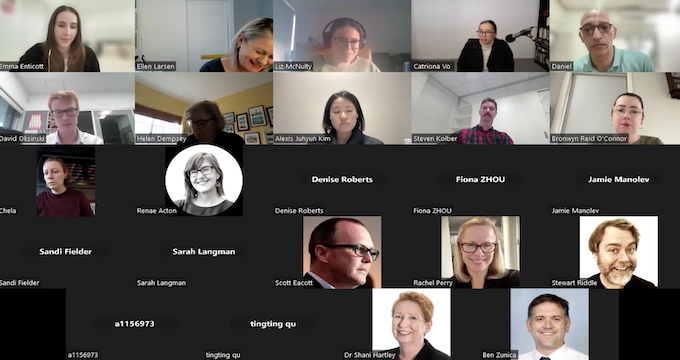
We’d like to thank those Early Career Teacher Panellists on the Teachers’ Voices : Catriona Vo, Emma Enticott, Liz McNulty, Daniel Siddhartha, Alexis Kim, David Oksinski
As educational researchers, we must listen to the voices of teachers to understand what research is critical to their work, and how we can effectively work with teachers to respond to contemporary issues and opportunities of the profession. Educational research operates in a void when teachers’ voices are left unheard. That void constrains the critical professional partnerships needed to bridge the research-practice divide and produce research with an authentic and powerful connection to educators’ work.
The Australian Association of Research in Education (AARE) Teachers’ Work and Lives Special Interest Group launched the first in a Teachers’ Voice Panel Series on June 24. It provides time and space for educational researchers to listen to teachers about what research matters to them. In this initial panel, six early career teachers from state and independent schools across Queensland, Victoria, the Northern Territory, and New South Wales came together online to share their ideas about research and their work. We asked our panel the following questions:
What are the current topics or issues for you as an early career teacher that are critically important for educational researchers to be investigating right now?
These early career teachers showed a clear and strong commitment to their professional growth. They indicated they were most interested in learning how best to meet the needs of the diverse students in their classes.
“How do we as teachers engage in culturally and linguistically responsive teaching? Given the diversity in schools and just how our classrooms are growing in terms of how diverse they are.” – Catriona
“Inclusive education… I’ve got anyone and everybody in my classroom, so what kind of research can be done so that students can get individual attention, and [teachers] giving each student exactly what they need.” – Liz
Inclusive practice
Inclusive practice and culturally responsive pedagogy emerged as topics of crucial importance, highlighting the focus of these future educational leaders on acknowledging, celebrating, and responding to the richness of their classroom cohorts.
They also spoke to their pressing need to understand how to work with Artificial Intelligence in ethical and practical ways.
“AI is another big thing. It’s taking over; whether its students using it to plagiarise (so how might we design tasks that stop this), or, how we might find ways to use it in responsible ways”. – David
The rapid evolution of digital technologies made the need for future-focused educational research in this space time-sensitive. Emma said: “Technology is moving so fast . . . I feel like the research that’s coming out now is delayed to my needs.” Panel members’ responses underscored the significant role that early career teachers will play in leading the way in working with a rapidly evolving digital landscape.
The panel also pointed to the potential for research to inform how teachers work together to innovate and collaboratively build professional capacity.
“To me, workplace culture is what it’s all about, genuine collegiality, with a generative outlook toward how to improve systems”. – Daniel
Still COVID-19
Interestingly, the residual impact of the COVID-19 years still loomed large as they discussed their need for research that could contribute to their address of student resilience, seen as an ongoing concern among students in the classroom.
“A lot of the younger students are coming out of the COVID years lack resilience. So it would be good to have more research into how we can support students with less resilience, especially with the limited resources we have”. – Alexis
We were impressed by the varied suite of topics reported by the panel as mattering to these early career teachers. At the heart of their interests was a commitment to social justice, a responsiveness to contemporary digital challenges, and a desire to contribute to a work culture of collegiality and collaboration.
To what extent do you, as an early career teacher, currently connect with research and/or researchers as part of your work? What are the available opportunities/challenges to doing this for you?
As with anything teaching, the “T word” loomed large as the key challenge to connecting with research and researchers.
“Time is a resource we don’t have much of, and I find that reading research can be quite difficult, it can be quite dense, but through reading groups and discussion this reading can be a lot more beneficial.” – David
Time alone, however, is not the only barrier to being research-connected as an early career teacher. The panel also shared how access to research post-graduation is also hindered when connections to their university are severed.
“Once I left university, of course, I have my alumni account, but that’s very restricted in terms of what I can access. So, I’m only often getting outdated information or I’m only ever getting the abstract.”- Emma
It was a theme that most of the early career teacher panel were primarily engaging in research through Professional Learning opportunities, with many of these opportunities being limited due to funding and time constraints. These systemic barriers to engaging in research, combined with the “density” (David) of research in some instances, led to the panel raising the need for “bite-size” research summaries on a variety of accessible platforms like practitioner journals, LinkedIn, and Instagram etc.
The diversity of ways that early career teachers preferred to access research-related media was also notable. with some noting preferences for print media (“the value of grabbing a physical text that is sitting around the staffroom”- Daniel) and others accessing videos and digital media more frequently.
For us as researchers, this raised thoughts of how we keep early career teachers connected to research and the universities they have spent so much time in after graduation. This appears to be an important question in moving forward in continuing to bridge the perceived research-practice gap.
As an early career teacher, what kind of research would you be most likely to take part in? How would you suggest we bridge the gap between the research community and the early career teacher community?
Many early career teachers leaned on the university-to-school connection during their first years of teaching, with a large portion of the connection to research coming from direct contact with past lecturers.
“The connection with lecturers and when you leave university, I think those relational connections are just so important for sustaining us as teachers sometimes just having that person that we can talk to, to say, “Hey, you know, this is going on in our classroom, do you have any thoughts about this” or just even checking in.” – Catriona
Emma too explained how she drew on her connections with past teacher educators. She proposed preservice teachers before graduation need to be upskilled in how to stay connected:
“It is a skill- staying connected. How do we stay connected? What are some really quick and easy places we can go to get this research? In that final year of ITE, how can we teach graduates how to stay connected and where to go for help”- Emma
They want access to research and are happy to be part of research
As well as these university-teacher connections providing a means of access to research, the panel also showed interest in being part of educational research while being cognisant that such research would need to work in with their everyday work.
“If I was part of research in my school, something that sat alongside my work, then that is something that I would be interested in”- Alexis
Excitingly, they encouraged educational researchers “to do a lot more research with their students who have gone out into teaching” (Daniel), reminding us that our alumni are important research partners.
The early career teachers on this panel, however, understood the important role that teachers played in being open to the value of research.
“There needs to be a shift in how teachers actually think about research…so how can we make research seem like it is accessible and approachable and that it is a part of everyday teachers’ work? Until we unpack that position that teachers may have about research and all those assumptions that teachers may have, that will go a long way to bridging teachers and research and how we design research that will get teachers onboard and involved in research too” – Catriona
As educational researchers, we need to find ways to connect with our early career teachers in ways that create manageable and timely access to cutting-edge research that can support their work.
Ways to connect
“This panel is an awesome starting point and I have learned so much this afternoon and that just speaks to the importance of these kinds of discussion.” – Liz
We would like to extend our heartfelt gratitude to these early career teachers for their time and insights. The convenors of the Teachers’ Work and Lives SIG, along with all participants in this event were left in no doubt that the future of the profession is in very good hands!
From left to right:
Ellen Larsen is a senior lecturer in the School of Education at the University of Southern Queensland (UniSQ). Ellen is a member of the Australian Association for Research in Education [AARE] executive and a convenor of the national AARE Teachers’ Work and Lives Special Interest Group. Ellen’s areas of research work include teacher professional learning, early career teachers, mentoring and induction, teacher identity, and education policy. She is on Twitter @DrEllenLarsen1.
Bronwyn Reid O’Connor is a mathematics educator and researcher in the Sydney School of Education and Social Work at the University of Sydney. Drawing on her experience as head of mathematics, Bronwyn teaches in the areas of secondary mathematics education at the undergraduate and graduate levels. Her research focuses on supporting students’ motivation, engagement, and learning in mathematic as well as secondary mathematics teacher education. Her work focuses on addressing the research-practice nexus, and she serves as Editor of the Australian Mathematics Education Journal to continue disseminating high-quality research to practitioners.
Steven Kolber is a proud public school teacher who has been teaching English, History and English as an additional language for 11 years. He has been recently named to the top 50 finalists in the Global Teacher Prize. He is passionate about teacher collaboration which he supports through organising Teach Meets, running #edureading (an online academic reading group) and supporting Khmer teachers by leading teacher development workshops in Cambodia with Teachers Across Borders Australia.
Header image from the Teachers’ Voice Panel Zoom call.
The draft International Education and Skills Strategic Framework, released late last month, calls for integrity. We suggest this can be achieved by a strategy that responds to global needs – as well as Australia’s – needs.
The ability of individual international students to pay fees determines access to Australian universities. There is no consideration of the educational needs of the countries from which students come or even serious consideration of Australia’s strategic interests.
We suggest a policy which combines international students in Australia and transnational online education, targeted to global educational needs and Australia’s national interest.
We are encouraged the Framework frequently refers for future education to be conducted with integrity. At the micro level, greater integrity should feature in the recruitment of students and all the processes associated with their Australian education. At the macro level educational offerings should address the current concerns expressed by many international policy scholars and ethicists. That is, the widening gap between the ‘haves’ and ‘have nots’ in and among members of the international community.
Three vital actions
We note and support especially the last three actions proposed in the Framework:
Expanding offshore, online, and other innovative arrangements to diversify the sector.
Contributing to global skills needs.
Advancing Australia’s strategic interests
These suggestions chime with recommendations in the Universities Accord to ‘support diversification of international student markets… including through using innovative transnational education delivery modes’.
We would add our hope that the ethical integrity of our educational offerings would include a deep and thoughtful concern to see global inequity reduced.
A missed opportunity for knowledge diplomacy
The focus of the higher education sector on the benefit of international students to Australian universities and to the wider economy is emphasised throughout most of the writings on international students, including in this latest Strategic Framework.
But this is not likely to earn the respect of the countries from which our students come. It also misses the opportunities to utilise international partnerships for the common good. The term knowledge diplomacy refers to ‘a new approach to understanding the role of international higher education, research, and innovation in strengthening relations among countries and addressing common global challenges.’ It depends on ‘collaboration, reciprocity, and mutuality.’ Taking account of global, rather than solely Australia’s, needs in Australia’s approach to international education would have integrity and could contribute to knowledge diplomacy.
Education of international students should be based on an appraisal of the needs of the national populations from which we draw them
Using 2022 data for higher education enrolment of international students in Australian universities, we show, three countries in South-East Asia stand out as having very high access rates
These are Singapore (403 students in Australia per 100,000 population), Brunei Daraussalam (115 per 100,000) and Malaysia (63 per 100,000). At the same time, Myanmar, Thailand, Laos, the Philippines, and Indonesia have rates less than 5 per 100,000 population.
Malaysia and Singapore together provided nearly half (47%) of South-East Asian international student numbers in Australia in 2022 but comprised only six per cent of the total population of South-East Asia. Indonesia provided 12 per cent of South-East Asian international student numbers in Australia but make up 40% of South-East Asia’s combined population.
Looking more broadly, in 2022, per 100,000 population, median rates of students coming to Australian universities were: Indian subcontinent 42, Pacific 28.9, China 10.5, South-East Asia 5.8, Sub-Saharan Africa 0.5: there was wide variation between countries within these regions.
It is difficult to see how these figures accord with Australia’s short-term strategic interests, let alone go far in honouring integrity (especially equity).
Longer-term, global populations will change.Nigeria is projected to have a larger population than China by 2100, as previously noted. The populations of many African countries will have doubled by 2050. Our planning for the future of international education should surely take the massive future growth among the youth of Africa into account.
A network of global online learning
We support the Framework’s mention of online learning. It has the potential to correct needs unmet by onshore education in Australia.
We propose expanding Australia’s international education through online learning, facilitated by a collaborative online global network. This would have several advantages.
First, it would offer education to individual students who would otherwise miss out from education in their local setting or an Australian in-person setting. .
Second, it could help redress the current inequities in global access to Australia’s higher education.
Third, Australian universities have adopted a largely competitive business model (with some exceptions mainly in research) with regard to international connections. The pedagogic locus of control remains firmly lodged in individual Australian universities. The manifest advantages of collaboration include building capacity among international universities for broad-spectrum academic activity including research. The network must include global universities. This would also avoid the accusation of colonisation of knowledge – of which Government and universities should be aware.
Fourth, it could match the provision of international education with Australia’s international strategic interests while providing long-term sustainability to the higher education sector. It would also set the scene for knowledge diplomacy as discussed above.
What would a network of global online learning look like?
Following a full international needs assessment for global higher education to which Australian universities might contribute, we repeat previous suggestions that such a network would require Australian universities to collaborate with each other as the key drivers of the network. Other universities in the global south should join the network. We need an infrastructure to include IT support and an appropriate quality assurance process should underpin the network.
We appreciate that the income of many Australian universities has come to depend on international student fees.
Online offshore (transnational) education should be delivered at cost, rather than the high fees currently charged which cross-subsidise other parts of Australia’s higher education system. We propose a combination of onshore education in Australia and offshore online education. This would be more sustainable. It would be better received by other countries – and it would offer a more equitable approach.
Rather than argue about numbers of international students coming to Australia, an assessment of capacity to offer a combination of onshore and offshore education would allow the development of a strategy with integrity to address inequity in global educational opportunity.
Richard Heller is emeritus professor at the Universities of Newcastle, Australia and Manchester, UK. He has been involved in educational programmes to build public health capacity in low- to middle-income population throughout his career. As Professor of Public Health in Manchester he set up the University’s first online master’s degree. He founded and coordinates the fully online volunteer-led Peoples-uni educational charity, offering master’s and continuing professional development awards.
Stephen Leeder is Emeritus Professor of public health and community medicine at the University of Sydney. Steve has 45 years of experience in epidemiological research and in medical education reform as a member of the foundation faculty in the new medical school in Newcastle and as dean of the Sydney medical school. He is currently Co-Editor-in-Chief of the International Journal of Epidemiology and was chair of the Western Sydney Local Health District Board from 2011 until 2016.
Translating research findings into practice or policy change is notoriously slow despite the time, effort and funding invested in research. In my peer reviewed journal article and presentation about research-based news articles, I give a step-by-step guide on how to write effectively for these research news sites to create impact and accelerate knowledge translation (also called research translation).
I also argue that while our institutions benefit and encourage us to engage in such research translation, they should recognise the time it takes to write and publish for these sites in our workloads. Further, institutions need to ensure their employment and promotion systems reward the efforts required for this type of research translation and stakeholder engagement. If these systems do not keep up, institutions risk reducing the potential impact of their research as researchers juggle their time.
Why bother with news articles?
Researchers have many demands within their institutions. Any investment in time to write research-based news articles (RBNAs) needs to be justified with important reasons. Firstly, in education, the translation of research into practice has been debated for a long time, with a large lag in uptake due to poor access to research findings and the high workloads of our target educators.
Secondly, many of our stakeholders do not necessarily have access to peer-reviewed papers. They are often exhausted from supporting children’s and student’s learning. For example, in my area of wellbeing research, my stakeholders are regional, rural and remote educators, support workers and parents. They are all busy groups of people.
Thirdly, although policymakers might have access to research libraries, they are also time-poor, wading through an increasing number of peer-reviewed publications.
Fourthly, in an information-rich environment, it is difficult for researchers to cut through the noise and have their research read, understood and put into practice.
Fifthly, RBNAs allow researchers to link their peer-reviewed publications. That ensures stakeholders who want more information are able to easily access their work.
Lastly, excellent research occurs in our universities and research institutes. But it is often only partially used because it is only accessed by other academics. Translating knowledge through RBNAs is one way to reduce such waste.
Research impact: benefits of RBNAs
There are many benefits of publishing RBNAs. This format allows researchers to summarise their research into snack-sized, easily digestible articles of around 600-1200 words available to the general public. Also, professionals working in the field might use the findings to inform their practice and decisions or increase their understanding and awareness of issues impacting their work. Researchers benefit by having a wider audience engage with their research, either by reading the RBNA or clicking on hyperlinks to their other research outputs. These metrics can be tracked using Altmetrics.which can be reported in funding, job and promotion applications as proof of stakeholder engagement and community service. Additionally, the researcher’s work is more likely to be noticed by media outlets, which might request further articles or interviews. This engagement further increases stakeholder and public engagement.
Understanding how RBNAs work
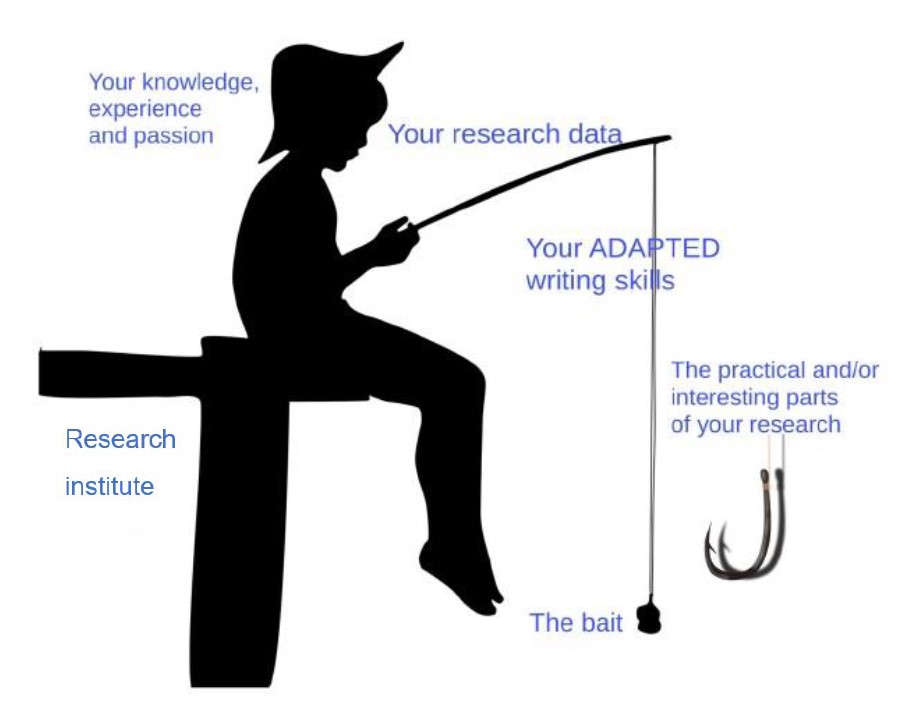
In my journal article, I use a new framework. It shows how RBNAs work and how researchers adapt their skills to write them using news values. Using a fishing analogy, shown in Figure 1, I explain the differences between RBNAs and writing opinion pieces in a newspaper.
Figure 1: Framework to explore RBNAs (Source: Rogers, 2024)
RBNAs are based on your research, using the platform of your institution as an authority and vantage point. Your academic knowledge, experience and passion are used as a fisherperson uses their knowledge to hunt fish.
Your research data and project become the fishing rod, skilfully moved and positioned to create impact. Importantly, the fishing line is stretched and adapted to accommodate the fish and conditions, just as you need to expand and adapt your writing style for different news sites. These articles are not mini essays, so this requires a definite shift in your style, language and tone.
The fishing hook is the engaging and practical part of your research. This can be tricky for researchers to identify because they might find all parts of their research interesting. Most readers will not share your fascination with theories and methodology. Working with your institution’s media and communication officers can be a big help here.
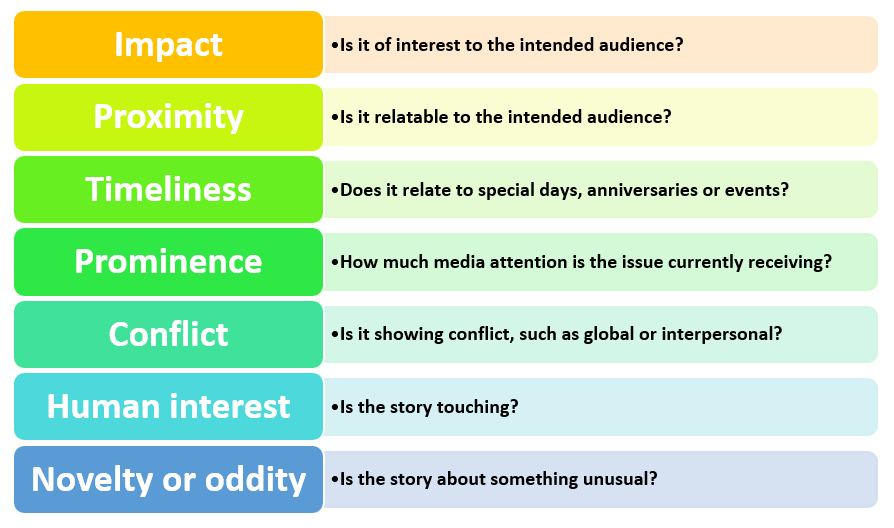
The most important part of your article is the bait. How will you lure your readers to your article? The easiest way to do this is to use news values that journalists use as shown in Figure 2 .
When drafting an RBNA or pitching an idea to an editor, frontload a one-sentence summary of your findings and place it in the first paragraph. (As an example, scroll up to look at the second sentence of this current RBNA). The first paragraph, headline and lead image need to work together to grab the audience’s attention.
This technique differs
This writing technique is quite different to an academic article or a mystery novel. The reader does not have to wade through to the end to find the punchline. Your style will need to change depending on the news site, so read some articles from your targeted site.
Use simple, everyday English without jargon and clearly explain technical terms. Use sub-headings and images to guide the reader. Your media and communications officers can read through drafts, and offer suggested edits.
Ensure you work with these colleagues and the news site editor collaboratively. Respect their journalism skills, and remember they are knowledgeable in their field. They are experts in style, tone, images, and importantly, what readers will (and will not) engage with. They know how to adapt your research to fit with news values.
Your content knowledge, combined with their journalistic expertise, can be a match made in heaven, provided you are willing to learn from them. When this happens, your stakeholders win.
To disseminate your RBNA widely, work with your media and communications team to do this through social media. Republish your article to other relevant news sites when this option is available. Learn from colleagues who have large social media followings by watching and imitating what they do. Be sure to tag your research colleagues, partners and funders when posting a link to your article.
Research impact – Challenges for academics
The Australian Universities Accord Final Report says there is a need to expand ‘government support for research translation’. But academics work in an increasingly time-pressured environment. They face increasing administrative pressures due to managerial-inspired systems and software that encourage research record keeping and compliance over innovation, creativity, stakeholder engagement and actual research.
Recognising the challenges, early career researchers, Granek and Nakash, explain:
As junior academics in vulnerable (i.e., pre-tenure) positions, we are well aware of the fact that it is easier to answer the question of why do [knowledge translation] KT than how to do KT given the very real academic constraints … the reality of a neoliberal academic climate that rewards publications and grants at the expense of the time and energy spent on the other kinds of KT initiatives … cannot be ignored. We work in a particular sociopolitical context that values some kinds of knowledge over others.
While institutions are often good at listing these activities in organisational narratives, they need to support this work in a practical way. Such activities must be valued and acknowledged in academic systems and workload agreements.
It’s time to value all the work researchers do to ensure our whole society benefits from our research.
Dr Marg Rogers is a senior lecturer in early childhood education at UNE and a postdoctoral fellow at the Manna Institute.