

AARE blog

How Australian universities could stop inequality and save the planet in one easy move

To address the global inequalities in access to higher education, I propose an Australian-led network for global online learning. A collaboration of Australian universities would offer online education to low- to middle-income populations, at large scale and low cost, with long-term benefits for future enrolments and global soft power.

As an example of global inequalities, access to higher education in Africa is one quarter of the global average. The importance of improving the education standards of the population to Africa and other regions with poor access does not need to be stated.

Australian universities are over-reliant on overseas student fees. This was demonstrated by the Covid pandemic which led to at least a temporary reduction in student numbers, with possible long-term loss of overseas students. The dependence on China as a source of international students is also a risk, given variations in geopolitical priorities. Given these concerns, the current policy whereby universities cross subsidise other activities such as research from overseas student fees is risky and likely to be unsustainable. Using student fee income from low-income countries to support universities and the broader economy in high-income countries such as Australia is unstainable and of questionable ethics. 

The Australian Strategy for International Education 2021-2030 is completely focused on the economic benefits to Australia from bringing international students to Australia, with no mention of the potential to reduce global inequalities in access to higher education.

Looking to the future, global populations will change. By 2100, Nigeria will have a larger population than China. Half of the current African countries will have doubled in size by 2050

Offering education that is clearly focused on building capacity in low- to middle-income populations rather than on earning income for ourselves own would likely raise the profile of Australian higher education and have future benefits in attracting students. This would also have the potential for more general soft power impacts. The Australian Government does offer scholarships for international students, as do many individual universities, but these are highly competitive and do not include online courses. They constitute only a small proportion of the large number of more than 450,000 overseas students who come to Australia each year.

My recent open access book, The Distributed University for Sustainable Higher Education, makes the case for a pivot from face-to-face to online education. There are many opportunities that this would create, including for education to be offered to a global audience at scale. 

An important consideration about bringing international students to study in a high-income country is the resulting high carbon footprint. This arises from travel and higher consumption patterns. My colleagues and I recently showed that a small cohort of only 128 international students who studied online rather than travelling to the UK for a master’s programme saved nearly a million kg of CO2, even without counting the contribution from their exposure to the physical university with its large carbon footprint.

I propose a programme which would increase global access to education – a network for global online learning. The driver, rather than to generate income from overseas students, would be to increase access to education among those in low- to middle-income countries where access is currently low. Student fees would thus have to be lower than at present. This can be justified by taking a long-term view of potential benefits to universities and the host country as discussed above, the realisation that the costs would be marginal as universities could utilise courses already in existence initially, and the suggestion that each partner need only provide part of the programme. A small increase in the amount of money the Australian Government and individual universities currently spend on scholarships could support such a programme. 

At present, universities compete with each other for international students, due to the competitive business model under which they operate. The creation of a network for global online learning focused on international students would depend on universities having the courage to collaborate rather than complete, to realise the power of collaboration. 

Although research is a more common area for collaboration, there are a number of examples of universities collaborating to offer education,  The Biostatistics Collaboration of Australia is an excellent example – students can enrol in, and graduate from, any of five Universities and access a common online curriculum. This approach differs from Open Universities Australia whose main task appears just to help students find appropriate online courses at Australian universities. Universitas 21, a global partnership which includes four Australian universities, offers a global online (non-degree) programme co-produced by a number of universities with an external partner.

What would the network for online global learning look like?

  • Australian universities would collaborate with each other as the key drivers of the network. 
  • Ideally other universities in the Global North and South and other ‘industry’ partners such as Non Governmental Organisations, and relevant governments and ministries would join the network.
  • Degrees would be offered by each University or created by a combination of courses from different network partners.
  • Students, as individuals or groups from industry partners, would enrol in award streams through a university of their choice even if the programme is made up from courses from a number of providers. 
  • Start with just one or two subject areas of relevance to those in the Global South, as proof of concept, and if successful build to scale. 
  • Develop an infrastructure to include IT support and a light touch quality assurance process.

A great deal more work is required to explore the potential for the idea of a network for online global learning. I call on interested parties to come together to think about this. Maybe Open Universities Australia or Universitas 21 would take on this challenge and lead the kind of collaborative network I have been describing?

Richard Heller is Emeritus Professor at the Universities of Newcastle, Australia and Manchester, UK. He has been involved in educational programmes to build pubic health capacity in low- to middle-income population throughout his career. In Newcastle this was through the International Clinical Epidemiology Network. As Professor of Public Health in Manchester he set up the University’s first online master’s degree. On retirement he founded and coordinated the fully online volunteer led Peoples-uni educational charity, offering master’s and continuing professional development awards. His recent open access book is The Distributed University for Sustainable Higher Education.

We can teach it so much better once we know what it is

‘Critical’ and ‘creative’ are commonly used terms, but shared understandings of these terms are less frequent. Critical and creative thinking (CCT) refers to two broad types of thinking that manifest in different ways and draw upon different combinations of knowledge and skills depending on the context and purpose. This explains the many slightly differing definitions you will find attached to the terms if you go looking.  Boiled down, critical thinking means evaluating ideas (especially claims and arguments), tools, methods, or products in reasoned ways, while creative thinking means making mental connections between and generating new ideas, tools, methods, or products for an intended effect. They’re different types of thinking but go well together. We believe developing young people’s CCT is a key purpose of education – and that teachers should be taught to teach CCT in a ‘deliberately incidental’ way.

CCT is not just important for Australia to stay internationally competitive or because there is increasing demand for employees with CCT skills. Thinking creatively and critically makes our world, and the lives we live, better. CCT gives meaning to much of what students learn at school. The OECD attributes such importance to CCT that it is introducing a standardised assessment of CCT this year. And of course, ACARA sees its importance, too; CCT is one of the seven General Capabilities in the Australian Curriculum.

So, it was with interest that we noted the findings of a recently published study by Carter and Buchanan. The 185 NSW primary teachers they surveyed agreed that the General Capabilities in the Australian Curriculum (Version 8.4) – which include CCT – were important, but the teachers were not confident in their knowledge of these capabilities. Almost half of the teachers reported that they did not understand the General Capabilities. Most reported teaching the General Capabilities only occasionally or not at all; and of the 37 teachers who were interviewed in the study, only 2 said they taught General Capabilities explicitly. 

Of all the reported excerpts about how Carter and Buchanan’s interviewees said they taught the General Capabilities, several of the General Capabilities were referenced but there was not a single mention of teaching CCT. The teachers cited – understandably – that a lack of professional development was the impediment to their understanding of the General Capabilities. It is not surprising that teachers would struggle with CCT particularly, given questions about the adequacy of teacher education in relation to teaching CCT.

A lack of clarity about CCT is pervasive. The more you read in this area, whether it is the scholarly literature or the grey literature, the more you can be forgiven for wondering if there is any kind of thinking that CCT does not include! We see the lack of definitional clarity around CCT as a significant barrier to confident and effective CCT teaching – but not an obstacle that quality teacher education and professional development cannot help teachers to overcome.

We argue that helping teachers to develop a deep understanding of CCT (much deeper than we can cover in this post) is important because of what well-established educational psychology principles – drawing on cognitive, social, and behavioural psychology – tell us. Only when teachers deeply understand the conceptual structures of CCT will they be able to teach CCT effectively.

Higher-order skills such as CCT are not the product of natural maturation and social interactions, and can therefore be thought of as biologically secondary skills. Cognitive psychology tells us that biologically secondary knowledge and skills should be taught explicitly, in order for the learning to be efficient and effective. This means that to most effectively develop students’ CCT, teachers need to teach CCT deliberately. This involves drawing attention to, explaining, and illustrating the concepts and skills involved (e.g., for critical thinking these might include evaluate, reason, argument, analyse, evidence, logic, conclusion, or the term critical itself; for creative thinking these might include imagination, brainstorm, open-minded, flexible, method, adapt, concept map, synthesise, or the term creative itself). The particular concepts, skills, explanations, and demonstrations will, of course, depend on the learners’ development, prior learning, and interests, and the learning area (or domain) knowledge being drawn on.

Cognitive psychology also tells us that CCT skills are not ‘generic strategies’, learnable in a content vacuum; they require content knowledge. To teach CCT in a knowledge-based way, teachers need to have a particularly deep understanding of CCT – so they can recognise and harness as many opportunities as possible to teach CCT skills utilising the domain knowledge they are teaching. Only by doing this as often as possible, in as many different learning areas as possible, can teachers encourage learners to engage in CCT habitually and ‘generally’. CCT skills taught in isolated CCT focused programs – if new skills are learned at all – do not generalise.

Social and behavioural psychology has much to contribute to teachers’ ability to establish CCT as socially normative thinking practices. To encourage children (and the adults they become) to engage in CCT in the various situations where it’s desirable to do so, teachers should frequently and explicitly model CCT skills, drawing attention to and labelling the specific skills they are using; provide plentiful and varied opportunities for learners to engage in the skills themselves, prompting and guiding where necessary; and try to ensure that the learners feel good (natural positive reinforcement) when they engage in those skills.

By taking a developmentally appropriate cognitive, social, and behavioural approach to teaching CCT – a ‘deliberately incidental’ approach – teachers can teach students not only what it means to think creatively and critically, but also that these are expected and valued ways of thinking. However, if teachers don’t have a deep understanding of what CCT is, they can’t fully harness the power of educational psychology principles to maximise the development of their students’ CCT. We believe that improved teacher education and professional development is needed to help many teachers feel confident enough to teach CCT in knowledge-based, explicit, and socially normalising ways.

We hope that any introduction of standardised testing of CCT skills encourages a more widespread focus on knowledge-based, explicit teaching of CCT. The OECD’s assertion that the “PISA assessment will examine students’ capacities to generate diverse and original ideas, and to evaluate and improve ideas, across a range of contexts” gives us some hope. Whether or not standardised testing of CCT is introduced in Australia, we hope all Australian teachers will get the support they need to develop a deep understanding of CCT and ‘deliberately incidental’ CCT pedagogies.

Overall, we hope that, in the future, all teachers will feel well prepared to teach CCT in a way that contributes to a society in which thinking creatively and critically in all domains of life is the wonderful norm.

From left to right: Kylie Murphy is a Senior Lecturer in Educational Psychology and Pedagogy at La Trobe University’s School of Education. Her background includes secondary teaching in science, psychology, and relationships education, and university teaching in research literacy, critical evidence-based practice, and pragmatic research methodology. Kylie is passionate about critically-informed teaching, including finding ways to support more inclusive and effective teaching of CCT. Follow her on Twitter @KylieMurphyEd or on LinkedIn. Steve Murphy is the Director of Professional Practice & School Partnerships at La Trobe University’s School of Education. He has extensive experience as a STEM educator and educational leader in schools. He researches rural education, with a particular focus on STEM education in rural schools and preparing teachers to work in rural communities. Follow Steve on LinkedIn or on Twitter @MurphyRuralEd. Nathaniel Swain is a teacher, instructional coach, and researcher with expertise in language, literacy, instructional practices, and cognitive science. He founded the national community of teachers and registered charity called Think Forward Educators, and produces a regular blog for teachers known as the Cognitorium. Nathaniel currently teaches Foundation at Brandon Park Primary, where he is also a Science of Learning Specialist. He is excited to be joining La Trobe University’s School of Education as a Senior Lecturer in January 2023. Follow him on LinkedIn or on Twitter@NathanielRSwain.

Why restoring trust in teaching now could fix the teacher shortage

Burnout is blamed for an exodus of teachers contributing to ‘a teacher shortage crisis’ in Australian schools. The teacher burnout argument offers a ‘convenient’ explanation of why teachers leave – they burn out as external pressures wear them down. Yet, framing the problem as one of teacher burnout diverts attention from ‘the moral crisis’ with which our teaching workforce has been grappling for years. 

The moral crisis is rooted in despair when teachers face persistent and chronic challenges to the values that animate their work. It emerges when the ‘call to teach’ as a moral practice meets an inequitably resourced education system that prioritises test-based accountability and top-down engineering of teachers’ work. 

The teacher shortage crisis 

The crisis talk has brought attention to some of the most legitimate grievances of teachers in Australia. Inadequate remuneration, unsustainable workloads, administrative burdens, and growing bureaucratic requirements have had irrefutable negative effects on teachers’ morale and their sense of career optimism. 

The teacher shortage crisis has also highlighted the importance of retaining teachers who are already in the job. This has led to a focus on improving teachers’ working conditions. At the same time, front-end-focused measures are introduced to address teacher supply issues. These policy solutions, including the recent Labor’s Plan to Fix Teacher Shortages, are aimed at making teaching a more attractive career option.

While these measures deal with elements of what has contributed a teacher shortage crisis, they remain largely oblivious to a less visible moral crisis that has haunted the teaching profession, a crisis rooted in tensions between the view of teaching as a caring practice driven by a sense of calling and education policies, school practices and working conditions that sit in tension with the call to service. 

A spectre is haunting teaching — the spectre of a moral crisis

A burnout explanation of why teachers leave the profession would lead to solutions that aim, at least in principle, to alleviate what burdens teachers, and burns them out. The New South Wales’ plan to support high-quality lesson planning is an example of such solutions. Universal access to centralised learning materials is offered to “free up lesson planning time each week” (Premier Dominic Perrottet). 

From a teacher burnout perspective, this policy response is adequate as it alleviates ‘the burden’ of lesson planning. This is, however, a problematic proposition. Many teachers view creating engaging lesson plans as part of their core work, something that provides them with the ownership of their practice.

A moral crisis explanation provides an alternative explanation of what wears teachers down and paves the way for their exit decision from teaching. Teachers may leave not because they burn out and have nothing more to offer; they leave because their call to service is consistently challenged by the realities of an inequitably resourced school system that pursues top-down engineering of their work. 

Viewed as such, teachers’ exit decisions can be interpreted as an ultimate act of dissent; it is a refusal to bear witness to and endure dehumanising conditions that undermine their professional autonomy, compromise their wellbeing and overlook what they cherish most in their work: making a positive difference in the lives of children and young people through the actual practices of teaching and learning. 

To exit, therefore, may not be a symptom of burning out. It can be an exercise of agency and a rejection of the top-down recipes that ignore the moral core that orients teachers’ practices.

Addressing the moral crisis

Addressing the moral crisis requires attending to what has eroded the fabric of education as a public good. This includes the school choice model and funding inequities that have created a two-tiered education system in which the least-resourced Australian schools cater for the most under-served students and their communities. Many of these schools have unsustainable working conditions that require teachers to forego their own wellbeing to do their job well. It should, therefore, not come as a surprise that the least advantaged schools in Australia are six times more likely to report teacher shortage problems compared to more affluent schools.

Attending to the moral core in teaching also requires a return to a view of education as a domain of possibility, agency and growth. It needs doing away with policies that prioritise compliance with centralised systems of monitoring tied to narrow test-based accountabilities. These practices have been shown to adversely impact on teacher morale and student wellbeing. We need to put the trust back in our teachers and their professional judgements. To do this, an audacious reform project is needed to rekindle an old flame amidst the ferocious onslaught of forces that codify teaching in purely managerial and technical terms.

Revisiting the teacher shortage crisis through a moral lens is more than reframing an existing problem in new terms. It requires us to attend to the values that sustain teaching as a caring form of practice. The moral argument disrupts the narrative that equates exit to a deficit in resilience and adaptability. Instead, it brings the focus back on teachers duty of care (for self and the other), and their agency to say ‘no’ to the conditions that dampen their morale, compromise their wellbeing and stall their care work. 

Babak Dadvand is a senior lecturer in Pedagogy, Professional Practice and Teacher Education at La Trobe School of Education. Babak’s research is in areas of teaching and teacher education with a focus on issues of equity, diversity and inclusion in relation to teachers’ work and student experiences. Babak’s current research is focused on the challenges that teachers face and the types of support that they need stay in the profession, especially in the more challenging working conditions of schools that serve communities that are socially-historically marginalised. Twitter: @DadvandBabak

The kids aren’t all right. Neither are staff.

Good morning on R U OK? Day 2022. Today’s the perfect day to ask our higher education (HE) students how they are doing. According to the latest national 2021 Student Experience Survey (SES) released late last month, the answer is a depressing ’not so good’. The 2021 data again show that the top ranked reason for the 19% of undergraduate students in Australia who consider early departure from their course is ‘health or stress’. For those students who consider leaving, 50% say this is why. The next highest ranked reasons, also consistently reported over the last several years (2015-2021), are all risk factors that can combine to further exacerbate students’ health or stress: study/life balance; workload difficulties; need to do paid work; financial difficulties; expectations not met; and personal reasons. Students lead complex and complicated lives! 

While some might say that considering leaving is not the same as actual leaving, this somewhat misses the point. It is enough and concerning that so many students feel overwhelmed in this way and that their learning engagement and student experience are so obviously impacted as a consequence. These findings also confirm what we have known for many years. Tertiary students are a ‘very high-risk population for psychological distress and mental disorders’ compared to the general population. Pre-pandemic, the prevalence and severity of mental wellbeing issues were well-known and increasing across student cohorts. In 2017, Orygen found that more than half of HE students aged 16–25 years reported high or very high levels of psychological distress and were more likely to consider an early exit from their course as a result. The National Tertiary Student Wellbeing Survey (2016), conducted by Headspace for the National Union of Students, similarly found that:

  • 67% of young students (16-25 years) and 59% of mature students (26-50+ years) rated their mental health as ‘fair’ or ‘poor’;
  • 65% of young students and 53% of mature students reported high or very high psychological distress; and
  •  Only 1.6% of young students and 3.4% of mature students reported no impact of study on their mental health in the past year.

Certain cohorts have been identified as particularly at-risk, including equity group students who, given their frequent intersectionality, may experience compounded disadvantage. These cohorts include, for example, students who are: young; Indigenous; international; from rural/remote areas; identify as LGBTQIA+; with disability; from low socio-economic backgrounds; HDRs; and/or studying law and medicine.

And then along came COVID. Already high levels of student distress increased as many students felt overwhelmed, isolated and frustrated in the rapid transition to new ways of learning, working and living. For example, one study found that the percentage of HE and vocational education students reporting extremely high levels of distress during the pandemic (at 23%) was higher than before the pandemic (at 19%); considerably higher than for the general population at 3% pre-COVID and 13% during COVID. University counselling services that were already finding it difficult pre-COVID to meet escalating demands for support and struggling with increasing complexity and severity of presentations had to move completely online.

It’s not just situational and personal factors that affect students’ mental health. There is considerable evidence also that ‘how students are taught and assessed, and how they engage with learning, can have an impact on their wellbeing’. That evidence has been available both pre– and over-COVID, and some excellent resources have been developed in response (for example, Nicole Crawford’s NCSEHE Fellowship and the seminal work of Baik and her colleagues). Recently, a large-scale project in the UK has also focused on how curriculum can support wellbeing and learning, and has developed an Education for Mental Health Toolkit.

Not just student mental wellbeing

Academic and professional staff are also at risk, awareness of which has also been raised both pre– and over-COVID. In the UK, Morrish analysed data obtained under Freedom of Information requests of HE providers in a study that could be usefully replicated in Australia. She found:

  • Evidence of an escalation of poor mental health among university staff in the period 2009 to 2016, based on data obtained from 59 HE providers on referrals to counselling and occupational health services; and 
  • That referral increases of 50% were common over that period, with some universities experiencing much higher rises: in counselling, up to 316% and in occupational health up to 424%.

When updating these data in April 2020, Morrish and Priaulx found that ‘analysis of 17 universities reveals a continued rise in staff access to counselling and occupational health referrals’.

It is also reported that ‘responding to student mental health problems now appears to be an inevitable [though ambiguous] part of the role of an academic’, given their frontline, student-facing responsibilities. This has been found to negatively impact on the wellbeing of academics and requires universities to respond with clarity around role and boundary definition in this regard.  

‘Mental health and wellbeing’ in Australian higher education

Orygen defines ‘mental health and wellbeing’ as encompassing ‘the continuum of mental health states… Mental health includes both the presence and absence of mental ill-health, though it is more commonly associated with the presence of mental illness. Mental wellbeing is generally thought of as positive mental health’.

The Higher Education Standards Framework 2021 (HESF), against which all HE providers are regulated, specifically requires that adequate support for student mental health and wellbeing be provided (HESF Wellbeing and Safety: Standard 2.3.3). Also, the provider’s governing body must ‘develop and maintain an institutional environment in which …the wellbeing of students and staff is fostered’ (HESF Corporate Governance: Standard 6.1.4, emphasis added). The extent of regulatory oversight of these specific matters is unclear, though TEQSA has identified ‘wellbeing and safety of students’ (with no specific inclusion of staff) as one of its ‘compliance priorities for 2022’.  

In 2017, the Higher Education Standards Panel (HESP) recommended that ‘every institution should have an institution-wide mental health strategy and implementation plan’ (Recommendation 8). In 2020, the Productivity Commission’s Mental Health Inquiry Report recommended that the ‘accountability of tertiary education providers should be strengthened with expanded mental health support to their students, including international students’ (Recommendation 6). Like the HESP, the Productivity Commission recommended that all education providers should develop a student mental health and wellbeing strategy as a requirement of registration, urging also that data be collected nationally on support services’ use and that both vocational education and HE regulators monitor and collect evidence of interventions for ongoing improvement.

In 2020, with government funding provided in response to the 2017 HESP Report, Orygen produced the Australian University Mental Health Framework. It is unclear how many HE providers have adopted the Orygen framework as many had already developed their own response between 2017-2020, a number of which focus to a greater extent that Orygen’s on staff wellbeing. In 2022, there still appears to be no collection of national data as recommended by the Productivity Commission. 

What would ‘good’ look like for sector-wide HE mental wellbeing?

In the face of COVID-19’s exacerbation of existing mental health concerns, we need to up our game as a sector on how we support our student and staff wellbeing. It is fortunate that we are able to draw on some excellent international research and resources in this regard. In particular, the UK student mental health charity, Student Minds, led an 18 month, sector-wide consultation process with thousands of students and staff to produce The University Mental Health Charter (2019) which covers both students and staff and directs specific attention to learning, teaching and assessment. 

This work is complemented by Universities UK’s development of a strategic framework launched in 2017 and updated over COVID – Stepchange: mentally healthy universities – for a whole-of-institution, whole-of-sector approach that positions mental health as fundamental to HE’s core mission and foundational to university life for its students and staff. UUK has also developed an open-access self-assessment tool that maps onto the Charter. Completing the UK package of initiatives, The Wellbeing Thesis, hosted by Student Minds, provides resources to support and improve the mental health of postgraduate research students, while the Student Space website, again courtesy of Student Minds, offers an amazing array of tailored support for student cohorts who might face additional challenges with mental health at university. Collectively, this impressive cross-sectoral collaboration and alignment sets the international benchmark for sector-wide best practice. Australia seems some way behind in comparison. Churchill Fellowship scholar Dr Ben Veness has asked whether it is perhaps time for Australian universities to introduce an award or credentialing program for their mental health programs, such as that available in the UK and the US

But wait – there’s more! With the abrupt scaling on online delivery, digital well-being has also become a priority for all students and citizens. Jisc now incorporates ‘digital well-being’ as an element in its digital capability framework, defining it as

the impact of technologies and digital services on people’s mental, physical, social and emotional health. It is a complex concept that can be viewed from a variety of perspectives and across different contexts and situations.

Jisc has produced resources to support the digital well-being of staff and students: one for practitioners, with guidance and good practice principles, and another for senior leaders that articulates key issues and responsibilities and eight good practice principles for organisations. 

Foreseeable harm + regulatory requirement = HE duty of care 

The mental health and wellbeing of our sector’s students and staff have been on the radar (out from Under the Radar) for many years now. We know that harm is foreseeable. We should listen closely when another blip sounds a warning, as it did again last month via the SES data, and ask ourselves – what are we really doing about the intractable and ‘wicked problem’ of student (and staff) mental health and wellbeing?

Professor Sally Kift is a Principal Fellow of the Higher Education Academy (PFHEA), a Fellow of the Australian Academy of Law (FAAL), and President of the Australian Learning & Teaching Fellows (ALTF). She has held several university leadership positions, including as Deputy Vice-Chancellor (Academic) at James Cook University. Sally is a national Teaching Award winner, a national Program Award winner and a national Senior Teaching Fellow on the First Year Experience. In 2010, she was appointed an Australian Discipline Scholar in Law. In 2017, Sally received an Australian University Career Achievement Award for her contribution to Australian higher education. Since 2017, she has been working as an independent higher education consultant. @kiftsally 

ECEC: Why joy at work is wonderful (but never enough)

Image courtesy of Joanna Crothers

Educators voted on Wednesday to take strike action on September 7 – Early Childhood Educators Day – to highlight the issues and stress that workers within the sector have been experiencing after “more than a decade of inaction”.The Guardian

The field of early childhood is currently facing a series of crises, including staff shortages, centre closures and unprecedented low levels of morale within and across the profession. None of these concerns is new! Although exacerbated by the global pandemic, the chronic challenges to providing quality early childhood care are complicated by funding, privatisation, ever increasing administrative demands placed on educators, poor working conditions, low salaries, and overall lack of recognition for the importance of the profession. 

Such issues have dominated the discussion of early childhood in the media, portraying an image of a field inundated with problems and at risk of being overwhelmed by them entirely. Together with my colleague at the University of Sydney, Dr. Cathy Little, we undertook a study that sought to hear the perspectives of this situation from the educators themselves, not just of the issues outlined above, but also of the field itself. The representation in the media seemed incomplete, too focused on the problems that beleaguered the sector rather than understanding the deeper issues at stake. We wanted to focus on what was also good, sustaining and valued in and by the profession. One of the emergent key findings, despite all the current challenges, was surprising. It was joy! This article discusses the notion of joy articulated by early childhood educators, its presence in early childhood programs and how it represents a way forward for the recognition and value of the profession in our society.

Defining Joy

C. S. Lewis understood. Joy comes to us, unexpected. A presence that we can neither manufacture nor control. Joy arrives and with it a fulfillment that is beyond the scope of pleasure or happiness and unlike those feelings, beyond our control. We may experience joy or hope that joy is waiting for us, however it cannot be manufactured, nor is its presence assured.

“Joy bursts in our lives when we go about doing the good at hand and not trying to manipulate things and times to achieve joy.”

CS Lewis

We mention C. S Lewis and his idea of joy as it resonates with the views expressed by the early childhood educators in this study.  A consistent definition of joy echoed through our research findings, one that connected with feelings of happiness or pleasure yet moved beyond these to a “Delight in everything I do”, “A feeling of lightness and emotional fullness”, “Serenity and peacefulness” and an “Overwhelming feeling of happiness that comes from within”.  Educators noted that joy “burst” into their lives as they went about their work with children. Joy sustains them, makes the work they do worthwhile and of inestimable professional and personal value. Joy is an occupational hazard.

Finding Joy

In listening to early childhood educators, we learned that the source of their joy was found in relationships, experienced always with children, families, and colleagues. They described this joy in the day-to-day interactions with children, the quieter moments or as one educator wrote, “certain times when I make a strong connection with a child or build on my working relationships with my colleagues”. Others found it by, “Being in the moment with the children” or “Being with children” and “When the children are interacting with me”. They spoke of the joy discovered when observing children, “Deeply engaged in doing something they enjoy” and about “Having fun, singing, dancing, meditating, doing yoga. Engaging in conversations with the children. Playing with the children” and the “Daily joy… from the moment I enter the gate… to children cheering my name blowing kisses”. 

Joy was seen as present in the wider relationships that surrounded the early childhood centre. The relationships with families of “Interacting with the children/educators/families. Sharing the children’s and educators’ achievements and learning” and “Daily conversations with family not just about their personal life but also about mine and my team”. Families contributed to educator’s sense of joy by their feedback about the program, in communicating their children’s happiness to educators and sharing in a sense of belonging. Educators experienced joy through a depth of feeling for their professional role, when they recognised themselves as central players in the bigger picture of supporting children to reach a goal or a milestone, in assisting families and children, or in actions they thought “Truly make a difference”.

Joy was and is everywhere, despite educator burnout, staffing shortages, low salaries, and poor working conditions. It is joy that remained after the educators responded to the needs of the children, at the same time as they prepared lunch, made beds, tended to children’s injuries, both physical and emotional, and tried to find time to plan, program and reflect. Joy could so easily be a casualty to these demands, and to the exigencies of the field of early education overall. All of which are a risk to joy, a risk that as recent events have illustrated, our society should not be so willing to take. The wellbeing of our children, their opportunity to grow and learn with others, to feel valued and appreciated is dependent on a stable and positive professional community. As one director said, “Being happy within really translates to the children”.

Implications of Joy

The reverence that educators expressed for children in our study should be reflected by a reverence in our society for the work they do, reflected in their qualifications, financial compensation and in the day-to-day experiences in each and every program. Day to day experiences that expand on the opportunities for the reciprocal learning that takes place between children and the adults who nurture them. Adults that are well qualified and extremely knowledgeable about the value of quality education in the early years, education that is holistic and which nurtures the whole child. Our early years programs move beyond compliance with standards, rather, they are environments, developed through rich, quality programming that allow educators to observe the children and engage with them in a range of creative learning experiences.  Our work seeks to develop educators’ professional autonomy and provide them with the time to make pedagogical choices that are informed by research, the unique context of their program and not directed by standardized curriculum alone. To restore to them their joy, their joy of being with the children, playing with the children and their joyful pedagogy.

Olivia Karaolis teaches across the School of Education and Social Work at Sydney University. She completed her research at USYD after working in the United States in the field of Early Childhood Education and Special Education. Her focus has been on creating inclusive communities through the framework of the creative arts.

 Cathy Little is the executive director of Initial Teacher Education at the University of Sydney. Her areas of interest are autistic spectrum disorder, high support needs, and positive behaviour support. She lectures at both undergraduate and postgraduate levels, and is supervising a number of research students.

Is the NAPLAN results delay about politics or precision?

The decision announced yesterday by ACARA to delay the release of preliminary NAPLAN data is perplexing. The justification is that the combination of concerns around the impact of COVID-19 on children, and the significant flooding that occurred across parts of Australia in early 2022 contributed to many parents deciding to opt their children out of participating in NAPLAN. The official account explains:

“The NAPLAN 2022 results detailing the long-term national and jurisdictional trends will be released towards the end of the year as usual, but there will be no preliminary results release in August this year as closer analysis is required due to lower than usual student participation rates as a result of the pandemic, flu and floods.”

The media release goes on to say that this decision will not affect the release of results to schools and to parents, which have historically occurred at similar times of the year. The question that this poses, of course, is why the preliminary reporting of results is affected, but student and school reports will not be. The answer is likely to do with the nature of the non-participation. 

The most perplexing part of this decision is that NAPLAN has regularly had participation rates below 90% at various times among various cohorts. That has never prevented preliminary results being released before.

What are the preliminary results?

Since 2008, NAPLAN has been a controversial feature of the Australian school calendar for students in Years 3, 5, 7 and 9. The ‘pencil-and-paper’ version of NAPLAN was criticised for how statistical error impacts its precision at the student and school level (Wu, 2016), the impact that NAPLAN has had on teaching and learning (Hardy, 2014), and the time it takes for the results to come back (Thompson, 2013). Since 2018, NAPLAN has gradually shifted to an online, adaptive design which ACARA claims “are better targeted to students’ achievement levels and response styles meaning that the tests “provide more efficient and precise estimates of students’ achievements than do fixed form paper based tests. 2022 was the first year that the tests were fully online. 

NAPLAN essentially comprises four levels of reporting. These are student reports, school level reports, preliminary national reports and national reports. The preliminary reports are usually released around the same time as the student and school results. They report on broad national and sub-national trends, including average results for each year level in each domain across each state and territory and nationally. Closer to the end of the year, a National Report is released which contains deeper analysis on how characteristics such as gender, Indigenous status, language background other than English status, parental occupation, parental education, and geolocation impact achievement at each year level in each test domain.

Participation rates

The justification given in the media release concerns participation rates. To understand this better, we need to understand how participation impacts the reliability of test data and the validity of inferences that can be made as a result (Thompson, Adie & Klenowski, 2018). NAPLAN is a census test. This means that in a perfect world, all students in Years 3, 5, 7 & 9 would sit their respective tests. Of course, 100% participation is highly unlikely, so ACARA sets a benchmark of 90% for participation. Their argument is that if 90% of any given cohort sits a test we can be confident that the results of those sitting the tests are representative of the patterns of achievement of the entire population, even sub-groups within that population. ACARA calculates the participation rate as “all students assessed, non-attempt and exempt students as a percentage of the total number of students in the year level”. Non-attempt students are those who were present but either refused to sit the test or did not provide sufficient information to estimate an achievement score. Exempt students are those exempt from  one or more of the tests on the grounds of English language proficiency or disability.

The challenge, of course, is that non-participation introduces error into the calculation of student achievement. Error is a feature of standardised testing, it doesn’t mean mistakes in the test itself, it rather is an estimation of the various ways that uncertainty emerges in predicting how proficient a student is in an entire domain based on a relatively small sample of questions that make up a test. The greater the error, the less precise (ie less reliable) the tests are. With regards to participation, the greater the non-participation, the more uncertainty is introduced into that prediction. 

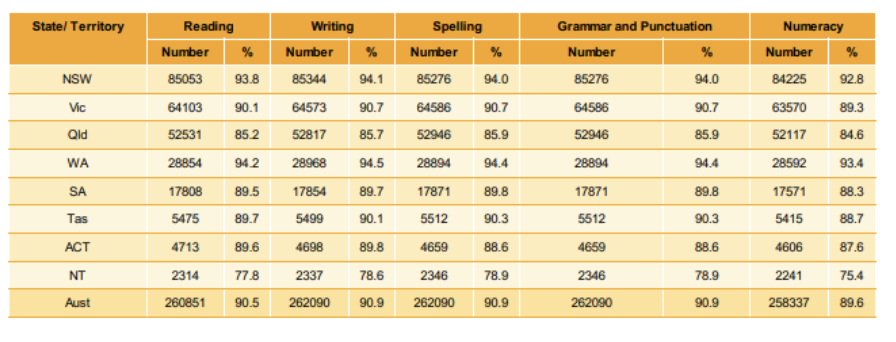
The confusing thing in this decision is that NAPLAN has regularly had participation rates below 90% at various times among various cohorts. This participation data can be accessed here.  For example, in 2021 the average participation rates for Year 9 students were slightly below the 90% threshold in every domain yet this did not impact the release of the Preliminary Report. 

Table 1: Year 9 Participation in NAPLAN 2021 (generated from ACARA data)

These 2021 results are not an anomaly, they are a trend that has emerged over time. For example, in pre-pandemic 2018 the jurisdictions of Queensland, South Australia, ACT and Northern Territory did not reach the 90% threshold in any of the Year 9 domains. 

Table 2: Year 9 Participation in NAPLAN 2018 (generated from ACARA data)

Given these results above, the question remains why has participation affected the reporting of the 2022 results, but Year 9 results in 2018, or 2021, were not similarly affected?

At the outset, I am going to say that there is a degree of speculation in answering this question. Primarily, this is because even if participation declines to 85%, this is still a very large sample with which to predict the achievement of the population in a given domain, so it must be that something has not worked when they have tried to model the data. I am going to suggest three possible reasons:

  1. The first is likely, given that it is hinted at in the ACARA press release. If we return to the relationship between participation, error and the validity of inferences, the most likely way that an 85% participation rate could be a problem is if non-participation is not randomly spread across the population. If non-participation was shown to be systematic, that is it is heavily biassed to particular subgroups, then depending upon the size of that bias, the ability to make valid inferences about achievement in different jurisdictions or amongst different sub-groups could be severely impacted. One effect of this is that it might become difficult to reliably equate 2022 results with previous years. This could explain why lower than 90% Year 9 participation in 2021 was not a problem – the non-participation was relatively randomly spread across the sub-groups.
  2. Second, and related to the above, is that the non-participation has something to do with the material and infrastructural requirements for an online test that is administered to all students across Australia. There have long been concerns about the infrastructure requirements of NAPLAN online such as access to computers, reliable internet connections and so on particularly in regional and remote areas of Australia. If these were to influence results, such as through an increased number of students unable to attempt the test, this could also influence the reliability of inferences amongst particular sub-groups. 
  3. The final possibility is political. It has been obvious for some time that various Education Ministers have become frustrated with aspects of the NAPLAN program. The most prominent example of this was the concern expressed by the Victorian Education Minister in 2018 about the reliability of the equation of the online and paper tests. (Education chiefs have botched Naplan online test, says Victoria minister | Australian education | The Guardian) During 2018, ACARA were criticised for showing a lack of responsible leadership in releasing results that seemed to show a mode effect, that is, a difference between students that sat the online vs the pen and paper test not related to their capacity in literacy and numeracy. It may be that ACARA has grown cautious as a result of the 2018 ministerial backlash and feel that any potential problems with the data need to be thoroughly investigated before jurisdictions are named and shamed based on their average scores. 

Ultimately, this leads us to perhaps one of the more frustrating things, we may never know. Where problems emerge around NAPLAN, the tendency is for ACARA and/or the Federal Education Minister to whom ACARA reports, to try to limit criticism by denying access to the data. In 2018, at the height of the controversy of the differences between the online and pencil and paper modes, I formed a team with two internationally eminent psychometricians to research whether there was a mode effect between the online and pencil and paper versions of NAPLAN. The request to ACARA to access the dataset was denied with the words that ACARA could not release item level data for the 2018 online items, presumably because they were provided by commercial entities. In the end, we just have to trust ACARA that there was not one. If we have learnt anything from recent political scandals, perfect opaqueness remains a problematic governance strategy.

Greg Thompson is a professor in the Faculty of Creative Industries, Education & Social Justice at the Queensland University of Technology. His research focuses on the philosophy of education and educational theory. He is also interested in education policy, and the philosophy/sociology of education assessment and measurement with a focus on large-scale testing and learning analytics/big data.

Just like us: why Australian students need teachers from everywhere

Our dwindling teacher workforce makes headlines every week and new Education Minister Jason Clare calls it “a massive challenge”. A wide range of strategies have been proposed: increasing the respect and reputation of teaching as a job, raising completion rates in university teaching programs, attracting more mid-career professionals into the teaching, offering bursaries, paid internships and reducing university fees for students studying teaching. There are also conversations about keeping teachers in the classroom by making the pay more competitive. 

Another option on the table is to fast-track visas for teachers from overseas. But can recruiting teachers internationally work?

Australia hasn’t previously welcomed teachers with overseas qualifications, especially those from language backgrounds other than English. The English Language proficiency scores required by AITSL are higher than is required for migrant doctors (and any other profession we could find). Likewise, the English proficiency scores to enter an Initial Teacher Education program are higher than for any other degree, including HDR programs. This creates expensive additional barriers for non-native English speakers, and could be considered discriminatory, given that native English speakers aren’t required to demonstrate the same level of proficiency.

These barriers are impacting the level of diversity of the teaching profession.  Less than one-fifth of of teachers (17 per cent) identify as being born overseas, compared with 33.6% of the wider working-aged Australian population. Further, it reinforces  a deficit view of teachers from culturally and linguistically diverse (CALD) backgrounds, overlooking the contribution that such teachers might make to school communities. 

Teachers in countries such as China are highly respected. In Japan and South Korea teachers are well paid and valued as highly educated professionals. Australian ITE programs go through rigorous accreditation to ensure that new teachers have the knowledge and skills they need to be effective teachers, as do other countries. Some countries require all teachers to hold Masters degrees, some require teachers to be bilingual or multilingual. Overseas teachers may actually be more qualified, not less.

A diverse teaching workforce allows culturally and linguistically diverse students and their families to see themselves reflected in their education system. Students will find role models that reflect their life experience, allowing them to feel more comfortable and more able to flourish in learning environments where their home culture is valued. Teachers from racial minorities can understand the experience of racism, and help prevent it from happening, as well as offer empathy to students experiencing prejudice. Studies from the USA have found that teachers of colour are more likely to have higher expectations of students of colour. Studies also found less absences and less disciplinary issues when students of colour were taught by teachers of colour. Most importantly, racially diverse teachers can play a key role in challenging stereotypes about racial minorities among the wider community. In short, everybody benefits from a diversified teacher workforce. 

However, our current highly homogenised workforce doesn’t allow for these benefits to be realised. While the few teachers that we have from minoritised and racialised backgrounds bring much needed diversity to the workforce, they can become victims of racism themselves. They regularly fend off criticism about everything from their accents to their dress, skin colour, religion or beliefs. Their pedagogies and knowledge of curriculum are often subject of criticism, whereas for their white anglo colleagues, nuances in teaching practices are accepted as part of individual difference in the profession. 

There’s sadly a lack of information about cultural diversity among teachers. Country of birth is a crude measure of diversity, and AITSL admits that it currently doesn’t have more detailed information.

Examining the experiences of teachers from different cultural groups, especially with regards to their intentions to remain or leave the profession, will become available in the ATWD in future, and will provide insight into our understanding of cultural safety in schools for students and teachers of different cultural groups. (ATWD report, 2021, p. 18)

However, we also need a far greater understanding of the contributions CALD teachers can make to school communities, and the circumstances that contribute to schools being the kinds of places where diverse teachers – and diverse students – can thrive.

Welcoming teachers from overseas can do much more than address our teacher shortage. While there does need to be some briefing and orientation into Australian teachers’ legal responsibilities, our curriculum and expectations of teachers, we can find ourselves enriched by a workforce that is more representative of our multicultural, multilingual population and our globally-oriented curriculum. More than just a solution to the teacher shortage: A diverse teaching workforce would add value to Australian schools.

Dr Rachael Jacobs is a lecturer in Creative Arts Education at Western Sydney University and a former secondary teacher (Dance, Drama and Music) and primary Arts specialist. Her research interests include assessment in the arts, language acquisition through the arts and decolonised approaches to embodied learning. 

Dr Rachael Dwyer is a lecturer in curriculum and pedagogy in the School of Education and Tertiary Access, University of the Sunshine Coast. She is also the president of the Australian Society for Music Education (ASME), Queensland Chapter.

Why is there so much talk about teachers right now? Because we are afraid of them

The federal minister for education Jason Clare convened a roundtable to solve the teacher shortage on the eve of the new government’s Job Summit. Items on the agenda? It wasn’t hard to go past working conditions, status, and a growing, chronic teacher shortage as the impetus for history-making industrial action and considerable media coverage.

Concerns about teachers’ working conditions have themselves arisen out of a context in which teacher quality, figures of the ‘good’ and ‘bad’ teacher, the fear of indoctrinating teachers, have been increasingly constructed as ‘policy problems’ to be addressed. ‘The teacher’, it seems, is becoming one of the most contested figures in contemporary education policy debates.

We have recently edited a Special Issue of the journal Education Policy Analysis Archives in which the collected papers reflect on the current positioning of teachers across a range of international policy contexts. This journal, unlike the majority of academic journals, is run by a university and is entirely open access, which means you can read the full issue. You can also watch a video introduction to the issue. 

Look at Australia, for example

In our introduction to the issue, we use Australia as an example of a country in which responsibility has been placed on teachers to ‘fix’ perceived educational crises, often through policy reform that requires teachers to be ‘better’ trained, more professional, more accountable and more standardised. Here, the past fifteen years of education policy has featured: the introduction of standardised census testing of students via the National Assessment Programme, the results of which are made public via the My School website; the introduction of national teaching standards and accreditation requirements; and repeated inquiries into initial teacher education, with the introduction of program standards and, more recently, mandated teacher performance assessments.

Why are teachers so central to education policy?

Given all this policy change, we think it’s reasonable to claim that teachers are the targets of much political and popular consternation. But what is it about teachers that makes them such a matter of attention and concern, and how does the current political climate contribute to these (often unrealistic) expectations?

According to Wodak, populism has an “appeal to the ‘common man/woman’ as opposed to the elites”. She has argued that in populist regimes, ‘difference’ is denied and the ‘common’ is valorised, creating “a demos which exists above and beyond the divides and diversities of social class and religion, gender and generation”.

We argue that it is possible to view schooling (and teaching) as a logical site of public commentary because of the common experience amongst most populations. Indeed, it is often suggested that everyone knows what it is like to be a teacher because everyone has gone to school. As Lortie put it, there is an ‘apprenticeship of observation’ in school education that means everyone, regardless of whether they become a teacher or not, forms ideas about the work of teaching simply because of their ongoing interactions with teachers throughout a significant portion of their lives. In terms of populist tendencies, this widespread experience and presumed knowledge about how schools should operate, positions teachers as a common ground upon which critique can be aimed.

At the same time, teachers increasingly bear the burden for the economic, social and political wellbeing of the countries within which they teach. As the global economy becomes understood as essentially knowledge-based, the need to track and compare student achievement within and across nation-states has taken on a broad prominence typified by, for instance, the regular Programme for International Student Assessment (PISA) tests run by the Organisation for Economic Cooperation and Development (OECD). Indeed, teachers are an increasing point of focus for the OECD, which now also runs the Teaching and Learning International Survey (TALIS) examining teachers’ work and working conditions. This, we argue, reflects a revived and rearticulated emphasis on the teacher.

The teacher as an object of fear

Yet despite this apparent importance, teaching does not often become an object of respect, but rather of fear, emblematic of growing national and international anxieties around knowledge, success and the moral character of the next generation. This puts the figure of the teacher in an uncomfortable position. Paradoxically, teaching is known to all (“anyone could do it!”), yet also unknowable (as a university-based, complex and contested form of expertise). Teachers’ success is supposedly important for global competition, but teaching is not necessarily viewed as worthy of professional status and fair working conditions. Within this context, ongoing attempts to control, standardise and responsibilise teaching and teachers becomes a rational, even urgent pursuit. So much so that the resulting hyper-focus on teachers-as-solution has created what Wodak calls a “fear ‘market’”, where teachers become the target of an expanding “cottage industry” of commercial products (e.g., professional development materials, data-tracking platforms, etc.).

It’s time to destabilise global narratives of teachers

The papers in our Special Issue explore teachers’ work across contexts including the United States, Europe, and the Asia-Pacific. The journal in which the issue has been published is based at Arizona State University, meaning that the inclusion of studies from places like Australia, New Zealand and the Pacific Islands may make somewhat unfamiliar reading for many subscribers. This was intentional.

In Australia, education policy is often developed and analysed in reference to what Lingard has termed our common ‘reference societies’ of the US and UK. As researchers and authors, we are routinely asked to make our work ‘relevant’ by situating it in relation to such dominant international reform contexts. But what would happen if this demand was reversed? Should research emanating from dominant contexts instead be required to make itself relevant to more diverse, local spaces, and what analytical possibilities might this open up? Possibly, what is needed is to reimagine teachers and schooling in ways that are less limited by the systems and structures that have led us to this point. Perhaps it is time for teachers and those who research them to truly warrant their positioning as an object of fear, by destabilising the taken-for-granted terms under which they work.


From left: Meghan Stacey is senior lecturer in the UNSW School of Education, researching in the fields of the sociology of education and education policy. Taking a particular interest in teachers, her research considers how teachers’ work is framed by policy, as well as the effects of such policy for those who work with, within and against it. Mihajla Gavin is a senior lecturer at UTS Business School. Her PhD, completed in 2019, examined how teacher trade unions have responded to neoliberal education reform. Her current research focuses on the restructuring of teachers’ work and conditions of work, worker voice, and women and employment relations. Jessica Gerrard is an associate professor at the Melbourne Graduate School of Education. Jessica researches the changing formations, and lived experiences, of social inequalities in relation to education, activism, work and unemployment. She works across the disciplines of sociology, history and policy studies with an interest in critical methodologies and theories. Anna Hogan is senior research fellow in the School of Teacher Education and Leadership at the Queensland University of Technology. Her research focuses on education privatisation and commercialisation. She currently works on a number of research projects, including investigating philanthropy in Australian public schooling, the privatisation of global school provision, and the intensification of teachers’ work. Jessica Holloway is senior research and ARC DECRA Fellow at the Australian Catholic University. Her research draws on political theory and policy sociology to investigate: (1) how metrics, data and digital tools produce new conditions, practices and subjectivities, especially as this relates to teachers and schools, and (2) how teachers and schools are positioned to respond to the evolving and emerging needs of their communities.

Why that one tweet went viral (and what we must do now to fix “teacher shortages”)

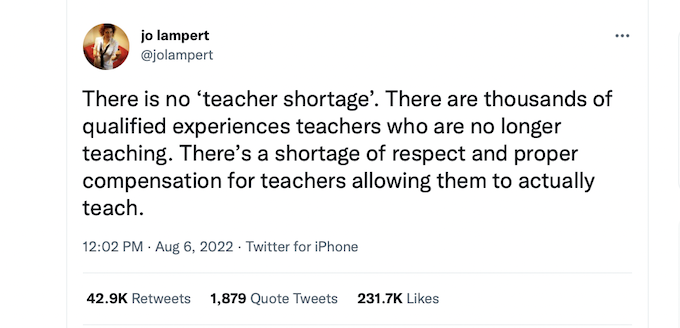
I almost never post on Twitter. Sometimes I like other people’s posts, but I’ve been a reluctant Twitter user. However, last week I posted this statement: There is no ‘teacher shortage’. There are thousands of qualified experienced teachers who are no longer teaching. There’s a shortage of respect and proper compensation for teachers allowing them to actually teach. In fact, as full disclosure, I paraphrased this from something posted by Professor Kara Mitchell Viesca | College of Education and Human Sciences at the University of Nebraska-Lincoln with whom I’ve worked. By the time I woke up in the morning, the tweet had gone viral. It’s been liked more 229.5K times, shared 44.2K times and commented on 1,937 times.

Nearly all these comments were posted by teachers or ex-teachers who emphatically agree that a change is needed in how we frame “teacher shortages”. These comments were from all around the world, mainly from the US but also from Australia, Canada, the UK and elsewhere. I haven’t yet sifted through all the comments, which keep on coming.

Overwhelmingly, these teachers (or ex-teachers) perceive the discourse of “teacher shortages” as misguided and even hurtful. As they point out, there are thousands and thousands of well-prepared, passionate, skilled, knowledgeable teachers. Comments on the original post recount how much they put into their teaching,  how well qualified they are yet how little they felt valued. The constant criticism of teachers is something Nicole Mockler has written about recently, in her review of media representations of teachers.

Those who posted explained how much they loved the kids in their classrooms, created and taught creative, content-rich lessons. Many said they had been fully planning to teach for the rest of their lives. In other words, there was never a ‘shortage’ of good teachers who might have stayed had it not been so hard. They grieve their loss of career. Many say they didn’t really want to leave teaching, but as widely reported, they could just no longer teach how they wanted to – nor in some cases could they maintain their mental and physical health under current conditions. Teachers talked about the pressures of only ever receiving impermanent contracts, of endless reporting, of unreasonable workloads dominated by non-teaching tasks, of being on the receiving end of constant teacher-blaming. They also wrote about the de-professionalisation of teaching and their loss of autonomy.

Some mentioned other reasons for leaving, such as poor student behaviour but by far the majority of comments simply responded ‘truth’ or ‘yessss’ or ‘agree’. The sadness on the part of teachers who no longer feel they can remain teaching is palpable from these responses.

Some teachers who have left the profession have found a way around those pressures by taking advantage of government schemes, both in Australia and elsewhere that are designed to address teacher shortages but may have created a different set of problems. For instance, in Victoria significant funding has been allocated through the Tutor Learning Initiative https://www.vic.gov.au/tutor-learning-initiative-2022-information-for-prospective-tutors which employs part-time tutors in schools to ‘catch up’ students who are academically behind since the pandemic. One unintended consequence was that exhausted and often very experienced teachers took the opportunity to take well-paid tutoring jobs that relieved them of the parts of teaching they liked least, such as duties that could be carried out by administrative staff. Again, the ‘resignation’ from teaching cannot be perceived as a ‘teacher shortage’ but as a kind of redistribution of talent. Good or ‘quality’ teachers have chosen to move sideways (in fact downwards, taking less pay and security but with less stress) to stay in schools.

In fact, there is no lack of research on why teachers leave. There have been numerous teacher attrition and retention studies over a great many years. Except for pandemic related workforce issues (sickness and lockdowns) we’ve been warned for a long time that we needed a teacher workforce renewal strategy, not just because of an ageing workforce but because of the increasing accountabilities and pressures on teachers. These issues are widely reported, not just by other researchers, but in recent reports such as the  Grattan Institute report Making Time for Great Teaching.

https://twitter.com/Run_San_Run/status/1556016322462552064?s=20&t=Hs1B_hll0ce7L63Vgvjvrg

Along with Amy McPherson, Bruce Burnett and Danielle Armour, our recent review of twenty years of government, ITE and private initiatives to attract and retain a teaching workforce conservatively found 147 government, ITE or partnered initiatives that have been trialled over the past twenty years. One recommendation is that understanding the retention of teachers at key ‘walking point’ moments would assist policymakers in designing longer-term, more impactful interventions to attract teachers towards hard-to-staff schools (especially when they are considering leaving the profession).

This review of the many initiatives that have already been funded and implemented is just one research project repeating what seems to be clear. Incentives may attract people including career-changers, to teaching, but it’s a whole of system issue. The problem isn’t Initial Teacher Education on its own, which has been graduating very good (sometimes great) teachers for many, many years. The problem isn’t a lack of smart, passionate, and committed people who want to be teachers. But the well may go dry – we can’t keep looking elsewhere for teachers if we aren’t able to keep them in the profession. There’s little question that this is a crisis. We do need teachers in front of students; and there is no doubt teaching workforce issues are urgent. But sending teachers our there more quickly or prescribing curriculum to ‘help them manage their time’ is a misunderstanding of what’s going on.  And by the way, school leaders agree. There were many comments from Principals as well.

I want to make it clear that I had not expected this post to go viral. I have been coordinating social justice teacher education programs such as the Nexus alternative pathway into teaching for a very long time . I see amazing schools and dedicated teachers ever day who are doing remarkable things under difficult circumstances. I am ‘for’ teachers and schools.

If 229.5K isn’t evidence enough of how teachers are feeling I’m not sure what is. I’m also very reluctant to focus only on “teacher grief”. Let’s also tap into the stories of teachers who remain in schools, especially now. Let’s find out what their working lives are like. Their lived experience will tell us how close they are to walking, why they stay, what keeps them going. Nobody knows how to find solutions better than those most affected.

On August 8, the Minister for Education Jason Clare published the Teacher Workforce Shortages Paper in advance of the Teacher Workforce Roundtable to tackle the national teacher workforce shortage

Maybe we should stop using the term teacher shortages.

We have a teacher workforce issue without a doubt. We need more teachers urgently. But some of us are nervous about recruiting new teachers at the same time as we are sorting out their workplace conditions.

Jo Lampert is Professor of Social Inclusion and Teacher Education at La Trobe University. She has led alternative pathways into teaching in hard-to-staff schools for over 15 years, most recently as Director of the Commonwealth and State supported Nexus M. Teach in Victoria, a social justice, employment-based pathway whereby preservice teachers work as Education Support Staff prior to gaining employment as paraprofessionals (Nexus). She tweets at @jolampert.

Broken but alive – COVID’s gender impacts in Australian universities now

In February 2020 we submitted an ARC Discovery application entitled Understanding and Addressing Everyday Sexisms in Australian Universities. Thinking that we would have zero chance of getting an ARC with the word ‘sexisms’ in the title (spoiler alert – we did get it!), we planned to do a pilot study that year that would trial a number of our proposed survey items and follow up interview content. While we were writing up the ARC application in January 2020, one of the team was working in Hong Kong as a guest lecturer at a local university. There were rumours flying around about a ‘strange flu’ that had come out of Wuhan city, Hubei province in mainland China…

By March of that year we had, to use popular vice-chancellorian parlance, ‘pivoted’ and were living in various stages of lockdown in Perth, Sydney and Melbourne. We worked remotely, some of us with children at home, as we tried to grapple with strange new realities and the terrible knowledge that this strange flu, now known as COVID-19, could kill us. As the months wore on, we noticed that gender-based inequalities at our workplaces had not pivoted, and given our focus on gender and Higher Education in Australia, we decided to investigate the impact of COVID-19 working conditions in this space. We brought Jo Pollitt into the pilot who, at the time, was working as a postdoc at ECU. The study sought to understand the ways in which everyday sexisms were playing out for academic workers in universities across Australia and the impact that the pandemic was having on the pre-existing gender inequalities in Australian Higher Education. Whilst not shocking or surprising, our findings were bleak.

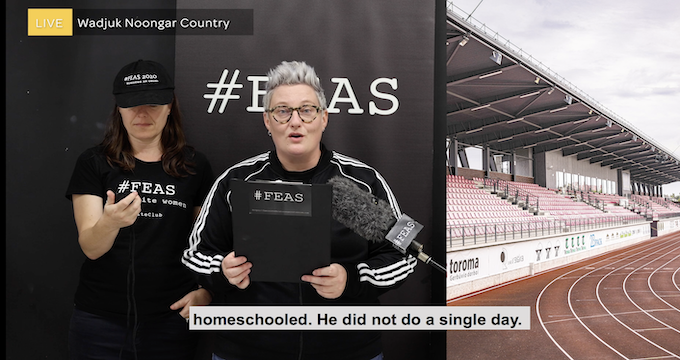
“Both my husband and I worked from home for the 10 weeks our children homeschooled. He did not do a single day.” From The #FEAS Report 2021: a satirical news report based upon this research. feat. Mindy Blaise, Emily Gray and Jo Pollitt

That the effects of the pandemic were/are not evenly distributed is, by now, well documented and research shows us that women globally are more likely to be precariously employed and/or engaged in ‘frontline work’, unpaid care work and volunteer community work. The global recession that COVID precipitated meant that women-dominated employment sectors such as retail and hospitality businesses have been adversely affected by social distancing and stay at home directions. As British feminist scholar Elaine Swan articulates, the impacts of COVID-19 on paid work and domestic labour were racialised and classed as well as gendered, and “that it became visible that women, especially women of colour in paid and domestic carework and key worker roles were keeping the system running”.  

Within higher education, social inequalities were similarly amplified. Research so far shows us that the domestic division of labour and stresses upon women’s time precipitated by increased domestic responsibilities mirrored that of the general population. Alarmingly, the lack of women scientists involved in COVID-related medical research means that there may be gendered effects of the virus itself that have not been attended to. This early research also illustrates a significant decrease in journal article submissions from women during the pandemic.

Our survey was taken by almost 200 participants, and while our convenience sample was not representative, it nonetheless provided a ‘snapshot’ of the experiences of academics for whom our survey focus was most relatable: those experiencing sexism and gender-based inequalities during the early stages of the pandemic. 

One of the things that we noticed was how women-identifying participants spoke about how their perceptions of the pandemic’s impact upon their working lives were not shared by their (cis)male colleagues.  Participants spoke of being in meetings where (cis)male members of staff would talk about what a ‘great year’ 2020 had been for them, how their research productivity had gone up. They got books out and were able to use time previously earmarked for commuting to write for publication. Participants who shared this experience talked about how no space was made for their conflicting experiences of the pandemic – for them to encourage their senior/leadership colleagues, as one participant articulated, to “look at the literal wreckage around (them)” and take action. The masculinist orientation of the contemporary neoliberal university was amplified by the pandemic, and those who haven’t historically been welcomed or belonged found out that, at the worst of times, they were left to clean up the mess. Our research showed that the university sector’s, ‘business as usual’ approach during the pandemic manifested as a refusal to allow academics pause, to sit with our fears, our losses, our grief and to attend to the needs of our families and communities.

Perhaps one of the starkest findings was the impact that messaging from university management had upon participants. Many spoke of a weird juxtaposition between ‘business as usual’ and ‘we’re all in it together’, which were both popular slogans that were used simultaneously by VC’s and upper management at universities. Several participants spoke of the psychological impacts that this had, including one participant who had previously been in a violent domestic partnership. This participant spoke of being triggered because the mixed messaging was tantamount to gaslighting – a coercive control tactic deployed by abusers in order to make another party feel insecure, belittled and ultimately insane. Within higher education, such gaslighting went along the lines of, as one participant phrased it: “Two days to pivot online, it’s business as usual. We care about you, but your student evaluation scores are low. We’re in this together – where are your three research outputs?”. Many participants also spoke of a disconnect between the lived realities of regular academic workers and university executives, who, in the early stages of the pandemic, were telling us all that ‘we’re in this together’ to a Zoom backdrop of expensive (often Aboriginal) artwork or Danish mid-century furniture. This was hard to swallow for many, especially precariously employed academic workers, one of whom we interviewed who had half of an IKEA kitchen table in their share-house as a workspace during periods of lockdown. 

Quantitative data showed that feelings of dread and insecurity about the future even characterised the experiences of ‘safe’ academic workers in ongoing positions. This was especially the case where universities had ‘voluntary’ redundancy programmes or were encouraging staff to ‘gift’ time and/or research income in order to relieve some of the financial burdens upon schools and institutions. Because the domestic division of labour continued to be mirrored at work, many women-identifying and minority academics found themselves suddenly feeling precarious because they had been so busy attending to the needs of students and/or colleagues, they had not had time for research-related work, which often requires prolonged periods of uninterrupted focus.  This was near-impossible for academic parents/carers and those providing pastoral care for students, including cohorts of international students stranded far from family support. 

As the pandemic continues, we are left wondering if our institutions see the literal wreckage around them, and more importantly, what they are doing about it. The gendered, racialised and classed impacts of the pandemic upon universities is likely to continue for years and will be reflected in lowered numbers of research outputs and failed promotion applications. COVID-19 needs to be understood as a career interruption for many, and a traumatic experience for all. Universities have to acknowledge this, to give us time to stop and reflect on the past 2 ½ years, to let us grieve for the time we lost, the fear that has become part of the lives of many, the births we missed, the funerals we couldn’t attend. That the pandemic amplified pre-existing inequalities so spectacularly means that the Higher Education sector writ large needs to stop and reflect, to make changes to masculinist neoliberal measurement techniques that punish those for whom universities were not made: women, Aboriginal and Torres Strait Islander peoples, LGBTIQ+ people, people with disabilities. These are the people who kept the system running in crisis, who continue to navigate the wreckage, who, in the words of an Aboriginal woman participant, are ‘broken but alive’. 

‘I’m broken but I’m alive’: gender, COVID-19 and higher education in Australia was published in Higher Education Research & Development.

From left to right: Emily Gray is a senior lecturer in education studies at RMIT’s School of Education. Her interests within both research and teaching are interdisciplinary and include sociology, cultural studies and education. She is particularly interested in questions of gender and sexuality and with how understandings these identity categories are lived by individuals and experienced within social institutions.  Jacqueline Ullman is an associate professor of Adolescent Development, Behaviour and Wellbeing at Western Sydney University, where she teaches in the areas of educational psychology, sociology of education, research design and research methods for preservice secondary teachers and educators looking to pursue continued education. Her primary research focus is in the area of diversity of genders and sexualities and associated inclusive educational practices. Mindy Blaise is a vice chancellor’s professorial research fellow at Edith Cowan University. She is leading an interdisciplinary project on children’s common world relations with place, materiality, and the more-than-human. Her research interests include creating and practising experimental and innovative pedagogies for the Anthropocene; interdisciplinarity; postdevelopmentalism; queer theory; feminism; post empiricism; multi-species ethnography. Jo Pollitt is a post doctoral research fellow at the School of Education, Edith Cowan University. As an interdisciplinary artist and researcher Jo’s work is grounded in a twenty-year practice of improvisation and her work in dance, dramaturgy and writing has been presented both locally and internationally. Her research applies choreographic thinking, expanded embodiment, experimental writing, and creative response in thinking with more-than-human worlds to explore children’s relations with common worlds.