
AARE blog

The education minister’s terrible, horrible, no good, very bad idea*

When will governments learn their lesson? Worksheets won’t fix workload crisis.

The teachers of NSW are at breaking point, and the government solution is to take away the part of their work they most expert in – lesson planning.  As Queensland’s experience shows, this ‘quick fix’ will not solve the workload issues which underpin NSW’s teacher shortage crisis.

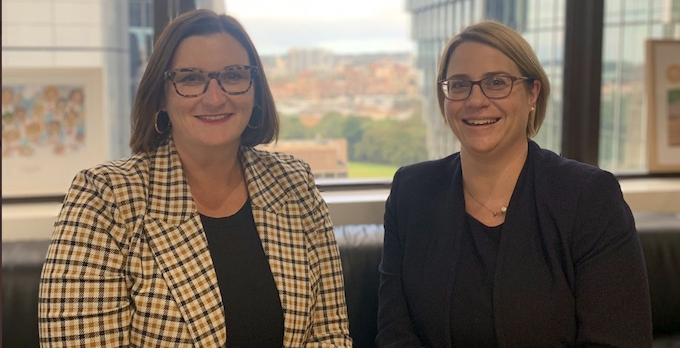
The social media response to the SMH’s article, which featured the NSW education minister Sarah Mitchell (pictured in the image with department secretary Georgina Harrison) on lesson planning reform has been swift.

and more.

https://twitter.com/FairerEduNSW/status/1554025121722933248?s=20&t=1hRnclq93sqH-By8sfWK1g

Teachers are decrying the government strategy. Of most concern,  the resources will be produced in under eight weeks, for a curriculum that is currently under review. The lack of transparency about how this feat will happen makes this approach look like this wasteful, impractical splurge on public funds during a time we are all being asked to tighten our belts.

The thing is, resources are already available and attached to the National Curriculum website via Scootle. Many of them arrived there because of a similar initiative by the Queensland Government. So our question is, why hasn’t the NSW government done its homework or listened to the teachers before addressing the core issues fuelling the teacher crisis?

Lesson planning is not the issue

While the Grattan Institute report, which forms the basis of the NSW government’s strategy, identifies the biggest demand on teacher time is planning, they have neglected that this lesson planning is the part of their work that teachers want to be doing – it is their core work. The top three activities teachers would choose to do if they had a  spare hour are working on student assessment, preparing effective classroom instruction, and adapting teaching.

 The Grattan report goes on to argue that providing teachers with centralised planning resources will alleviate pressure. But the report’s own findings show the issue not the planning per se, but the time needed to undertake it – teachers could develop common lesson plans and resources, tailored to and developed within their school context, with their colleagues, if the time that they identify as the biggest impediment is provided to them.

Increased administrative duties and expanding pastoral care pressures are chewing into time teachers once had to collaborate, plan and prepare their students for success. Time is the issue, but time could be made available by strategies that deal with the administrivia of teacher workloads, rather than removing the core work.

Queensland tried and failed

Queensland tried the centralised provision of “curriculum lesson plans, texts and learning materials” a decade ago in the Curriculum to Classroom (C2C) reforms, designed to support the initial implementation of the Australian Curriculum. This project, while well-intentioned, was not as simple as the Queensland Department of Education first imagined. It became plagued by multiple issues which both slowed down the roll out and reduced the quality of the resources in comparison to what a teacher could develop themselves, if given the time. For example, according to Naomi Barnes who was a Senior Writer on the program, copyright meant that only resources which were made freely available by those who owned the copyright, or were out of copyright, were approved for use in the C2C program. This means that in an era where teachers are trying to increase the diversity of texts in their classrooms (which they could do through purchasing class sets and designing their own lessons)  they were instead provided with worksheets that referred to dated works that were less prone to copyright issues.  To include diverse texts would mean adequately compensating authors, rather than financially cutting corners through inferior resourcing.

Even more concerning was the political interference in the development of the materials, with resources being vetoed by the Newman LNP government at the time. As such, lesson plans were held up to scrutiny via the “Courier Mail test” or whether they would hit the newspaper for content Newman’s government might determine was partisan. Issues of diversity and contestability were removed for “safer” options. In other words the government decided what was safe for children to know. This political interference in teacher’s work is still a feature of LNP curriculum governance

C2C also increased workload. Research from both C2C implementation and more recently shows that even with highly proscriptive, resourced lesson plans, teachers viewed and used the materials in a wide range of ways, negating the promise of consistency and workload reduction. For example, Mathematics teachers pointed out that the initial C2C materials did not actually address all elements of the curriculum they were meant to support and so required significant redevelopment. Barton et al’s exploration of the initial responses to C2C implementation found “prescription of curriculum materials only leads to mistrust and a devaluing of teachers’ expertise”. Hardy suggested rather than seeking to standardise teacher work, we instead recognise teachers’ professional skills as experts in lesson planning and curriculum implementation, valuing their professional collaborations and practices .

Workload correction

While having a set of resources can be a helpful starting point when planning, it is not going to fix the workload issues facing teachers because teachers will still have to spend time adapting them to their school context, which is what they already do with the myriad of resources already available to teachers in numerous resource banks, like Scootle.

A full-time teacher is currently allocated approximately 3.5- 4 hours a week as non-contact or preparation and correction time. A standard teaching load is 4-6 classes, so this is less 30 minutes per week during the school day to plan for learning and mark assessment. The Grattan report pointed out that 28% of teacher time is devoted to non-teaching activity (ie over one full day a week – more than their allocated non-contact time). As one example, the introduction of the Nationally Consistent Collection of Data (NCCD) has significantly increased the administrative workload for teachers in maintaining detailed lesson plans and tracking individual resources to ensure funding is allocated to students with additional needs or disabilities (Union survey highlights data overload (informit.org)). Properly funding learning support staff who can assist classroom teachers both with the planning for and administration of differentiated materials would be one welcome change. A reduction in teacher’s cocurricular loads would also be another easy-to-implement solution, as would reviewing the extent of classroom teacher involvement in pastoral care work, which has only increased with the increased disruption and distress of COVID and bouts of lockdown and homeschooling. 

The issue is that the proportion of non-teaching activity is taking up their allocated time to prepare for their core work – lesson planning and differentiated delivery. Rather than spending money on creating (already available) resources the funds NSW has to spend on this project would be better spent investing in additional school staff to take up some of this administrative load.

The clear and obvious solution to relieving pressure on teachers is an ongoing investment in additional staff: learning support experts, sports and arts co-curricular supervisors, and professional pastoral staff.  Recognising teachers’ professional expertise as educators and giving them the time to do their core business well is the real answer to the teaching crisis, not handing out another worksheet.

*Headline with apologies to Alexander and to Judith Viorst

Dr Alison Bedford is a lecturer (curriculum and pedagogy) in the School of Education at the University of Southern Queensland and a secondary school history teacher.

Dr Naomi Barnes is a network analyst and theorist interested in how ideas influence education policy. She is a senior lecturer in literacy teaching and has worked for Education Queensland as a senior writer and has worked as a secondary English, hstory and geography teacher in government, Catholic and independent schools.

Is the cheery praise for mindfulness based on expert evidence?

Educators, desperate to offset the mental health impacts of COVID on students, are taking up mindfulness programs to address the wellbeing needs of students. But is the cheery praise for mindfulness based on expert evidence?

It’s becoming a staple within Australian education – from preschool to universities. The Smiling Mind Primary School Program, for example, has been rolled out to 445 schools across NSW, including 13 specialist schools, and is gaining increased direct funding support from government.

Many in education – including educators, school leaders and policy-makers – have welcomed mindfulness and are excited about what mindfulness may hold for education. But is enthusiasm for mindfulness  outpacing the evidence in its favour? Do applications of mindfulness in education retain an overly narrow account of what mindfulness is? If we are using mindfulness with young people, what is it best used for?

Can mindfulness deliver on its promise for education, and what do educators really think of it?

While extensive research on the wellbeing benefits of mindfulness has been undertaken, recent, rigorous research on mindfulness for school age children has produced inconclusive findings. Findings just published from the UK’s MYRIAD trial, involving over 8000 young people, failed to show any mental health benefits of mindfulness training over regular SEL teaching. Importantly, very limited work has been done to understand how educators themselves understand and use mindfulness in their work.

 In light of this, the Contemplative Studies Centre at the University of Melbourne is running a national survey of educators (including Early Childhood, Primary, Secondary and Tertiary) to build a robust understanding of educators’ views of, and uses of, mindfulness. The findings will provide an important basis for evidence-informed discussions about what mindfulness might – and might not – be able to achieve in education.

Why definitions, purposes and practitioner understandings matter

Discussions of mindfulness in education rarely pose the question of what mindfulness really is (definition) or what it is actually for (purpose). But these are incredibly important questions to ask, as understandings of mindfulness and approaches to its practice have become highly diverse as they have evolved over time. From its 2,500-year history within Buddhism, contemporary mindfulness practices within education (and beyond) are often reduced to simply a breathing exercise for relaxation purposes. Likewise, meditation has increasingly been positioned as a form of ethically- and politically-neutral attention training to enhance focus and productivity. In the context of these (often highly reductive) transformations, it is necessary to re-ask what mindfulness is, and what value it has for education.

As the authors of the recent MYRIAD findings conclude, contextual and implementation factors – and especially the role of the teacher – may be highly important in moderating the impact of mindfulness-based interventions in education. Whether mindfulness is conceived primarily as a psychological training technique for increasing individual wellbeing, or as inherently embedded in a range of ethical and transformational aims (or some combination of the two) really matters. Educators who come to mindfulness primarily through its secular manifestations – such as Mindfulness Based Stress Reduction, or the Mindfulness in Schools Project – are likely to understand, practice and promote mindfulness in a very different way to educators who come to mindfulness through engagement with Buddhism or other contemplative traditions. Educators who see the purpose of mindfulness in terms of psychological training are likely to enact it with their students in a very different way to those who see it as part of a broader philosophical, ethical, and potentially religious process of living. Moreover, just because an educator, or school, is implementing Smiling Mind (or any other pre-packaged Mindfulness-inspired program) it doesn’t follow that their way of thinking or doing mindfulness remains identical to the program curriculum. Educators, as active agents of educational policy, will always implement and adapt programs on the basis of their existing values, commitments and priorities.

Some scholars have become concerned that as mindfulness practices are adapted for use in education, they have become detached from the ethical systems and philosophies that have underpinned them. While it might be possible to retain these richer philosophies behind the practice, experts indicate that this requires adapted procedures and considerable efforts on behalf of the educators, including establishing their own solid personal mindfulness practice. 

The importance of mapping the diversity of mindfulness in education

The point here is not for experts to decide which version of mindfulness is the ‘right’ or ‘real’ one. For educators pursuing brief stress relief and/or relaxation for their students, it may be that a simple breathing exercise is perfectly appropriate. For others interested in students developing emotional balance, compassion or insights into the nature of mind, other more comprehensive notions of mindfulness may be relevant. There is nothing wrong with using different practices for different goals. Ultimately, in different contexts and communities, mindfulness will be defined differently, practised differently, and used toward different goals. But, while these divergent definitions and purposes remain unexamined, and until there is open, clear conversation about this, there is the risk of confusion and misunderstanding as programs are implemented and evaluated.

Correspondingly, the Contemplative Studies Centre is seeking to build a rich, evidence-based picture of Australian educators’ understanding of and engagement with mindfulness in their work, through our national survey. This study is important because, despite the structure, curriculum and intentions of mindfulness programs in education, it is the views, practices and purposes of educators themselves that will ultimately determine the everyday experiences of young people and adults they work with. We invite readers to complete the survey – and to share it with your networks.

So – what do you think mindfulness is? What is it for? And how is it used in your educational setting? Please let us know!

From left: Dr Christopher T. McCaw is a lecturer in education at the Melbourne Graduate School of Education, and is Education Fellow at the Contemplative Studies Centre. Ms Winky Lee is a PhD candidate (Educational and Developmental Psychology) at the Melbourne Graduate School of Education. Associate Professor Nicholas Van Dam is Director of the Contemplative Studies Centre at the University of Melbourne.

Desperate and despondent: the truth about the way we treat immigrant teachers

In the battle to fix teacher shortages, much is made of recruiting teachers internationally. Three researchers reveal what happens when non-native English speaking immigrant teachers try to join the local workforce.

As Australia faces a serious shortage of teachers, how do we treat teachers who come to Australia as non-native speakers?

Non-native English speaking immigrant teachers (NNESITs) comprise around 10 % of teaching workforce in Australia today but we know little about their professional experiences impacting their professional selves. 

Early results of a large-scale study of 16 such teachers, analysing the narratives of their professional experiences across sectors, reveal this: they are treated unequally and inequitably from pre-migration up until they access their profession in Australia. 

Some take years to secure jobs.

Their experiences of marginalisation and differentiation repeatedly challenged them to claim their professional identity before and after migration to Australia. This continued in varied forms within their professional contexts and beyond. 

The key unique challenges involved are meeting requirements of the English language multiple times, getting their experiences and teaching qualifications fully recognised, and in some cases accepted even after their qualifications were recognised and upgraded to those of local equivalents.Then, despite meeting all eligibility criteria, these teachers still don’t get work. 

These challenges impacted them differently at material, social, cultural, emotional, and psychological levels. Even after accessing the profession, they were constantly judged by their non-native status, non-native English language uses, and their ethnicities.This leads them to feel like an imposter

Some did experience assistance in developing their professional identity but in our research we are focusing on the data of how the constitution of the professional identity of these teachers in Australia was challenged throughout the stages of migration and settlement, and how that impacted their professional identity. 

Before and after migration, these immigrant teachers (NNESITs) faced many professional challenges because of their cultural differences. Their professional status drastically dropped from a very high professional and social status to the one of the lowest. For instance, they had to meet English language requirements multiple times, such as for the purposes of immigration and for teacher registration. This also involves the change of requirements while applying for or renewing visas and applying for migration and  teacher registration.

For example, a high school teacher, Laura said, for migration, she “took the IELTS test (one of the many requirements for a Secondary Teacher) four times. … applied for reassessment of the result of the fourth take”. She had to spend around three months of her salary to pay for the fees for IELTS tests and review. 

The English language requirements stipulated by for NNESITs by VIT (Victorian Institute of Teacher) and AITSL (Australian Institute for Teaching and School Leadership) are both linguistically and racially discriminatory because the requirements do not apply for native English-speaking teachers (NESTs) from BANA (Britain and the Australasian and North American nations). 

Despite meeting all criteria, including gaining Australian qualification/s, getting an English language teaching teaching job was a monumental hurdle for them. Despite the English language and English language teaching being similar around the globe, it took months to years to access the profession before and/or after meeting the country-specific criteria. Most of them had no choice but to work in discriminatory cash-in hand, and/or low paid unskilled sectors: hospitality, cleaning services, children’s and aged care services, call centres, taxi industry and community services.

Raphael reminisced,

“I wanted a job. It didn’t matter what job I did. So I went and applied for a job as a train conductor … my first job in Melbourne. I’ve never found it hard to get a job, but I was willing to do some very, very low paid work. … I was a taxi driver for 10 years.”

A highly revered teacher from India, Mahati, landed a job in a Sri Lankan grocery that still haunts her like a nightmare, “cooking, cleaning, packing, selling, etc – the worst time of my life!”

Frida felt utterly despondent and “discouraged” finding herself unemployed after having been employed full time in the Philippines and internationally “since graduating from university”.

Failure to show Australian job experiences led Mandy to determine “I would apply for any kind of job [to] create income …”.

Jasha almost gave up and thought “I would never find a stable and interesting job”.

The impact of working in professionally unrelated and exploitative industries, the teachers’ professional identity was negatively impacted, their self-esteem and professional spirit were greatly diminished. 

Some were not called for job interviews until they had Australian qualifications and volunteer teaching experience, and some were repeatedly rejected after they were interviewed. Even after upgrading her teaching qualification at a renowned university in Melbourne, another high school teacher, Jigna, could not set her foot in a high school. 

“I started shortly as a casual relief teacher. … I got an interview for a teaching position at a public school in Cranbourne. I was unsuccessful on the grounds of lack of experience. Then again, I was interviewed telephonically by SERCO, but could not be successful on the grounds of lack of Australian experience. I took up employment as a Coordinator for an after-school Program (OSHC) with Camp Australia. It utilised my VIT licence and got me into a school. However, it was far from a teaching career.”

Now a TAFE teacher, Jasha believes “some schools even today are looking for ‘native speakers’ only”. She had a job interview for “TESOL training to international students” but shortly after the interview finished she received an email: “Unfortunately, the position has been filled.”

Some of our participants, despite being qualified and/or experienced high school and primary school teachers, chose to be employed in TAFE, community and ELICOS (English Language Intensive Courses for Overseas Students) sectors because they did not wish to be unemployed.

Immigrant teachers face many challenges to reconstitute their professional identity in Australia. If Australia wants to utilise immigrant teachers to address the current teacher shortage, then it must address institutional and micro socio-cultural and professional barriers to entry. To accept NNESITs’ cultural professional repertoire as assets rather than deficit is the first step. Customised transition programs such as mentorship  and ongoing support within and beyond professional contexts are also essential to transition and develop them further in new interculturally enriched processional context. It is both ethical and ecological to recognise and fully include NNESITs as legitimate teachers within Australian teaching sectors. It is suggested to engage in intercultural dialogue productively and to listen and be open to those who appear to be culturally and professionally different and be responsible to them. 

When immigrant teachers no longer suffer the discrimination and marginalisation due to their cultural, linguistic and racial difference, they are then assured of equal rights and empowered to freely negotiate their professional identity. 

Nashid Nigar teaches Master of TESOL and Master of Education programs at the Melbourne Graduate School of Education, University of Melbourne. She is a PhD candidate at Monash University, investigating immigrant teachers’ professional identity in Australia. Amongst her study interests are teacher professional identity and theories, career development, academic literacy, curriculum development, and English language teaching and learning in intercultural contexts. 

Alex Kostogriz is a Professor in Languages and TESOL Education at the Faculty of Education, Monash University. Alex’s current research projects focus on the professional practice and ethics of language teachers, teacher education and experiences of beginning teachers.

Mahtab Janfada is a Lecturer in Language and Literacy department at the Melbourne Graduate School of Education, University of Melbourne, She coordinates subjects in the Master of TESOL/Additional Languages and Master of Education programs. Mahtab’s research captures Critical and Dialogic philosophy and pedagogy, and Academic Literacy in the plurilingual context of education.

Here’s what a brave new minister for education could do right away to fix the horrific teacher shortage

The new Federal Minister for Education Jason Clare announced last Friday he would convene a Teacher Workforce Roundtable focussed on tackling the nationwide teacher shortage, to be held on August 12. The roundtable will include principals, teachers and education experts.

The critical shortage of teachers is a crisis of our own making. 

We knew the teaching workforce was ageing a long time ago and we knew we would reach a point where we would have so many teachers retiring that we would need to increase the number entering to make up the gap. 

Too many pundits are blaming the stress of the pandemic – but this is not the consequence of COVID. It is a failure of workforce planning by successive governments and now we all have to take some responsibility for – and find new ways – of working together to address the problem.

First, let me say that the ministers, both Federal and State, must urgently address the disparity between state schools and private schools in the recruitment process.

As head of the University of Sydney School of Education and Social Work, I observe closely what happens to students in their final year who are able to apply for Conditional accreditation, and to teach up to a recommended 0.6 of a full time teacher’s load. Some of my colleagues have wisely pointed out the risks of mixing work and study, and the potential to hasten burnout.  

The final year, with its long placement (internship), and opportunities for well-managed Conditional accreditation, is also a great opportunity for schools to assess a student teacher’s capacity and whether they are likely to fit within the school culture. 

Independent schools use this as a kind of probation period, and some provide scholarships to students in the final year of their teaching degrees AND, if they work out well,  guarantee them permanent, secure jobs. That’s not something public school principals are able to do. I hear from so many public school principals who say they would love to be able to offer similar incentives.

Instead, the majority of young students eager to stay in the public system have to work years as casuals before they can get a permanent secure job. We have outstanding student teachers who are committed to the public system but the public system is not committed to them.

Why is the public system so hamstrung? Our students, not just at Sydney University but across the nation, should be snapped up and looked after, instead of being abandoned to such a casual approach.

We need to value the contributions of those who have committed to a career in education. Instead, there is a chorus of critics. The immediate previous federal minister for education Stuart Robert attacked public school teachers as duds without a shred of evidence. While it is pleasing to note that the new minister has a vastly different approach, the general attitude of politicans and pundits is poor. As my colleague Nicole Mockler has written elsewhere, there is a lot of focus on “teacher quality” but none on system quality. Poor performance is blamed on “teachers themselves, rather than to the system in which they practise”.

As Mockler says: “It has been used to justify tighter controls on who enters teaching, denigrate teachers and evade difficult questions of equity and funding.”

For a moment, at the height of lockdown, I thought that changed. The work of teachers was valued, particularly by parents trying to teach their children at home. Suddenly everyone understood how hard it was to teach just one or two children. Imagine 30 in a classroom at once.

But that momentary shift in attitude appears to have disappeared and there has been a return to denigrating the profession, those who enter teaching, and those who teach teachers. This has an influence on recruitment and an impact on young people’s choices. Why would you join a profession that is so lacking in value and respect. 

We also need to do a much better job looking after and retaining the teachers we have. Almost two-thirds (59%) of teachers surveyed from New South Wales, the Northern Territory and South Australia indicated that they either intended to leave the profession before they retire, or were unsure if they would stay until retirement. If we think the problem is bad now, imagine what it will be like if those teachers do leave.

Public education must be made more attractive to our graduates but also to the teachers who are already in our public schools. It is difficult to maintain a steady flow into the public school system for the reasons I’ve outlined above – but even teachers early in their careers are deterred by the lack of security and flexibility. The incentives to work in regional, rural or remote areas are not enough to attract and keep teachers. Many of our graduates want to make a difference but they also need to be able to look after themselves and their families. Without any prospect of a permanent position, other systems and occupations become too attractive, especially when they offer higher starting and award rates, and more opportunities for earlier progression to higher rates of pay. This is especially so in the current tight labour market.

This is what poor workforce planning looks like.

It is not the time to shake up initial teacher education because it is not the problem causing a shortage in teachers, and we must not risk undermining the quality of these programs or of the graduates they produce.

We can have confidence in initial teacher education in this country. It is in very good shape. There is too much focus on the intake into teacher education. The fact is that, in NSW for example, school leavers wanting to enter an education degree must have three band fives in their HSC (including English) or equivalent – and those who don’t must do well in the first year of university studies before they are admitted. 

We can also have confidence in the quality of our graduates because of the standards they have to meet to become accredited. But what we must do is mentor our new graduates. Give them additional time for preparation, to continue to learn the craft of teaching. Don’t just throw them into the deep end and expect them to swim, because the job of teaching is complex and difficult and without proper support they are likely to not thrive, and may not survive.

It is great that new federal education minister, Jason Clare, has called a meeting of his state counterparts and other key stakeholders because to solve the teacher shortage, we must all  work together and be solution-focussed. The Labor Party has committed to new ‘universities accord’. What better challenge to meet first through this collaborative approach than bringing all stakeholders together to fix the teaching workforce crisis?  

This can’t just be another opportunity to continue unhelpful criticism of teachers or of young people who choose to be teachers or of initial teacher education. We must stop criticising people who are committed to teaching.

But there is something which can be done immediately in schools to help address the crisis. We can employ many more paraprofessionals, who can undertake the tasks that teachers currently do that don’t require a teaching qualification. Relieving teachers of these time-consuming administrative tasks is likely to assist in retaining our existing teachers.

There is also something that can be done in funding arrangements. State health systems receive large amounts of Commonwealth funding for teaching, training and research activities which occur in public hospital services. NSW alone gets $750m this year and the Commonwealth hands over $2billion nationally for it. This funding is provided to state health systems in recognition of the critical importance of education, training and research to the ongoing quality and sustainability of our health system nationally. This kind of funding is not available to school systems. 

Pay our teachers better. Improve their conditions. Invest in training and research in our public, catholic and independent school systems to improve quality and a pipeline of skilled graduates to renew our ageing teaching workforce. Teachers are striking because their pay and conditions are not adequate for the work they do. Entice back the teachers who have left by easing the burden of accreditation. Drop so many of the barriers we have.

The deans of education across Australian universities are wanting to work in cooperation with systems and with ministers. We are keen to do our bit by continuing to produce high quality graduates who will help to fill the teaching shortage.

The views expressed here in this blog are those of the author alone and are not made on behalf of or are intended to represent the views of the University of Sydney.

Debra Hayes is professor of education and equity, and head of the University of Sydney School of Education and Social Work.  Her most recent book (with Ruth Lupton) is Great Mistakes in Education Policy: How to avoid them in the Future (Policy Press, 2021). She tweets at @DrDebHayes.

How to talk to students right now about the most important crisis of our time

Charlotte Jones on why we need to pay attention to the emotional significance climate change has for students, as many young people experiencing legitimate and increasing anxiety as they grapple with climate change. Cristy Clark on the existential threat posed by climate change and why the only ethical thing educators can do is to acknowledge this reality and empower students to play a role in solving the climate crisis.

With the recent release of the Australia State of the Environment report and the IPCC 6th Assessment report, there is mounting evidence that climate change is already having drastic impacts on the planet and will fundamentally change our way of life in the future.  

Bringing the crisis into the classroom

Charlotte Jones: Young people are aware of these facts of climate change and are expressing overwhelming concern. Furthermore, young people, like us all, are already living with the dire impacts of climate change such as extreme weather events including 2019/20 Black Summer Fires.

In response, many young people are taking actions – changing consumer choices, striking from school (more recently through online strikes), talking with MPs and taking litigation action.  

At the same time there have been growing demands from students, parents and academics, to bring climate change more prominently into education curricula. This presents important opportunities to address existential issues of our time and to prepare young people for climate changed futures.   

However, as we bring climate change into the curricula, we need to pay attention to the emotional significance this has for students, with many young people experiencing legitimate and increasing anxiety as they grapple with climate change.

So, what can we learn from young people’s experiences as we bring climate change further into the classroom?

Our research involved talking with young people (18-24 years) about their educational experiences of climate change when they were at school. We asked them to describe, reflect upon and interpret their educational encounters with climate change, and their emotional responses to climate change during schooling, including any ongoing significances of these in their early adulthood. Three key themes emerged.

1. Stripped of power

For many students learning about climate change left them overwhelmed by information and by experiences of limited agency and power. Climate change knowledge was fragmented and divided by disciplinary boundaries. Students were not supported to navigate the boundaries between school and life and were left feeling helpless before this unfolding emergency. The home/school dichotomy was reflective of the public/private dichotomy of emotion, with emotions about the climate crisis, for many, discouraged in formal education spaces by their teachers and peers. While some students sought to maintain this distance, others were paralysed by it. 

2. Stranded by the generational gap

Learning about climate change alerted many students to their positions in a system of unequal power. At the time of learning about climate change they couldn’t vote and had limited ability to change their consumer choices or their mode of transport – and yet they learnt that these very actions are powerful tools to respond to climate change. Adults by contrast can undertake these actions and are positioned in our society as protectors and guides. However, for many of these participants learning about climate change sparked feelings of betrayal, as adults failed to fulfil these promised roles. Their security in adults, for many, was lost during these learning experiences as they grappled with a lack of intergenerational climate justice.

3. Daunted by the future 

For many, the jarring reality of climate change conflicted with ideals of a stable and secure future. Students felt ill-equipped to cope with the future climatic instability they had just learnt about. Anxiety about instability, and grief for lived and anticipated loss, were deeply felt by many (often in private) and changed how students perceived their personal and global futures. Hope, however, was experienced in various ways – hope in action, in technology, in religion, in humanity – and was experienced in entanglement with other emotions. 

Bearing witness to emotions 

These experiences present a snapshot of the formative experiences of climate change education and offer key learning for educators as we bring climate change into school curricula. These stories make clear the need for fostering safe and facilitative spaces for young people to respond to learning about climate change through their full range of cognitive, bodily and emotive registers. Young people are beginning to be louder in initiating these spaces and are demanding places for these conversations. Educators, parents, politicians and others need to be active in responding to this need and in creating and fostering spaces alongside young people that give social permission to experience and express emotions about climate change. 

Acknowledge and empower

Cristy Clark: There are several important things to remember when talking to university students about the environment. The first is that they are already hyper-aware of their intimate relationship with the environment, and of the ways that climate change is affecting their lives and their futures. The second is that this is an issue that most of them feel very passionate about. Finally, the environment is relevant to every subject we teach.

I teach law, and the environment forms the background to all of the subjects that we engage with. In Property Law, this means that students learn about the role of our property law system in commodifying land and entrenching an extractive approach to the environment, while also learning about First Law and the relational approach to land embedded in the obligations to Country that it recognises. It doesn’t take much for students to note the imperative to decolonise our property law system in the face of the destructive ecological and social impacts of our settler-colonial framework. They have grown up witnessing these impacts and are already open to alternative approaches.

Similarly, I have never seen my human rights law students more passionate than when they worked on the right to a healthy environment. They spoke about living through the horror of the Black Summer Bushfires, as thick acrid smoke filled the air and Canberra became, for a time, the most polluted city on earth. Students were also quick to grasp the link between human rights and the environment – its foundational role in realising the rights to health, life, water and livelihood; and the specific relationship that it shares with the right to culture for Indigenous peoples. 

Finally, when studying emerging jurisprudence around so-called ‘rights of nature’, students moved quickly from scepticism to acceptance, as they learned about the wide range of jurisdictions around the world recognising the rights of natural entities, such as rivers. Once again, they were quick to intuitively grasp our interdependence with the environment – that we are part of nature and cannot afford to continue to treat it as a resource that exists solely for our benefit. In this context, the tensions and potential synergies of these developments with First Law raised complex questions around ontologies (the ways we categorise things and the relationships between them) and epistemologies (theories of knowledge), but the students were more than up to the challenge and keen to grapple with these issues.

The environment affects every aspect of our lives and every subject we study, and students are intimately aware of the pressures that it is under and the existential threat posed by climate change. In the face of these realities, the only ethical thing we can do is to acknowledge this reality and empower our students to play a role in solving the climate crisis – whether through law reform, human rights litigation, or in any other profession such as education, science, and health. The very last thing they want is to be expected to passively sit by while those in charge continue to squander their futures.

Charlotte Jones is a social scientist and current PhD Candidate in the School of Geography, Planning, and Spatial Sciences at the University of Tasmania. Her research focusses on the emotional significances for young people, and how this shapes their relationships and orientations towards personal and planetary futures.

Cristy Clark is an Associate Professor of Law in the Faculty of Business, Government and Law at the University of Canberra, Australia. Her research focuses on legal geography, the commons, and the intersection of human rights, neoliberalism, activism and the environment.

Patience, persistence and persuasion: the how-to of Indigenous curriculum practice

‘I can’t breathe’.

As the Black Lives Matter movement gathered global momentum these words became a familiar refrain; forever linked to the African American man whose life was extinguished by police on a city street in 2020. Few recall the same words uttered by an Aboriginal man in a police cell in Sydney in 2015, as his life too was violently terminated. This is but one example to illustrate that much of the truth of Indigenous history and colonialism remains unknown by many Australians thirty years after the Royal Commission into Aboriginal Deaths in Custody recommended that all Australians needed better education on Indigenous Australian history. This lack of knowledge also permeates higher education with many non-Indigenous staff under-confident in Indigenous matters.

Since 2017 the Universities Australia Indigenous Strategies have committed all Australian universities to ensuring university students develop cultural capability through Indigenous content embedded in disciplinary curricula. The work required to achieve this often falls to Indigenous staff, some like myself who have dedicated learning and teaching roles but also other Indigenous colleagues who have more conventional teaching and research roles.

My role: I have been lucky enough, for almost the last decade to be focused on work to Indigenise curriculum or embedding Indigenous curriculum. While this work includes policy work, research and publishing, as well as disciplinary and institutional service, a large part of my role is working with largely non-Indigenous academics in various disciplines on Indigenising their curriculum.

It is in this context that I use my 3P approach that draws on persuasion, patience and persistence.

My practice involves a lot of conversations and talking as I work with colleagues to make new meaning. This dialogic approach is purposeful, and I use it to address ignorance and to collaborate on creating engaging Indigenous curriculum. Through these conversations I aim to (re)animate disciplinary silences (Bodkin-Andrews, et al. 2018) and (re)fill absences in curriculum to produce university graduates who can not only better serve Indigenous peoples and communities but also build a stronger, more just nation.

Persuasion: The skill of persuasion can be required in a range of circumstances, both individual and institutional, at times requires more effort than others. I often use persuasion to challenge existing thinking and open dialogue with colleagues. Below are some examples of how I use persuasion.

  • Colleagues unconvinced Indigenous content needed in curriculum

Persuasion might be required to support colleagues who don’t think there is space in their curriculum or who want to embed Indigenous curriculum into their courses but who don’t quite know how. We talk about the possibilities, about resources that might be sought or approaches that could be taken. On other occasions persuasion is required to help manage fear. Some of my work is persuading teachers (and administrators) to continue rather than be immobilised by uncertainty or by occasional negative feedback.

  • Serving on Committees

Persuasion may be required at institutional level to convince a committee of the need for policy change to support Indigenous curriculum implementation or to create an award to recognise staff achievement.

  • Convincing Indigenous colleagues their work is valuable

Conversely, sometimes I find myself persuading Indigenous colleagues that their work is valuable and valued, although it may seem invisible in their school, department, faculty or university. Support your Indigenous colleagues who are often doing amazing work under difficult circumstances (Locke, et al. 2021, Thunig & Jones, 2020).

Patience, along with traits such as openness, respect and curiosity, are considered important for student learning but is less often considered as a teacher trait or considered necessary for organisational change. The academy is a place where patience -and its associated requirement of time – is not necessarily considered as a virtue. Academic time is constrained by things like timetables, semesters and increasingly by workload formulas, as well as performance and productivity requirements. The time I spent in conversations with colleagues requires patience and time.

Wasting time? I am aware though of the commodification of time that represents money – the idea that time is money, and the increasing compression and control of time. Consequently, I worry about whether I am I using my time wisely, if conversations that are so integral to my work are a useful way to spend my time, or if I am simply wasting time. These reflections are associated with feelings of guilt, being rushed, and can be a source of stress.

Or an investment? Using my conversations with academic colleagues as a point of reference, the topics we discuss are very similar and they fall into two major categories – fear of getting ‘things’ wrong and a lack of confidence in whether Indigenous curriculum is something the individual should be doing. Although the topics of conversation are similar, each individual experiences them in their own way – similar to students really. It is difficult to know at the outset whether the time will be ‘wasted’ or how many of those single hours taken for meetings it will take for confidence to build or understanding to develop. In this respect, I consider the time spent as an investment, recognising that any productivity gains, within the Western constraints of modern educational spaces, in this deeply interpersonal work, require that patience.

Persistence is both the overarching and underpinning factor, without which patience and persuasion have limited capacity to galvanize change. The ability to persist and the act of persisting in the face of adversity and indifference is critical. Across the sector, Indigenous persistence has been the key to creating space, initially for Indigenous people in universities and more recently for advocating for change in curriculum.

No opportunity lost: Resolve is required to have the same conversation with different colleagues – justifying the need to Indigenous curriculum despite existing national and institutional policy commitments, knowing that it is often the second or third conversation which causes a shift in thinking that will ultimately result in change and better curriculum for students.

Groundhog Day: Persistence also manifests as the capacity to return to teaching Indigenous studies classes, for example, knowing that there will be resistant students, racist comments and misinformation to address. Like Groundhog Day, each year, each semester delivers a fresh set of learners who will not know that you have heard these same arguments regularly or be unaware of the hurt that can be caused by even inadvertent racism. It’s been a while since I taught in a classroom myself but not so long since I have tended the wounds of Indigenous tutors enraged or cut to the quick by student comments.

The Key to Sustainable Indigenous Curriculum Development

Indigenous academics feel the strain of advising their colleagues on Indigenising curriculum and are sometimes captive to university quality and workload processes, which fail to account for the nature of this work (Bullen & Flavell, 2017).

The work of developing Indigenous curriculum is part of a role which I enjoy immensely. It is less so for many Indigenous academics who are attempting to develop their own careers while juggling the dual demands of servicing the needs of (sometimes) unknowing non-Indigenous colleagues and the teaching of Indigenous studies where they are confronted with (and by) challenging and uncertain students.

Professor Susan Page is an Aboriginal Australian academic whose research focuses on Aboriginal and Torres Strait Islander peoples’ experience of learning and academic work in higher education and student learning in Indigenous Studies. Her current role is Director of Indigenous Learning and Teaching at Western Sydney University. She has collaborated on several competitive research grants, received a national award for Excellence in Teaching (Neville Bonner Award) and is published in Indigenous Higher Education. She recently co-edited a special edition of the journal Higher Education Research and Development, Ō tatou reo, Na domoda, Kuruwilang birad: Indigenous voices in higher education.


Why we must take the pulse of education research in Australia now

Australian education research is at a key turning point in a pandemic world where the dramatic effects of climate change demand our urgent attention. This blog piece explores the current challenges facing Australian Education research and the contemporary opportunities to create a future radical agenda for inclusive and compassionate education research. This piece has been adapted from the Community of Associate Deans of Education Research (cADRE) address* that I presented on 29 June at the recent AARE/cADRE Education Research Leaders’ Summit hosted by Professor Anna Sullivan on Kaurna Land at the University of South Australia. 

In Australia, we are in a post-election phase. We will have a new Labor government and a new Minister of Education, Jason Clare. We also have a number of other key federal portfolios that will particularly impact upon our sector including Linda Burney, Minister of Indigenous Australians; Ed Husic, Minister of Industry and Science and Anne Aly, Minister of Early Childhood Education and Youth. Australia has voted for change after a long period of Coalition government. 

Education research encompasses a rich transdisciplinary field including all education sectors such as home, early childhood, compulsory school years, senior secondary, higher education, vocational education, professional education, community, transitional and adult learning as well as initial and ongoing teacher education. Our field faces a series of external wicked problems, particularly demoralisation and burnout because of university job losses at a time, as Emeritus Professor Frank Larkins wrote earlier this year, when many universities report large profits. We face a severe lack of grant funding for education research with a significant decline in ARC funding. There is a pressing need to improve the national profile of educational research at a time of extreme change and cutbacks and a significant restriction of opportunities for HDR, early and mid-career academics to build research momentum because of excessive workloads and unrealistic performance goals. We witness the increasing casualization of higher education and more colleagues moving to teaching-focused positions. Science-based metrics are used to inaccurately measure education research outcomes and education researchers experience shrinking time for research and the narrowing of the purposes of universities to vocational skill development (Brennan et al., 2020 AARE Working Party report).

We have seen the previous Australian government increasingly outsourcing education research to organisations and groups outside of universities such as external organisations like AERO and private consultancies, NFPs, philanthropies and corporations. The previous Coalition government’s Australia’s Economic Accelerator (AEA) initiative committed significant funding to the commercialisation of Australian research as part of a package designed to improve commercialisation in Australia’s 6 research priorities which are all in areas of manufacturing. As Professor Tom Lowrie indicated in the recent cADRE/ACDE webinar, this funding initiative will not assist education. However, other funding possibilities include incubator and start-up hubs, philanthropic support, angel investors may be interested in funding our research. The previous government has also introduced funding for industry PhDs and fellowships. These priorities are likely to continue under the new Labor Government. It is, as Emeritus Professor Marie Brennan argued in the cADRE/ACDE webinar, ‘a dangerous time’ for education research in Australia.

There are also a number of key internal challenges also facing Australian education research. Firstly, we need to take a more collegial approach to peer reviewing for ARC grants, ERA, and other competitive research activities. This is an issue facing not only education but HASS as a whole. We also need to improve collaboration between universities and resist the pressure to endlessly compete for very scarce resources. There is a need to think creatively about succession planning in our field given the dramatic changes we are witnessing in the education research workforce with the retirement or retrenchment of many senior researchers; the lack of academic positions available to replace these experienced colleagues; the challenges many Senior Lecturers and Associate Professors face in gaining promotion given the dominance of science metrics to measure academic success in all fields and the difficulties early and mid-career education researchers are experiencing in building and sustaining research momentum. Professor Stephen Billett argued in the cADRE/ACDE webinar that this amounts to ‘a withering of the academic workforce’. Across Australia, Associate Deans of Research in Education report strong cultures of teaching in the field of Education which detract from a focus on research. Deans of Education are often focused on the budget-generating, politicised and rapidly shifting field of Initial Teacher Education to the detriment of other domains of Education research. 

cADRE would like to argue for a radical agenda for inclusive and compassionate education research that informs educational policy and practice. This would challenge the empty rhetoric of ‘excellence’ that we hear so much about in universities. Back in 1996, US scholar Bill Readings was one of the first people to query the ways in which the discourse of ‘excellence’ was replacing the development of culture as the key driving force in universities. While excellence has a convenient ring to it for university managers and governments, we believe we should be seeking transformational or disruptive Education research that has the power to make a real difference to the lives of Australian people of all ages. 

Inclusive and compassionate education research would take a strengths-based approach to the education of all Australians, especially the education of First Nations, migrant, refugee, culturally diverse peoples, people who are differently abled, and all other sections of Australian society. An inclusive and compassionate education research agenda would broaden the scope education research ‘beyond the school/university fence’ to include public, adult, parental, environmental, civil and community education as Professor Stephen Billett argued in our webinar. It would advocate for the commitment of research funding and other resources to foster education research. It would engage in active and genuine partnerships with all of the important education stakeholders, particularly teachers, students, families, communities, Elders, organisations and citizens, to generate grass roots education research agenda setting using the scalable methodologies used in the NSW Deans grass roots education research agenda setting project, including artists who document and sketch the ideas put forward in world café style dialogues, as Professor Amy Cutter-Mackenzie Knowles outlined in the cADRE/AARE webinar. It would engage in respectful education research with, for and by these communities and citizens. It would provide for a dedicated and respectful focus in Education research on Indigenous knowledge in all domains of education including climate science. Inclusive and compassionate education research would be based on a relational, post-feminist ethics of care approach. 

There is also an important need for the federal Labor government to significantly broaden the national research priorities. There were significant calls at the AIATSIS Summit held on Kabi Kabi Country on the Sunshine Coast from 30 May to 3 June for the national priorities to include Indigenous issues. HASS fields also need to be reinstated as a matter of national research priority given the contribution HASS fields make to research innovation, creativity, transformation and inclusion. We need to lobby the Federal Minister for national targeted research funding for Education that goes beyond the narrow instrumentalist focus of AERO. 

We also need to shift the focus on the exchange value of education research or education research as a commodity on sale to the knowledge economy to Education research’s use value as Emeritus Professor Marie Brennan argued in our cADRE/ACDE webinar. This would involve engaging in research translation, where we educate the public about the value of the research we produce so that our research becomes publicly discussible for the community and for practitioners as well as governments, bureaucrats and funders. These strategies would consolidate our evidence about the Impact and Engagement value of our field in preparation for the ERA Impact and Engagement exercise in 2024.

AARE and ACDE are currently developing a coherent action plan for proactive strategies to enhance the national profile of inclusive and compassionate education research in Australia well into the future. Watch this space!

While I wrote this address, I would like to acknowledge that it was collaboratively workshopped with members of the cADRE Network Steering Group and built upon the recommendations developed at the cADRE/ ACDE webinar Reimagining education research in a post-election world that was held on 27 May (for video recording see https://www.acde.edu.au/networks-and-partnerships/cadre/ ).

Professor Catherine Manathunga, University of the Sunshine Coast; Chair of Community of Associate Deans of Education Research (cADRE – a network of the Australian Council of Deans of Education (ACDE) 

How to fix the fascinating, challenging, dangerous problem of cheating

Cheating is a big problem. By my reading of the literature, around one in ten Australian university students has at some stage submitted an assignment they didn’t do themselves. Add to that other types of cheating such as using unauthorised material in exams, and emergent threats from artificial intelligence, and you have a fascinating, challenging and dangerous problem.

How can we address this problem? That’s a really hard question. When I talk about cheating I’ve learnt that I need to acknowledge a few big macro factors. So if you think cheating is caused by neoliberalism, under-funded education, or a fundamentally broken system of assessment then I’m not here to argue with you. But I don’t find those to be tractable problems for me, with the skillset I have.

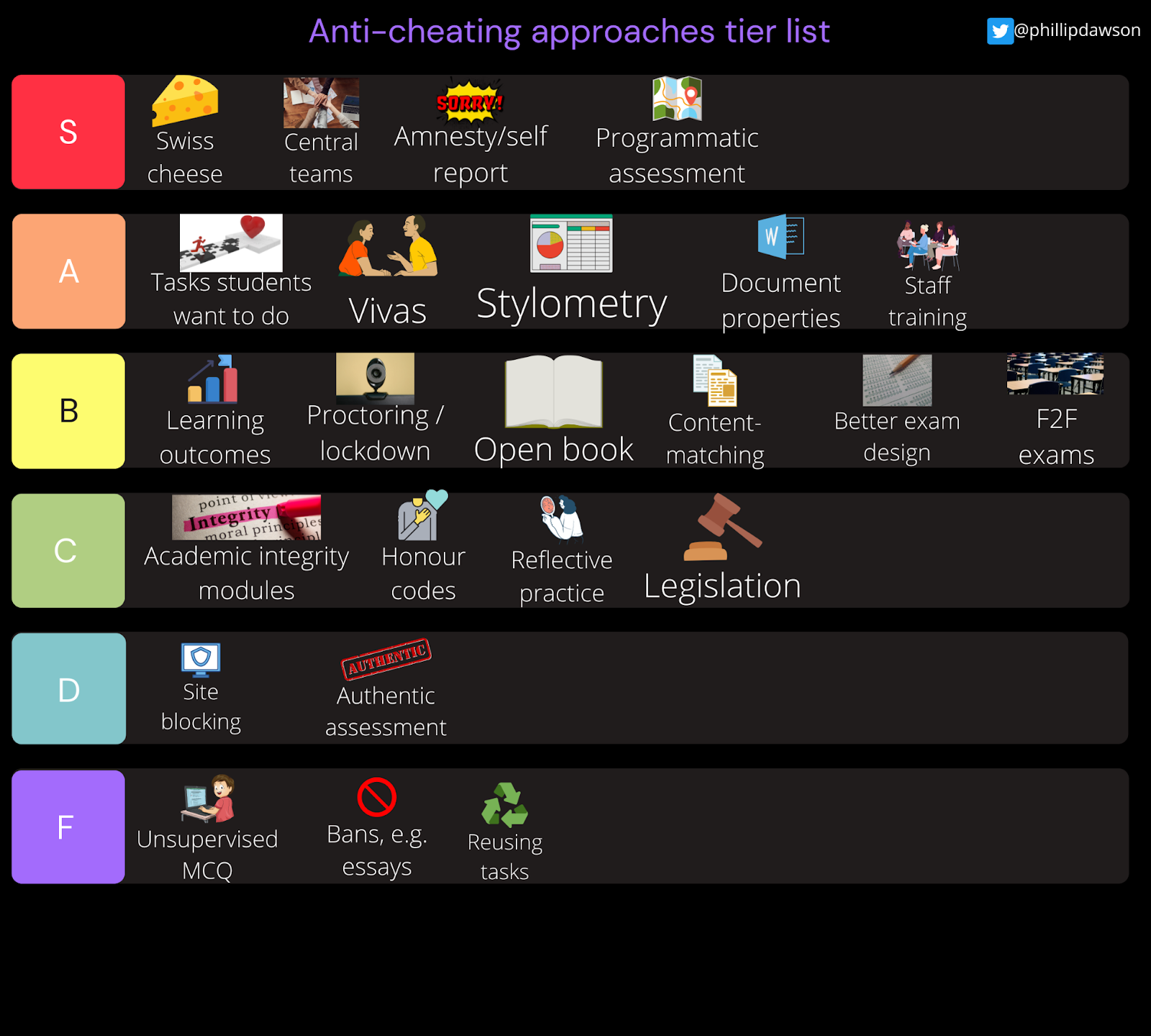
I research what sorts of interventions we can do to address cheating within the everyday higher education situation we are in now. For my keynote at the Higher Education Research & Development Society of Australasia (HERDSA) conference this year I ranked different approaches to addressing cheating. I used the genre of a tier list to do so. Tier lists are used to show how good some ideas/interventions/albums/animals/foods are compared to others. Here’s my completed tier list for anti-cheating approaches:

The first thing to look at are the tiers: S, A, B, C, D, and F. The S-tier is where the most effective anti-cheating approaches live. Why ‘S’? That’s difficult to answer, and a fun rabbit hole to go down, but suffice to say that S is where the most effective approaches are, and F is where the least effective approaches are.

What’s on the tiers and why?

S-tier

Swiss cheese: the layering of multiple different anti-cheating interventions can be more effective than just one intervention

Central teams: dealing with cheating is an expert practice – its own job title these days – so concentrate those experts together and resource them well so they can take the load off everyday academics

Amnesty/self-report: rather than treating every case of cheating through an adversarial pseudo-legal process, we should also allow students to come forward and say “I’ve done something wrong and I’d like to make it right”

Programmatic assessment: zooming out from trying to stop cheating in every individual act of assessment, and instead thinking: how do we secure the degree as a whole from cheating?

A-tier

Tasks students want to do: the rather obvious idea that students might cheat less in tasks they actually want to do

Vivas: having discussions with students about their work can be a great way to understand if they actually did it themselves

Stylometry: a range of emerging technologies that can compare student assignments with their previous work to see if they were likely all written by the same person (hopefully the student)

Document properties: people who investigate cheating cases look for all sorts of signals in document metadata that I don’t want to reveal here – but trust me, they are very useful evidence

Staff training: dealing with cheating is something we can get better at with training, for example, our research has found that people can get more accurate at detecting contract cheating with training

B-Tier

Learning outcomes: think carefully about the outcomes being assessed, and maybe don’t try to assess lower-level outcomes if you don’t need to as they are harder to secure

Proctoring/lockdown: there is strong evidence students score worse grades in remote proctored tests vs unsupervised online tests, which probably means they cheat less – but this needs to be balanced against privacy, surveillance and other concerns

Open book: if you make an exam open book you no longer need to stop people from bringing their notes in, eliminating a type of cheating (and often making for a better exam)

Content-matching: like it or hate it, the introduction of text-matching tools put a big dent on copy-paste plagiarism – though there are concerns around intellectual property and the algorithmization of integrity

Better exam design: a grab bag of clever tricks test designers use that I can’t explain in a sentence but trust me if you do tests you should look it up

Face-to-face exams: these are ok, not great, and likely the site of more cheating than we think, but if you need to assess lower-level learning outcomes they are solid B-tier material

C-tier

Academic integrity modules: yes it’s important we teach students about integrity, but does anybody have evidence it actually reduces rates of cheating? (the answer is no as far as I know)

Honour codes: popular in Northern America, these require students to sign a document saying that they know what cheating and integrity are and that they’ll do the right thing… the problem is that their effects on cheating are quite small

Reflective practice: reflection matters but I’ve heard from a friend that apparently people lie and embellish a lot in these tasks (but of course I’ve never done that)

Legislation: laws that ban cheating sound like a good idea, and they might have some symbolic value, but despite being around since the 70s in some contexts there is no evidence they work (and some evidence they don’t work)

D-tier

Site blocking: while it sounds like a good idea to block access to cheating websites, the problem is that these blocks are super-easy to circumvent for students, and if they also block educators from accessing sites they can be counter-productive

Authentic assessment: I LOVE AUTHENTIC ASSESSMENT AND IT SHOULD BE THE DEFAULT MODE OF ASSESSMENT (ok with that out of the way, let me be controversial: there’s just no evidence authentic assessment has effects at reducing rates of cheating, and there is evidence of industrial-scale cheating in authentic assessment)

F-tier

Unsupervised multiple-choice questions: just don’t use these for high-stakes summative assessment; they are just the site of so much cheating/collusion (but do use them for formative tasks!)

Bans: there was talk about banning essays because they would stop essay mills and somehow miraculously stop cheating… the problem is that contract cheating sites don’t just make essays

Reusing tasks: thanks to sites like Chegg, once an assessment has been set you can assume the question and the answers are public knowledge (do click that Chegg link if you want to cry)

That’s where I’d put things on the list – what about you? If you’d like to revise the list, it’s available as a template on Canva (free account required).

Professor Phillip (Phill) Dawson is the Associate Director of the Centre for Research in Assessment and Digital Learning (CRADLE) at Deakin University. His two latest books are Defending Assessment Security in a Digital World: Preventing E-Cheating and Supporting Academic Integrity in Higher Education (Routledge, 2021) and the co-edited volume Re-imagining University Assessment in a Digital World (Springer, 2020). Phill’s work on cheating is part of his broader research into assessment, which includes work on assessment design and feedback. In his spare time Phill performs improv comedy and produces the academia-themed comedy show The Peer Revue.

O’Shea: All I want for higher education now and tomorrow

Fresh from delivering a widely-applauded keynote at this year’s HERDSA conference, Fragility or tenacity? Equity and participation in the pandemic university (read it, it’s fantastic), Professor Sarah O’Shea of the National Centre of Student Equity in Higher Education at Curtin University shares her hopes and visions for the sector’s future.

My first face-to-face conference in over two years has given me pause to consider the many changes and challenges the university sector has encountered in the last years. The onset of the pandemic both exacerbated existing issues within the sector as well as revealing a whole gamut of new complexities related to funding sources, precarity of employment and systemic injustices for equity-bearing students. 

We are not yet post-pandemic and there are many things  the onset of the health crisis has revealed. It showed us COVID was never simply a health issue but required a much broader social response. 

Indeed, key to how we emerge from the pandemic will be our education systems, particularly the higher education setting. With this in mind I offer a personal wish list of changes needed in the system, to better serve the students and staff therein:

  • Linked to the previous point is the need to revisit the removal of Commonwealth financial support for those students who do not manage to maintain ‘an overall pass rate of 50 per cent’ across their studies (DESE, 2021). We know that many students from equity backgrounds may initially fail some subjects as they navigate the university system but still go on to succeed academically. Pedagogically, failing can often result in key points of learning and students should never be penalised financially as a result.
  • Recent research has indicated the high cost of ‘investment’ universities make to support and retain the equity student cohort. These costs are often borne by those institutions located in regional areas or who have committed to a mission to open up educational pathways for disadvantaged communities. Such work is laudable and deserves to be funded in ways that recognise the variable nature of investment required in different communities and locations.
  • The precarity of academic employment has always existed but its visibility and impact has become more visible since the onset of COVID-19. I hazard a guess that most of the readers would know of colleagues who have either not had a contract renewed or have been ‘restructured’ out of the organisation. A recent report has highlighted how tertiary education topped national job losses (39%) across Australia, but again, if Australia is to navigate its way out of the current health situation then securing and rewarding university staff is a requisite need moving forward.
  • Finally and fundamentally the current ‘business model’ of the university sector needs to be challenged and revised. The level of public investment in the sector has declined to just 52% of university revenue, which has led to an untenable funding model characterised by an over-reliance on international student fees derived largely from two markets (China and India), a situation identified as problematic even by the Tertiary Education Quality Standards Agency (TEQSA) 

COVID has irrevocably disrupted the existing and accepted business model of higher education, but embracing this disruption will ultimately assist in reimagining this system. Identifying and addressing the enduring and emerging pressure points in the system, provides an opportunity to strengthen the resilience of Australian education systems. We know developing robust and inclusive higher education environments will be key to adapting to new and unforeseen challenges in the future. This is challenging work but  confronting the deficiencies of the current system will ultimately enable us to ‘build back better’.

Sarah O’Shea is a Professor and Director of the National Centre of Student Equity in Higher Education at Curtin University. Sarah has over 25 years experience teaching in universities as well as the VET and Adult Education sector, she has also published widely on issues related to educational access and equity.

What I learned from my first year of teaching

“Ring the bells that can still ring, 

Forget your perfect offering.

There is a crack, a crack in everything, 

That’s how the light gets in”.*

Trauma walks to its own beat. As with adults, children and young people who have experienced trauma, or any other adverse experiences often seem to have a different rhythm than children of a similar age. This is because of the way their sensory system makes meaning of the information around them, the information they see, hear, touch, taste, or smell. I recall one of my students, on a school excursion, responding in horror when we walked into the education room. He pointed to a corner of the ceiling and called out, “they are coming…with big horns on them”. His distress so intense, I took him outside until he felt safe and settled. We then returned to our school; he was too distressed to join the rest of the group. No-one suggested another possibility for him to participate in the event. He was excluded.

My first-year teaching in a program for children with disabilities, was filled with experiences like this. It became apparent that all of my assumptions about children, about language, about the very meaning of the objects and situations around me, belonged only to me. The children in my class had other ways of communicating, of seeinging and of understanding the world that was uniquely their own. A uniqueness many schools interpreted as a problem, a “developmental delay”. A perspective, I found only expressed what my students were not yet able to do compared to other children. A perspective supporting the existence of two school systems in Australia, schools for specific purposes (SSP’s) and schools for everybody else.

Last week the disability royal commission heard about the experience of students and their families in both school settings. Despite the legal right of students with a disability to a free education, “on the same basis” as students without a disability, SSP’s appear to be increasing. A phenomenon that is at odds with the overwhelming research in support of inclusive education. Research that outlines how education can be accessible for all.

Education that is accessible for all is not about changing students. It does not problematize students by attempting to (as I did in my early career) correct their differences, their differences in language, communication, the differences in their literacy, numeracy, or the differences in the way they played. It should not be about “getting children ready for big school”, and attempting to shape them into a size to fit a school for which they had never been considered.

It is an approach, as one mother told the disability royal comission, “that will never work”.

Or until we learn to do otherwise. About a year into my teaching, I was introduced to AMICI Dance Theatre at an Orff Schulwerk Conference in Sydney. Wolfgang Stange, the artistic director led us through a series of workshops that for my thinking and teaching were transformational. At the heart of his practice, was a belief in the contribution of everyone to dance, a unique contribution that should be valued and recognized. It was an approach that challenged the notion that there was only one way to do things and explored the possibilities of many, including those dependent on spoken language.

I danced back to my classroom with not only a range of approaches and strategies for children to express their ideas, make choices and reveal themselves in a way that was uniquely their own. I had been given a way “to see” the children and everything that they were doing, a complete contrast to the view of everything they were not. Now the light was getting in.

A light that gave me the permission to bring my knowledge of theatre, drama, and puppetry into the classroom. The puppets helped me not only to “see” but to “listen” to the children. To discover their interests, their strengths and how much they could contribute to their learning at “big school”. I wondered how much “big school” would contribute to them. 

Twenty years later, I am still wondering, wondering if children and young people, walking to their own beat will belong in all our schools.  Testimonies by children, families and young people at the Disability Royal Comission speak of their experience of being excluded. My research told the story of how puppets and the creative arts could bring about alternative ways of teaching and connecting with ALL children. To remove the barriers to communication and self expression through the object of the puppet was a revelation and one that allowed the children and I to learn together, to see our differences and embrace them. 

Teaching is problematic. It asks that teachers be responsive, be reflexive and embrace the idea that every day is not the same and that every child is unique. To let the light shine in.

Olivia Karaolis teaches across the School of Education and Social Work at Sydney University. She completed her research at USYD after working in the United States in the field of Early Childhood Education and Special Education. Her focus has been on creating inclusive communities through the framework of the creative arts.