
AARE blog

Why performance pay will never fix the disastrous teaching crisis

The NSW teaching profession is currently in crisis. However, recent education reform announcements to address the crisis miss the mark. Teacher workloads have reached unsustainable levels. Our survey research of over 18,000 NSW public sector teachers showed that teachers are now working an average of 55 hours per week. Increased data collection requirements, constant curriculum and policy changes, and more complex student needs have contributed to this.

Most teachers responding to the survey (91%) reported that administrative demands impacted their core work of teaching. Teachers coped with the challenges of this significant administrative load by working longer hours.

Findings from an Independent Inquiry into the NSW Teaching Profession chaired by Emeritus Professor Geoff Gallop released in February 2021 found that, in recent decades, there had been a significant increase in the volume and complexity of teachers’ work. But there was a decline in the relative position of teacher salaries compared to that of other professions. Meanwhile the state is facing a worsening teacher shortage which is only contributing to workload problems. 

Stalling award negotiations over issues of pay and workload have triggered months of industrial unrest in the state’s education system.

Is performance pay the answer?

In a bid to ‘modernise’ the state’s education system, Premier Dominic Perrottet recently announced proposed changes to NSW school education. This suite of changes would introduce performance-based pay for teachers, which it is claimed will ‘excel and drive better results for kids’, reduce the amount of administrative work that teachers do, and change school hours.

Under current pay arrangements, teachers typically receive pay increases based on their length of service in the profession and attainment of professional standards. However, salary growth for teachers slows over time

While details of the Premier’s plan for performance-based pay are not yet known, discussions around linking pay to teachers’ performance in Australia – and worldwide – are not new

Performance-based pay schemes have been introduced in countries like the USA – such as President Bush’s Teacher Incentive Fund for states and school districts that chose to introduce merit pay schemes – as well others like China, England, Sweden and Singapore. In Australia, there has also been a long discussion about revitalising teacher pay schemes to attract and retain the best teachers in the profession. Just 5 years ago, measures to pay teachers for performance were also announced by Simon Birmingham as Federal Minister for Education.

Proponents of performance pay commonly argue that it is fairer to reward high-performing teachers than pay all teachers equally, that it motivates teachers, and raises the quality and accountability of teachers. But the weight of evidence to support performance-based pay is lacking. Experts in this area argue that it creates competition between teachers, negatively impacts teacher collegiality, and creates a culture of fear and isolation rather than growth and collaboration in schools. Evaluating teachers’ performance is also highly complex. 

Those against performance-based pay argue that it is difficult to quantify success in a classroom because there are so many elements to it. Scholars have noted how any single measure, such as measurement of student achievement on standardised tests, cannot be a reliable basis for making performance-related decisions about the efforts of individual teachers. Context is also important. Evidence also shows that such schemes are not effective in improving student achievement. At the heart is also a broader conversation about the need for education reform to move away from a focus on performativity and narrow accountability measures.

The Independent Inquiry into the NSW Teaching Profession – with expert witnesses and over 1000 submissions from teachers and schools – also didn’t recommend performance-based pay as a solution to the complex issues urgently facing the teaching profession. 

The solutions to the teaching crisis are clear

A wealth of evidence is clear about the solutions needed to address the multiple crises facing the NSW teaching profession. Conversations about performance-based pay detract from the real issues facing the profession. We’ve written previously that there appears to be a disconnect between teacher workforces across Australia and the policymakers with power over their conditions. Through imposing a new, divisive pay scheme, the Premier reinforces rather than removes these divisions. 

Dominic Perrottet has stated he wants to be known as the ‘Education Premier’, but this will require deeper, more effective steps and genuine engagement with teachers.

The frustration of teachers around issues of pay, workload and shortages has boiled over into industrial unrest since late 2021. It was recently announced by the state teachers’ union that NSW state teachers would participate in another 24-hour strike on 30 June. What is different from earlier strike action is that Catholic school teachers will join them. The last time both unions took joint action was over 25 years ago in 1996 when John Aquilina was NSW Minister for Education. This signals problems in the NSW teaching profession are spreading deep and broad.

Meaningful reform in education should be focused on listening to and supporting teachers, giving teachers the time to collaborate with others, reducing unnecessary administrative burdens, ensuring salaries are competitive, addressing the worsening teacher shortage, and appreciating the integral and vital role that teachers play in our communities and for society.

Mihajla Gavin is a lecturer in the Business School at the University of Technology Sydney, and has worked as a senior officer in the public sector in Australia across various workplace relations advisory, policy and project roles. Mihajla’s research is concerned with analysing the response of teacher unions to neoliberal education reform that has affected teachers’ conditions of work. Mihajla is on Twitter @Mihajla_Gavin

Susan McGrath-Champ is Professor in the Work and Organisational Studies Discipline at the University of Sydney Business School, Australia. Her research includes the geographical aspects of the world of work, employment relations and international human resource management. Recent studies include those of school teachers’ work and working conditions.

What we should all know about authentic inclusive classrooms

Kids with learning and behavioural difficulties couldn’t possibly tell us anything about quality teaching… could they?

Anti-inclusion sentiment has reached fever pitch following the most recent Hearing of the Disability Royal Commission; one that aimed to hear both sides of a so-called “binary” debate.

If folks were hoping the hearing would prove that it’s all unicorns and rainbows in special schools, they would have been disappointed. 

Former students and distraught parents enumerated the many ways respective school systems had failed them, both when students were in mainstream schools and when they were in or had moved to a special school.

There have been dark mutterings in various fora since the Hearing. Frustratingly, but as usual, those mutterings have conflated mainstreaming with inclusive education. 

Advocates of the latter are being framed as dangerous ideologues who are arguing for the impossible, especially when it comes to students with challenging behaviour.

So, what is this ‘impossible’?

The goal of inclusive education is to reform schooling, such that all schools are capable of including all students, especially those with a disability. 

The goal is not simply to move students with disability from segregated settings to mainstream schools. That’s integration (or what used to be called mainstreaming). Integration is what is currently happening in most schools, and we learned waaaay back in the 1970s that it doesn’t work.

Inclusive education is different. It is also a human right under Article 24 of the United Nations Convention on the Rights of Persons with Disability (CRPD). The Australian government ratified the CRPD in 2008, which means that it agrees to be held legally accountable to its terms.

After a decade of relative inaction that the CRPD Committee correctly surmised was influenced by confusion as to what inclusive education really is, inclusion was defined in General Comment No. 4, as:

“…a process of systemic reform embodying changes and modifications in content, teaching methods, approaches, structures and strategies in education to overcome barriers with a vision serving to provide all students of the relevant age range with an equitable and participatory learning experience”.

To make this right a reality, we need to seriously lift the quality of teaching in everyday classrooms. We need to move it from integration (which GC4 also defines) to genuine inclusion.

We can’t do it by using existing pedagogical frameworks and measures because—like the idea of balanced literacy—the approach is skewed towards a perceived majority, ergo “the mainstream”, and is based on what has been shown to work with them. 

Assessing quality teaching 

What happens when you flip from teaching to reach most to teaching to reach all? What does that add to existing conceptions of quality teaching? 

Can teaching even be considered to be quality, if it fails to reach all students? Do students with disability need something different that the average student doesn’t need or do they need something better

We wanted to know, so we went to the students that few people think have anything to offer by way of insight into teaching and learning, and we asked them.

They weren’t hard to find. We were already working in complex secondary schools serving disadvantaged communities; schools with higher than average suspensions, high numbers of teachers on contract, schools where the quality of teaching matters most to kids’ lives. 

We pointed to the Positive Behaviour for Learning triangle and asked the school leadership teams from each school to nominate the kids in the “red pointy end”. The ones with a long record of behaviour incidents, especially involving conflict with teachers. Kids who have familiarised themselves with the principal’s office, who may have been previously suspended or excluded and who, when they weren’t truanting, were generally not engaging and not learning.  

The leadership in these schools had no trouble identifying them.

We ended up with a Brains Trust comprising 50 pointy end kids across Grades 7 to 10. We asked them lots of questions. About school, whether they liked it, what they did and didn’t like about it, when they started disliking it, what they typically get in trouble for, about conflict with teachers, and even what they think they’d be like as a teacher! 

Around the middle of the interview we asked them “What makes an excellent teacher?” 

They were free to say whatever they liked and our job was to make sense of those responses.

The idea for our new paper on the quality of teaching necessary for the inclusion of these students formed when we were conducting the interviews because it became clear very quickly that there was a strong pattern in the responses. 

Kids talked differently in response to this question than they did our questions about teachers they got along with (or didn’t). They did not—in the main, for this specific question—refer to teachers they liked, they talked about teachers who taught well

More than just teaching well, these kids from the pointy end of the behaviour support triangle who some people think have nothing of value to add, described practices that help them to learn.

What did they say about excellence in teaching?

Our 50 participants generated 90 statements that we coded into four categories. Three were based on the domains of teaching quality described in the Classroom Assessment Scoring System, “emotional support”, “classroom organisation”, and “instructional support”. Because there is strong popular belief that these kids want ‘fun’ and ‘funny’ teachers, we added a fourth category, “temperament/personality”.

Only 16.1% of statements related to teachers’ temperament or personality. Importantly, while students said that they appreciate teachers who are bubbly, fun, and good-natured, they clarified that excellent teachers still make sure that students are learning. 

“Just have a bit of fun in the classroom but still on task and that type of stuff” (Grade 10, School A).

A slightly higher percentage of statements (18.3%) related to classroom organisation. Students told us that excellent teachers kept them on the ball but were fair and kind in how they did it. 

“Mr V. He cares for basically the whole school. He gives us reasonable detentions and gives us fitness if we don’t do what he says, and he’s just a very nice teacher” (Grade 8, School A).

Almost one quarter (24.7%) of students’ statements related to emotional support: the positive climate that teachers fostered in their classrooms, teachers’ sensitivity to their students, and their responsiveness to student perspectives. 

“…their understanding and their kindness… if you get a teacher like that, then you automatically you feel safe, so you’re like, “Okay, well I can learn with this teacher. I know that they’re going to help me and understand me” (Grade 9, School D).

The majority of statements (40.9%) fell into the instructional support domain which is sometimes referred to as ‘cognitive activation’. This domain includes practices that scaffold and support and extend intellectual demand, such as feedback, modelling and explicit teaching.

One student talked about how this prevented student-teacher conflict: 

“It’s like he always like stops fights before they happen. He like – so like say that a student doesn’t get it he stops and like he explains it like multiple times until like the person actually gets it and does demonstrations, get the students up there. Like the students that don’t get it and gets them to do it, so they get it” (Grade 9, School A).

Other students said excellent teachers were those who checked in with students to make sure they had understood and who then clarified if they didn’t. 

“They explain everything, they take time out of the lesson to ensure you’re okay and see if you’re on track and always supportive and even if you’re not normal, they support you no matter what” (Grade 9, School D).

A really important finding from our work with these students is that they do not need something that other students don’t need. They just need quality teaching to be accessible.

We also concluded that existing pedagogical frameworks and measures of quality teaching do not emphasise accessibility, and nor do they go to the granularity necessary to help teachers produce a level of quality teaching that is good enough for these students.

So what now?

This work is informing the Accessible Assessment ARC Linkage project, now in its second year. 

From the 400-plus Grade 10 students participating in this Linkage, we have identified a subgroup of 63 with identified language and/or attentional difficulties. In student interviews, we are checking their views on teaching excellence.

This time we have provided a matrix describing the four categories above and have asked students to select which element is most important to them.

When presented with the matrix, students have ruminated, “Well, they’re all important but if I had to say most, I’d say…”

Instructional support, which we have described as teachers helping students to learn by explaining things well and providing examples, still came in first (42%). 

The pattern shifted slightly after that with just over a quarter (27%) choosing temperament and personality. Emotional support came in third with 19% of responses, and classroom organisation came in last (13%). 

The schools that we are now working in are not as complex as our previous high schools and this may explain the change in pattern. Overall however, the students we are working with say the same thing: they need accessible quality teaching and they rate the teachers who strive to provide them with it.

Although we are yet to crunch the masses of data being produced in this project, we are already seeing benefits from our work with these students’ teachers.

In an interview last week, both interviewer (Graham) and teacher (who we’ll call “Miss Maudie”) were in tears as Miss Maudie described what the various refinements to her practice, that we proposed during this term’s program of learning, had achieved. 

In doing she talked about “Patrick”, a “solid D” student who had finally made it to a C-. More than the grade though, for Miss Maudie, the positive impact came from the fact that Patrick had for the first time really engaged and that he believed he could achieve the task being set.

We want many more Patricks and Miss Maudies to feel like this, rather than how our original pointy end kids and their teachers did. 

We have a lot more work to do but the revolution has started. And it isn’t going away.

From left to right: Linda J. Graham is Director of The Centre for Inclusive Education (C4IE) in the Faculty of Creative Industries, Education and Social Justice at Queensland University of Technology (QUT). Her research focuses on responses to students experiencing difficulties in school and with learning. Ms Haley Tancredi is a PhD candidate on the Accessible Assessment ARC Linkage project, investigating the impact of accessible teaching practices on the engagement, experiences and outcomes of students with language and/or attentional difficulties. She is also a senior research assistant within C4IE. Dr Jenna Gillett-Swan is an Associate Professor and researcher in the Faculty of CI, Education, and Social Justice at QUT. Her research focuses on wellbeing, rights, voice, inclusion, and participation.

We refuse to value care – why sexism is at the core of our early childhood crisis

Introduction: The old, old problem

The introduction of an extra year of education for three and four-year olds in New South Wales (by 2030) and Victoria (by 2025) is an ambitious initiative. Articles in response argue that promises to boost provision may be difficult to deliver. Australia already has a problem filling existing positions in childcare.

Yet the commentary frequently glosses over the fundamental cause of these workforce problems. It’s sexism. Discrimination based on stereotypical understandings about gender. That old, old problem that is ever present, even in these post #metoo days, in which society has awakened to #everydaysexism.

Of course, pay, conditions and turnover affect recruitment and retention in the sector. But without naming and addressing the gender inequalities underpinning these issues, they will not be adequately addressed.

Working in a feminised profession

So what’s going on? Education in Australia (as in the UK and Canada) is a feminised profession.

This means both that women do most of the work, especially at lower pay levels, and that it is perceived as “women’s work”. The majority of teachers, at all levels of education from early years to tertiary, are women. In Australian early childhood education, women make up 96% of the workforce.

Feminist theorist Professor Madeleine Grumet has pointed out the relationship between nurturing at home and at school. Devaluing of women’s work at home (and indeed that of all those who act as carers in our society) is echoed in the devaluing of teachers’ work. In early childhood education these are closely interwoven, and it is therefore undermined as ‘child care’ or ‘glorified baby sitting’. Children themselves are also devalued and dismissed as not worthy until they become “fully formed”, idealised adults.

Caring for children, therefore, is “abjectified”. It is pushed beyond the boundaries of what is recognised and rewarded by society. Caring for children involves snot and poo, dribble, phlegm, sweat, tears, glue, mud, paint, food, vomit, crouching on the floor, carrying heavy bodies, tirelessly comforting, calming, encouraging and supporting. It is also rewarding, tender, exhilarating, creative, loving, funny and inspirational.

The gender binary’s impacts

Many feminist researchers believe that society is organised by a gender binary that privileges what is perceived as masculine over what is perceived as feminine. So the “masculine”, or what is serious, scientific, rigorous, rational, measurable, finite, cleanly defined, standardised, programmable, instrumental and technical is valued above the messy, woolly, grubby world of the so-called “feminine”.

This binary operates at countless levels, in countless ways, to keep the hierarchical status quo in place. Misogyny, the hatred of women, and mysopedy, the hatred of children, are at the heart of a larger system that refuses to value caring. This binary’s stereotypes and assumptions also discriminate against male educators working in the sector.

Early childhood teachers are discriminated against, paid low wages and employed under poor conditions because of the gendered nature of their work. This sexism feeds into the discrimination faced by all primary carers, because undermining the quality and extent of “childcare” affects participation in the workforce more generally. We argue that to change early childhood education, the sexism at its heart needs to be openly named, critiqued and challenged.

What can be done?

So… how to go about this, and ultimately, to make the profession more attractive to all, including those of all genders, colours, abilities, class backgrounds and ages? At the most basic level, researchers, the media, policymakers and politicians need to start naming sexism as the basis for the challenges faced by the early childhood sector.

The labour of workers in this sector is never gender-neutral, but always caught up in societal judgements based on its alliance with child-bearing and rearing in the home. We need to stop pretending these challenges are about early childhood education as a career being rejected simply as “boring”, low-paid or hard work.

Nothing less than a paradigm shift is necessary. If the early years are the most vital years of education, in which children develop at an astonishing rate, then we need investment that places these years at the top of any hierarchy.

Instead of valuing a medical paradigm in education, where being efficient, scientific and  “clinical” are revered, we need to value what is culturally considered to be more feminine. We might ask, “Are there kindergarten surgeons, who model their practice on the patience, kindness and empathy of early childhood teachers?” Flipping a scenario is often a handy way to expose the gender stereotypes and power asymmetries that underpin it.

Conclusion: Reinvention needs both imagination… and funding

Raising the status of early childhood teachers, paying them more, restructuring their work to acknowledge its intensity and toll, creating and rewarding career progression, making early years programs permeable with local communities, creating vibrant, accessible and well-resourced professional learning environments, enhancing early childhood teacher preparation, incentivising transfer for those in other careers, funding vitally needed research… there is no shortage of ideas for where money can be spent.

Whether there is the courage and honesty to address the real problem at the heart of early childhood education is another matter.

Dr Lucinda McKnight is an Australian Research Council (ARC) Discovery Early Career Research Award (DECRA) Fellow in the REDI (Research for Educational Impact) Centre at Deakin University. She uses a range of feminist theories in her work on teacher autonomy and professionalism. She is also a mother of two children and has spent many hours caring for children at home, and providing community support in early childhood education as a parent helper. Follow her Teaching Digital Writing project blog or her twitter account @lucindamcknight8

Dr Natalie Robertson is a Senior Lecturer in Early Childhood Education at Deakin University. During her time working as an early childhood teacher, she developed a strong interest in workforce issues and play-based learning. These interests have followed Natalie into her later research and work in initial teacher education.  Natalie’s focus on workforce issues has framed her professional and research interests towards the attraction and retention of teachers in early childhood education. She is currently working with the Victorian Department of Education and Training to deliver the Early Childhood Professional Practice Partnerships (ECPPP) project) and the Innovate ITE program: Accelerated Bachelor of Early Childhood Education.

It’s one thing to extend preschool. But where is the supply of the remarkable teachers we need?

Rachael Hedger on early childhood reform: implications for our children, the sector, and the economy.

This week, Victoria and New South Wales jointly announced a universal preschool year for all 4-year-old children, offering 30-hours of fully subsided ‘pre-prep’ or ‘pre-kindergarten’. Victoria plans to implement this change from 2025 whilst NSW will begin from 2030.

This announcement demonstrates a significant investment in families and young children, improving workforce participation for mothers, and therefore providing a substantial boost to the economy.

The news is music to the ears of the Early Childhood sector who have advocated for the importance of early learning for decades. The Thrive by Five Campaign, part of the Minderoo Foundation, have advocated for equal and early access to early learning to politicians and the government for some time now. Whilst parents may have concerns about putting their child into an Early Years setting for 5-days per week, at this stage, the opportunity is optional. As the people who know their child best, parents have agency here as to whether they take up the offer, considering what will work best for them within their own family dynamic.

Whilst it’s great to have Commonwealth and State level government support, this initiative is not without its complexities.

A key consideration in these early stages is whether these States have the infrastructure needed to uphold this promise. As it stands, there will be considerable issues in rural and remote areas, with 44% of regional families and 85% of remote families living in a ‘childcare desert’.

Australia’s disadvantaged children have a lot to gain from regular preschool attendance. AEDC data reveals that children in the poorest areas of Australia are three times more likely to demonstrate developmental vulnerability than children in wealthier areas. Universal access could help reduce this statistic. However, attendance alone is not enough to close the equity gap. These children need high-quality, accessible, play-based opportunities provided by knowledgeable and experienced educators.

Crucial to effective Early Childhood education is a rich, play-based program of teaching and learning. The first five years is when a child’s brain develops the most. These years are vital for setting the foundation for life-long learning and children’s ability to form meaningful relationships. It is through play that children engage and interact with the world around them developing creativity, imagination, problem solving, and social and emotional skills. To facilitate valuable play opportunities for children, they need educators who understand the theories that underpin effective play pedagogies. We need educators who are specially trained to support, guide and care for children successfully.

The most significant matter in implementing this reform will be the distinct lack of Early Childhood educators across the sector. Before the announcement on Wednesday, there were an estimated 6000 vacancies for educators in birth-5 settings, with a predicted 39,000 educators needed by 2023. The reform will be directly dependent on a strong Education and Care Workforce Strategy that recruits and retains Early Childhood educators. At present, the lower-than-average pay and conditions results in huge staff turnover as they leave the sector to look for more prosperous opportunities. This greatly impacts children’s learning as they cannot establish and build meaningful, positive relationships with a consistent caregiver.

Working with young children is a rewarding profession. To see children flourish and grow on a daily basis is a beautiful experience. Simultaneously, it is hard work. To care for young children’s needs involves feeding, cleaning and toileting, keeping them safe at all times. To educate young children involves observing, assessing and documenting their learning, preparing resources and the learning environment, and maintaining relationships with families. It involves engaging in play opportunities, extending children’s thinking through questioning and conversation, encouraging new language, and supporting children’s physical, social and emotional development. Few people understand the complexities of balancing the differing demands of this role. Childcare is often seen as only child-care, and this is perhaps why it is underrated and undervalued. An Education and Care Workforce Strategy would need to attract, retain, value and appropriately pay educators for the vital work that they do with young children.

Accompanying the announcement this week, there was mention of incentives to encourage the uptake of Early Childhood Education degrees. Some Eastern universities are looking to offer fast-tracked degrees ranging from 3-years to as little as 18-months. Many will provide up to a year of credit for Certificate III and Diploma qualified applicants, shortening their study time considerably. This approach questions the quality of the Early Childhood educators that we look to produce. If governments invest billions of dollars into the sector only to staff it with employees that have not been adequately educated, we defeat the purpose of what we’ve set out to achieve; quality education for our young children. Teaching is an art form. It takes time and commitment to understand how children learn, the theories that underpin practice, and experience in how to effectively educate Australia’s diverse children. Rushing educators through an Early Childhood education degree will not deliver quality outcomes and would be a disservice to our children.

The reform announcement this week is long overdue and should be celebrated. It is a guaranteed boost for the economy and offers more choice for working parents, but we should tread with caution from here. The biggest and best investment that we can make is in our youngest citizens. They are our future. Australia is beginning to put the economy where it belongs – in our children’s hands.

The main question now is if, or when, will the other States follow?

Rachael Hedger is a Lecturer in Early Childhood Education and Course Coordinator for the Early Childhood Initial Teacher Education degrees at Flinders University. She is undertaking a PhD (Deakin University) in which she explores on how arts-based practices can support children’s science learning. Her research interests focus on how drawing can be used as a vehicle for exploring science concepts, focussing on process and exploration. She is a supporter of learning through play pedagogies and encouraging pre-service teachers to be advocates for young children’s learning. 

Why kids under five must start learning to code


There’s a lot of pressure to learn coding in primary school to develop 21st century computational skills. But I think we should start in preschool.

Schools and governments recognise the need for teaching 21st century skills. We can see the evidence for that in the Australian Curriculum: Mathematics. But just as we teach preschool children the fundamentals of reading, we must now include computational thinking and coding.

While many early childhood services may have digital technologies, how they are presented and taught to young children, requires more focus and perhaps, upskilling of educators.

In my research we use cubettos. These are simple wooden square box robots with a smiley face that come with coding boards with colourful plastic pieces which make the robots move. We also uses bee-bots, small plastic bee-shaped robots with simple programming buttons on their backs, and blue-bots, clear cased bee-shaped robots that respond to commands sent from a computer or iPad.

I have been exploring how children learn to use them, and how educators support their use, as an extension to my PhD research. With 3-5 year olds, they realise that the pieces you put in the coding board, or the buttons you push, make the robots move in particular ways, and you can start explaining how they move and why they follow our commands.

Learning the basics of robotics at this age will set the foundation for primary school learning. It’s a great introduction to pre-maths, algorithms, counting and problem-solving: they learn this is the ‘recipe’ that moves the robots along.

While some early childhood education services have some robots to play with, what’s missing is the opportunity for richer learning that these devices offer.

Some educators will have a blue-bot or bee-bot and they might push the buttons to create a code for the children, but they’re not necessarily taking the next step to explaining the concept of coding.

The aim for my research is to think about the best way to equip educators to teach coding to pre-schoolers through play, for example whether it will be creating an instruction manual or workshop or something else.

Screens and play

Another aspect of technology is the use of screen technologies among the 3-5 year old age group, both real and replica or broken, which I call ‘imaginative’ technologies. Children want to use real technologies in play, but imaginative technologies are the next best thing. Children today live in a digital world and, given the opportunity, will readily use technology to meet their play needs.

Through my research, which has included interviewing 84 educators in the New England region alongside my colleague Dr Marg Rogers, I have found some educators are reluctant to incorporate real technologies into their classrooms for use by very young children.

Some educators and parents believe early use of technology will reduce their child’s creativity and imagination. Others encourage it. I have found with people holding such strong views, discussions on the subject can be a minefield.

Many services don’t provide real technology for children. They might use an iPad or camera, but it’s very controlled and directed, and the children are not given enough time with the technologies to develop skills and to learn.

The anxiety around using screens could also be further compounded and confused by current national guidelines on screen use.

National guidelines out of step

The current national guidelines recommend children under two are not exposed to any screen time. But this is really out of sync with home or modern life. So, it’s an interesting question for technology researchers like myself – do we follow the guidelines and not give technology to children? But children see technology and in their imaginative play, they want to copy what adults do.

They see people on phones, taking photos and typing on computers from an early age. How can you then have a ‘home corner’ in early childhood education centres that don’t have any of that? How many restaurants take orders on a phone or iPad? How can children re-enact what goes on in a restaurant without technology? Same with a doctor’s surgery or a supermarket. Technology is everywhere.

In a new research project, I will ask children aged 3-5 what they want in their imaginative play spaces and if they can make (out of recycled materials), what they need to in order to have an imaginative play space reflective of the real thing. For example, having iPads in a restaurant to take the orders or look up recipes. I believe real technologies also need to play a larger role in early childhood education.

And I don’t believe we can stop children accessing technologies.

I think it’s a bit disrespectful to not let children use technology in their play. How does it compute in their brains that technology is everywhere in their world, but they are not allowed to use or understand it? It must be confusing for them. I have found, educators need to support children’s technology use in positive ways. I’d like to see non screen-based coding, and iPads with select apps chosen for the learning that’s possible, including to document their own learning, in the preschool years.

Children need to learn how to use technologies and when it is appropriate to use them. Hopefully further research will help to guide the provision of technologies and guidelines for its use, support children’s ethical behaviour and reduce some of the discomfort educators and parents feel around the inclusion of working technologies in children’s lives.

Jo Bird is a senior lecturer at the University of New England, Armidale. Her PhD explored children’s use of digital technologies in imaginative play and the educators’ provision of the various devices, both working and imaginative. Her research interests include children’s play, the use of technologies by both children and educators and early childhood leadership. She loves presenting, both her research and inspiring others to use technologies in creative ways with children and to recognise their leadership worth.

How to make sure your vote really counts

Millennial voters and Australian citizens aged under 45 made up 43 percent of the voters in the 2022 federal election. Analyses show that their vote mattered in swings against the major parties and revealed just how discerning young voters can be.

But clearly, for their votes to count, and to ensure their most preferred candidate is elected, understanding how the preferential voting system works is essential. This requires civics learning, so that young people can be informed citizens, with experience of voting systems.

However, results reported in 2021, from the National Assessment Program – Civics and Citizenship (NAP-CC, 2019), conducted every three years since 2004, showed that the proportion of Australian school students with the skills and knowledge required to be active and informed citizens has not changed since 2016.

At the national level, only 38 per cent of Year 10 students, and 53 per cent of Year 6 students, attained the stated proficiency standards regarding core aspects of Australian democracy, and their roles and responsibilities as citizens. So, there is significant room for improvement in building understanding of civics and citizenship education.

The Australian Curriculum: Civics and citizenship includes developing understanding of the electoral system as part of the focus on exploring how the people, as citizens, choose their governments; how the system safeguards democracy by vesting people with civic rights and responsibilities; how laws and the legal system protect people’s rights; and how individuals and groups can influence civic life.  It also aims to develop students’ knowledge, understanding and appreciation of the values, principles, institutions and practices of Australia’s system of democratic government and law, and the role of the citizen in Australian government and society. There is a specific focus on the preferential voting systems. 

So, what is the preferential system, and how can students be engaged in effective learning about the processes involved?

The Australian Electoral Commission (AEC) explains that there are many different types of preferential voting systems in use across Australia and the world.

Some preferential voting systems make it compulsory for voters to mark a preference for all candidates on the ballot paper, whereas others require a defined number of preferences to be indicated. Australian federal elections use a preferential voting system where voters are required to:

·       mark a preference for every candidate on the green ballot paper (House of Representatives)

·       mark a preference for a designated number of preferences on the white ballot paper (Senate)

The AEC explains that the preferential voting system used for the House of Representatives provides for multiple counts of ballot papers, in order to determine who has acquired an absolute majority of the total votes (more than 50% of formal votes). During the counting process, votes are transferred between candidates according to the preferences marked by voters. 

The AEC provides multiple online, plain language resources that schools and community members can access. One document explains that at each polling place, when voting closes, officials sort all ballot papers by first preference votes, which are then counted for each candidate. Informal votes that are incorrectly filled in are identified and removed from the count. All the ‘1’ votes are counted for each candidate in an electorate. If a candidate gets more than an absolute majority – they are immediately elected. Even though they are elected, a full preference count is completed to show how the electorate voted. If no candidate has an absolute majority, the candidate with the fewest votes is excluded from the count. The votes for this candidate are then transferred to the candidate numbered ‘2’ on each of their ballot papers, the voters’ ‘second preference’. This process continues until one candidate has more than half the total formal votes cast and is then declared elected.

The National Electoral Education Centre (NEEC) at Old Parliament House in Canberra provides onsite experiential learning experiences for students visiting the national capital to engage and inform young people about voting and elections. Students meet DemocraBot and are immersed in DemocraCity, a brand new interactive virtual world, to learn about representation, enrolment, and voting and to experience the electoral process in action by running their own election in a dedicated polling place. Students vote, count the votes, and declare the election result, while taking on the roles of voters, ballot box guards, scrutineers and polling officials!

The NEEC also offers online education programs and resources for primary, secondary and adult groups.. One of these programs links learning about voting and the preferential system to Bloom’s Taxonomy of cognitive objectives that describes learning in six levels in the order of: knowledge, comprehension, application, analysis, synthesis and evaluation. Students are challenged for example to: examine why sometimes the person with the most first preference votes is not elected in a federal election; debate different systems of voting (full preferential, partial preferential, first past the post); make a flowchart to show how the preferences flowed in a real election at your school, and construct arguments for and against full preferential voting. Understanding the preferential system also requires critical thinking and knowledge about who the candidates are and their policies and standpoints on critical issues.

Voters also need to know what to do when they get to the ballot box, so the AEC provides images of the ballot papers and simple instructions about how to make sure that your ballot paper is completed properly for the House of Representatives and the Senate.

The Get Voting resource provides a step by step guide to running a mock election in a school as a hands-on way of developing understanding of the preferential systems.  As the introduction to the Democracy Rules resource says: ‘Teachers play a critical part in shaping young people’s understanding of their role as citizens and future electors. In fact, the work of the teaching profession helps to guide the democratic development of our nation’.

There is no lack of resources available to teachers to ensure that young people can build their knowledge and skills. But since Civics and Citizenship is not often a designated subject in school timetables, the challenge is for schools to ensure that they do plan multiple opportunities for students to experience and learn about voting and elections.

 Understanding the preferential system matters, so that students can be active, participatory citizens, capable of thinking about their choices and registering their vote for the candidates that they most and least prefer. But this learning should also be part of whole school approaches to Civics and Citizenship education that empower young people to have voice and agency. They should not be citizens-in-waiting, but have opportunities to be citizens now. This involves learning about and participating in critical debates about issues they are concerned about. 

Results from triple j’s What’s Up In Your World survey, conducted in May, 2022, that surveyed more than 1,600 18-29 year olds, show that young Australians are highly politically engaged, but extremely disappointed with leadership from the major parties. Only two percent believe that politicians are working in the best interests of young Australians.

Ariadne Vromen (May 30, The Conversation)  pointed out that Prime Minister Albanese wants to change the way we do politics in Australia. With a new government there is an opportunity to re-engage citizens in policy-making and politics; and this includes young people in schools.   She reported the OECD’s view that ‘when citizens are more engaged in politics and involved in decision-making, the more likely it is that good policies will result that can address critical, difficult issues. Citizens will be more invested in the outcome when they see their views are heard and acted upon’.

It’s clearly a good time for a renewed focus on civics and citizenship in schools.

Libby Tudball is an Associate Professor in the Faculty of Education, at Monash University. Her research and publications focus on teacher education and the humanities and social sciences, with a particular focus on civics and citizenship education.

We all love a good story (and you can join in)

The role of story for humankind is a given: we live storied lives. Reading rich literature is always pleasurable (and sometimes challenging). But it is much more than a source of entertainment. Quality literary texts enable us to nurture our imaginations, understand who we are and what our place might be in the world, value different perspectives, develop empathy and compassion, question, laugh, cry, wonder and help us to heal. As Olivia Fialho (2019) writes:

the purpose of literature lies in the experience itself, in its power to prompt us to connect deeply and conscientiously with our emotions, deepening our senses of who we are, what we are in this world for, and how we are in a relationship with others.

Olivia Fialho

Opportunities to share our literary reading with others helps us grow together as a rich and diverse community and enables the envisioning of alternative possibilities and different ways of knowing, doing, being and becoming. Every child and young person is entitled to easy access to a rich diversity of literature in their homes and classrooms. 

Australia is privileged to have many talented authors, artists and illustrators, designers and publishers who create high quality literature for children and young people from birth to adulthood.  Rich literature should be a foundational resource in the teaching of talking, listening, reading, writing and viewing. Unfortunately, too much emphasis on overly contrived texts in literacy learning can fail to engage and nurture early learners’ imaginations and creativities and sustain their love of reading. If we want to nurture empathy in our learners so they can understand different perspectives and explore alternative ways of doing, being and becoming, we must ensure rich literature is at the heart of every home, library and classroom.

Thirteen peak Australian professional associations, organisations, foundations and councils representing thousands of English and literacy educators and community groups have partnered to develop an online, free Literature Symposium under the umbrella of We all love a good story. Sessions include short keynotes, conversations with authors, artists, educators and young learners and panel discussions to explore the power and pleasure of literature from many perspectives. Each highlights how and why rich and imaginative literature should be a central in both homes and classrooms.

Program dates, details and a once-only registration link can be found here.

The first of these presentations launches on Wednesday 8 June and the series will conclude in mid-November. After each presentation is released, it will be available on YouTube for use by teachers, librarians, school leaders, early years educators, parents, carers, and all interested in ensuring there is rich literature in every home, preschool, classroom and library.

The organisations are: 

Australia Reads                                                    

Children’s Book Council Australia

Australian Children’s Laureate Foundation     

Indigenous Literacy Foundation 

Australian Council of TESOL Associations        

Primary English Teaching Association Australia                     

Australian Literacy Educators’ Association                                     

Australian School Libraries Association            

Reading Australia      

Australian Theatre for Young People                

Sydney Theatre Company

Foundation for Learning and Literacy               

WestWords

Robyn Ewing AM is formerly a primary teacher and currently Professor Emerita and Co- Director, Creativity in Research, Engaging the Arts, Transforming Education, Health and Wellbeing  (CREATE) Centre, University of Sydney. A former past president of ALEA and PETAA, she is Co-Convenor of the Foundation of Learning and Literacy.

Jo Padgham is currently co-convenor of the Foundation for Learning and Literacy, a former primary principal and system leader in the public education system and past vice president of the Australian Literacy Educators’ Association. Jo has been awarded ALEA Life Membership, ALEA Principal Fellow, Fellow of the Australian College of Educational Leaders, ACEL Award for Collaborative Practice and the ACT Women’s Honour Roll.

Everything you never knew you wanted to know about school funding

Book review: Waiting For Gonski: How Australia Failed its Schools, by Tom Greenwell and Chris Bonnor

With the 2022 federal election now in the rear-view mirror and a new Labor government taking office, discussions about the Education portfolio have already begun. As journalists and media commentators noted, education did not figure largely in the election campaign, notwithstanding the understandable public interest in this area. One of the enduring topics of education debates –  and the key theme of Waiting For Gonski: How Australia Failed its Schools, by Tom Greenwell and Chris Bonnor – is school funding.

It is easy, and common, to view the school funding debate as a partisan issue. Inequities in school funding are often presumed to be an extension of conservative government policies going back to the Howard government. Waiting for Gonski shows how inaccurate this perception is, and how far governments of any political persuasion have to go before true reform is achieved. 

The first part of the book is an analysis of the context that gave rise to the Review of Funding for Schooling in 2011, commonly known as the Gonski Report. Greenwell and Bonnor devote their first chapter to an overview of the policy arguments and reforms that consumed much of the 20th century, leading to the Gillard government establishing the review. This history is written in a compelling, detailed and interesting way, and contains many eye-opening revelations. For example, the parallels between the 1973 Karmel report and the 2011 Gonski version are somewhat demoralizing for those who feel that school funding reform should be attainable in our lifetimes. Secondly, the integral role that Catholic church authorities have played in the structure of funding distributions that continue to the present day is, I think, a piece of 20th century history that is very little known. Julia Gillard’s establishment of the first Gonski review is thus situated as part of a longer narrative that is as much a part of Australia’s cultural legacy as are questions around national holidays, or whether or not Australia should become a republic.

Several subsequent chapters detail the findings of the 2011 Gonski review, its reception by governments, lobby groups, and the public, and the immediate rush to build in exceptions when interest groups (particularly independent and catholic school bodies) saw they would “lose money”. The extent to which federal Labor governments are equally responsible for the inequitable state of school funding is made more and more apparent in the first half of the book. Greenwell and Bonnor sought far and wide for comments and recollections from many of the major players in this process, including politicians of both colours, commentators, lobbyists, and members of the review panel itself. This certainly shows in the rich detail and description of this section.

Rather than representing a true champion of equity and fairness, the Gonski report is painted as one built on flawed assumptions, burdened with legacies that were not properly unpacked, and marred by a multitude of compromises, designed to appease the loudest proponents of public funding for private and catholic schools. The second Gonski review, officially titled, Through Growth to Achievement: Report of The Review to Achieve Educational Excellence in Australian Schools, is given less emphasis perhaps because this second review was less about equity and funding and more about teacher quality and instructional reform – a book-length subject in itself.

Waiting for Gonski is most certainly an intriguing and entertaining read (a considerable achievement, given its fairly dry subject matter), and is highly relevant for those of us working towards educational improvements of any description in Australia. My main criticism of the book is that it tends to drag a little in the middle third. While the details of machinations between political leaders and catholic and independent school lobbyists are certainly interesting, the arguments in these middle chapters are generally repetitions from earlier chapters, with reiterated examples of specific funding inequities between schools. 

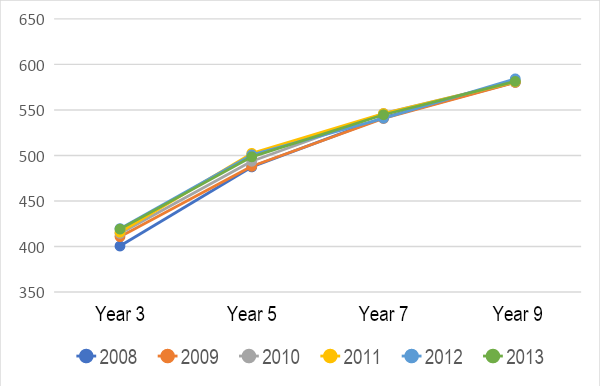
A second concern I have is the uncritical focus on Programme for International Student Assessment (PISA) data to support claims of widespread student academic failure. While it’s true that PISA shows long-term average declines in achievement amongst Australian school students, these assessments are not the only standardized tests of student achievement in this country. The National Assessment Program: Literacy and Numeracy (NAPLAN) is briefly touched upon in Chapter 8, but not emphasized. The reality is that while average student achievement on NAPLAN literacy and numeracy tests have not increased – after their initial boost between 2008 and 2009 – nor have students’ results suffered large scale declines. Figure 1 demonstrates this graphically, showing the mean scores for all cohorts who have completed four NAPLAN assessments (up until 2019).

Figure 1. Mean NAPLAN reading achievement for six cohorts in all Australian states and territories. Calendar years indicate Year 3. (Data sourced from the National Assessment Program: Results website) 

It seems somewhat disingenuous to focus so wholeheartedly on one standardized assessment regime at the expense of another to support claims that schools and students are ‘failing’. For example, in Chapter 3 the authors argue that,

 “…the second unlevel playing field [i.e. the uneven power of Australian schools to attract high performing students] is a major cause of negative peer effects and, therefore, the decline in the educational outcomes of young Australians witnessed over the course of the 21st century” (p.93) 

In my view, claims such as these are over-reach, not least because arguments of a decline in educational outcomes rely solely on PISA results. Furthermore, the notion that the scale and influence of peer effects are established facts is also not necessarily supported by the research literature. Other claims made about student achievement growth are similarly unsupported by longitudinal research. In this latter case, not because claims overinterpret existing research, rather because there is very little truly longitudinal research in Australia on patterns of basic skills development – despite the fact that NAPLAN is a tool capable of tracking achievement over time. 

Using hyperbole to reinforce a point is not a crime, of course, however the endless repetition of similar claims in the public sphere in Australia tends to reify ideas that are not always supported by empirical evidence. While these may simply be stylistic criticisms, they also throw into sharp relief the research gaps in the Australian context that could do with addressing from several angles (not just reports produced by the Australian Curriculum, Assessment and Reporting Authority [ACARA], which are liberally cited throughout).

I hope that the overabundance of detail, and the somewhat repetitive nature of the examples in this middle section of the book, don’t deter readers from the final chapter: Leveling the playing field. To the credit of Greenwell and Bonnor, rather than outline all the problems leaving readers with a sense of despair, the final chapter spells out several compelling policy options for future reform. While structures of education funding in Australia may seem intractable, the suggestions give concrete and seemingly-achievable options which would work presuming all players are equally interested in educational equity. The authors also tackle the issue of religious schools with sensitivity and candour. It is true that some parents want their children to attend religious schools. How policy can ensure that these schools don’t move further and further along the path of excluding the poorest and most disadvantaged – arguably those whom churches have the greatest mission to help – should be fully considered, without commentators tying themselves in knots over the fact that a proportion of Australia’s citizens have religious convictions.

Questions around school funding, school choice and educational outcomes are perennial topics in public debate in Australia. However, claims about funding reform should be underpinned by a good understanding of how the system actually works, and why it is like this in the first place. This is the great achievement of Greenwell and Bonnor in Waiting for Gonski. The way schools obtain government funding are obscure, to say the least, and there is a perception that private schools are not funded to the same extent as public schools. Waiting for Gonski clearly shows how wrong this idea is. As the book so powerfully argues, what Australia’s school funding system essentially does is allow children from already economically advantaged families to have access to additional educational resources via the school fee contributions these families are able to make. The book is a call to action to all of us to advocate for a rethink of the system.

Education is at the heart of public policy in many nations, not least in Australia. Waiting for Gonski is as much a cautionary tale for other nations as it is a comprehensive and insightful evaluation of what’s gone wrong in Australia, and how we might go about fixing it. 

Waiting for Gonski: How Australia Failed its Schools by Tom Greenwell & Chris Bonnor. 367pp. UNSW Press. RRP $39.99

Sally Larsen is a Lecturer in Learning, Teaching and Inclusive Education at the University of New England. Her research is in the area of reading and maths development across the primary and early secondary school years in Australia, including investigating patterns of growth in NAPLAN assessment data. She is interested in educational measurement and quantitative methods in social and educational research. You can find her on Twitter @SallyLars_27

Lazy, crazy mathematicians and other myths we need to bust

Creating opportunities for students to develop ‘healthy’ images of mathematicians and mathematics is paramount. The images of mathematics or mathematicians that students hold have a huge impact on their learning outcomes. For example, the perceived negative image of mathematicians by students could result in unhappiness in mathematics classrooms or a loathing of mathematics (Hatisaru & Murphy, 2019). 

Why is it important? Maths matters because it impacts life quality, income and national development.

Since 2009, I have aimed to understand school students’ images of mathematics and mathematicians (Hatisaru, 2020). What views do they have about mathematicians and their work? What are the connections between students’ views about mathematicians and their attitudes towards mathematics? What views do they have about the needs for mathematics? How do they perceive their mathematics classroom?

Students’ images of mathematicians and mathematics are developed throughout years and impacted by several different factors. From the investigations of myself and others it is clear that experiences in mathematics classrooms contribute to students’ perceptions. Other factors include representations in media and popular culture, and family or society related factors. 

For example, Wilson and Latterell (2001) found that in movies, literature, comics, and music mathematicians are portrayed as insane,  socially inept. Darragh (2018) too.

Ucar et al. (2010) examined the image of mathematicians held by a group of 19 elementary school students and observed that the students described mathematicians as ‘unsocial, lonely, angry, quiet who always work with numbers’. (p. 131).

Picker and Berry (2000) introduce a cycle of the perpetuation of stereotypical images of mathematics and mathematicians (for example ‘mathematicians are weird’ or ‘mathematicians are asocial people’). According to them, this cycle begins with exposition of different cultural and societal stereotypes via TV, cartoons, books, other media, also via peers and adults through negative repeating phrases. 

Among students there is a dominant male perception of mathematicians (e.g., Aguilar et al. 2016;  Picker & Berry 2000). In Picker and Berry’s study, which included participants from 5 different countries, students sometimes associated negative or aggressive behaviours to mathematicians such as being large authority figures, crazy men, or having some special power.

Darragh (2018) examined 59 young adult fiction books to identify the depiction of school mathematics in them. Mathematics was more commonly portrayedto be “nightmarish; inherently difficult; something to be avoided: …” 

“Mathematics teachers in particular bore the brunt of negative portrayals and were depicted as ridiculous, sinister, insane, and even dispensable; in short, they were positioned as villains.”

Students then meet teachers who lack awareness of stereotypes of mathematics and mathematicians, and sometimes they themselves hold certain stereotypes. Through teachers and the media, students are affected by certain attitudes such as ‘they must be quick at mathematics to be good at it’, or ‘mathematicians are a privileged group who have the special ability to do mathematics’. These messages and others, according to Picker and Berry, contribute to the formulation of the perceptions of mathematics and mathematicians in students’ minds. Jo Boaler, too, indicates that in her writings on the (important) role of holding a Growth Mindset in mathematics.

Over time, Picker and Berry continue, students develop attitudes and belief systems towards mathematics and mathematicians that may lead to generalisations or stereotypes. The cycle completes with the exchanging of students’ views with others. As a part of society, each student now contributes to others’ images of mathematicians and mathematics.

Given that some students hold negative images of mathematicians and mathematics, and their images are impacted by school-related factors, it is important that school educators are aware of student images. 

For about four years now, in my interactions with schoolteachers in several different conferences, workshops, and professional learning events, I have noticed that some teachers use the phrase ‘Since mathematicians are lazy …’ often when they introduce some ‘short-cut’ methods or procedures to their students. Once, for example, the context was solving the problem: 27 + 28 + 13 = ? The teacher’s language practice was: ‘Since mathematicians are lazy, they add 27 to 13 first, which is 40, and then add 28 which gives 68’. 

In fact, the mathematical behaviour behind this solution is ‘efficiency’ (Cirillon & Eisenmann, 2011) rather than ‘laziness’. The mentioned ‘lazy mathematicians’ know that, according to the associative property, 27 + 28 + 13 = (27 + 28) + 13 = (27 + 13) + 28. In this case, adding 27 to 13 first is a lot easier than adding 27 to 28 as 7 and 3 makes 10. 

Using this property for solving a problem such as 138 + 44 + 12 + 6 = ? makes the calculations even easier: adding 138 to 12 gives 150, and adding 44 to 6 gives 50. The sum of 150 and 50 is 200. Once again, the reason for mathematicians’ desire to use these approaches is not ‘laziness’ but their desire for ‘efficiency’. They also see mathematics as a connected body of knowledge. That is, they use the same property in solving algebra problems (e.g., 17x + 21y + 43x + 19y = (17x + 43x) + (21y + 19y) = 60x + 40y).

In the short term, ‘mathematicians are lazy’ types of messages may appeal to students, but in the long term, they may contribute to the development of (negative) stereotypical images of mathematicians in students. It may prevent students from ‘seeing’ the reasons behind mathematical procedures, and the beauty and connectedness in mathematical ideas. Furthermore, they are morally wrong: Are mathematicians really ‘lazy’? Have we met all mathematicians? Have we measured their relevant attitudes? Were they found to be ‘lazy’ based on those measurements?

While we cannot control messages in the media or popular culture, as also Cirillon and Eisenmann tell us, we could carry and share best messages with our students. My suggestion to schoolteachers, and all other actors in mathematics education including parents and family members, is that we use alternative phrases. Why not use: ‘Since mathematicians are creative …’, ‘Since mathematicians seek to find alternative approaches …’, or ‘Since mathematicians desire to use more efficient ways …’.

These messages are not only more representative and morally more appropriate, but they also have more value in developing images of mathematicians and mathematics in students that are closer to the reality. Moreover, they could contribute to establishing ‘healthier’ relationships between students and mathematicians and mathematics.

Vesife Hatisaru MEdB, MEdM, PhD, MEdD is a lecturer in Mathematics Education (Secondary) in the School of Education, Edith Cowan University Joondalup, and an adjunct senior reseacher in the School of Education, University of Tasmania. She had a long career as a secondary school mathematics teacher before entering academia.

Be brave: how to Indigenise the curriculum

Acknowledgement: I acknowledge the Traditional Owners and Custodians of the lands on which I live and work and pay my respect to Elders past and present. Western Sydney University acknowledges the Darug, Eora, Dharawal (also referred to as Tharawal) and Wiradjuri peoples and thanks them for their support of its work in their lands. I also acknowledge the important feedback provided by Associate Professor Corrinne Sullivan on this article.

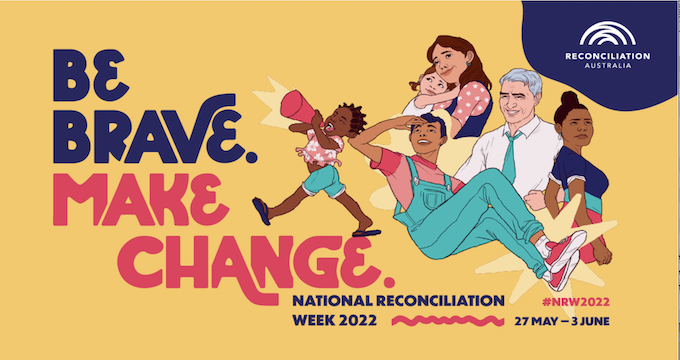
This year’s theme for National Reconciliation Week is Be Brave. Make Change. Coincidentally being brave has motivated me throughout my tertiary teaching career as I have sought to tackle colonial hegemony in the curriculum. It is also my ‘go to’ phrase when approached by fellow educators who wish to decolonise or ‘Indigenise’ their curriculum but don’t know how or where to start. It is our job as educators to challenge the engrained power structures and ways of knowing that have privileged many of us, to varying extents, for so long. This is, understandably, a daunting prospect.

I have a hunch that the anxiety felt by educators (particularly non-Indigenous educators like myself) is partly rooted in a misconception that decolonising and Indigenising are the same. Yin Paradies (2020), Aboriginal-Asian-Anglo Australian of the Wakaya people and anarchist radical scholar explains that ‘Decoloniality/decolonisation is about deep awareness of colonial pasts, cognisance of present colonial conditions and striving for “a future … free from the colonial past”’ (quoting Ming Dong Gu 2020 ). Colonisation functions via multiple and intersecting power structures such as racism, patriarchy, heterosexism, ableism, ageism, capitalism and other ‘isms’. While a manifold task, the acknowledgment of the ongoing impacts of colonisation on Aboriginal and Torres Strait Islander peoples, and re-centring of Aboriginal and Torres Strait Islander peoples experiences, perspectives and knowledges is urgent in the decolonial project.

In the Australian educational context, decolonising curriculum requires us to unsettle, challenge, and eventually dismantle the power structures of colonial systems that shape the way educational institutions create and share knowledge. Indigenising curriculum is the embedding of Indigenous histories, voices, experiences, knowledges and ways of learning into our teaching. These are ‘too often unknown, hidden and silenced’ (Bodkin-Andrews et al. 2018) due to ongoing settler colonialism.

At this point, I’d like to acknowledge the elephant in the room and ask: can we ever truly decolonise our curriculums if the very institutions in which we teach and learn are continued manifestations of settler-coloniality? While the answer is obvious, I’m hopeful that we can Indigenise our curriculums as a step toward a decolonial future.

Tips to Indigenise curriculum

Tip 1: Reflect and critique

I prompt you to start by looking at the way your subject/discipline has perpetuated colonial power structures in the past, and continues to do so in the present. I then ask you to consider how you perpetuate and privilege colonial/Western structures of knowledge and power in your teaching. You can begin by asking yourself the following:

·         What issues or topics are covered in my teaching/subject?

·         What theoretical and conceptual lenses are they approached from?

·         Who’s voices, scholarship and perspectives are included – who’s are not?

·         What are the gaps and silences in the teaching content?

·         What assumptions are being presented?

·         What are students asked to do?

·         What are teaching staff asked to do?

For those of us who teach into the arts, humanities and social sciences, these questions may be answered quite easily. For those who teach maths or physical sciences, the relevance may be unclear. Perhaps a ‘way in’ for teachers of STEM subjects, is to focus not so much on the learning content, but on the methods of teaching/learning. These can be Indigenised (and decolonised) too.

Tip 2: Survey your curriculum

My next tip is to systematically work through all aspects of the curriculum to identify specific places where colonial content, methods, and theoretical and conceptual lenses can be challenged and alternative knowledges and forms of knowledge making can be embedded. This means looking at lesson plans, reading lists, supplementary teaching material, assessment tasks, guest speakers, case studies, and field work/excursions. Conducting a whole-scale survey ensures a ‘check-box’ or tokenising approach is avoided: instead of inserting one week or one topic area on ‘Indigenous issues’, Indigenous teaching/learning practices, issues, ways of knowing and understanding are embedded throughout.

Tip 3: Make changes

The next step I suggest is perhaps the most anxiety provoking. This is to make the curriculum changes. Remember that this is an ongoing process so changes can (and should) be made over time. It is imperative to ensure the changes you implement are informed, meaningful and respectful, so take your time, do your research, seek feedback, and invest in continued interrogation and critique of your teaching practise.

Changes you make may include the embedding of experiential learning activities, centring of student voice (e.g. yarning), and incorporation of Indigenous perspectives and issues. Many educators are rightfully anxious about ‘speaking for’ Indigenous and other groups who they do not identify/belong. If you have the networks and resources, guest speakers and teaching collaborators are a great way of overcoming that barrier. If this is not possible, there is a plethora of multimedia and web material developed and presented by Indigenous Australians, and readings and other resources that are written by Indigenous Australians and/or prioritise Indigenous voices. I also often use contemporary Indigenous art as a ‘way in’ for my students to examine contemporary issues. Checking-in with Indigenous colleagues or your networks for feedback and advice is also important.

Reconciliation Australia’s Narragunnawali has been developed to ‘support schools and early learning services in Australia to develop environments that foster a high level of knowledge and pride in Aboriginal and Torres Strait Islander histories, cultures and contributions’. The implementation of Reconciliation Action Plans, Professional Learning for educators and curriculum resources are the key foundations of the program and another great place to start.

A means of transformational learning

In my experience, Indigenising curriculum has facilitated profound transformational learning experiences for students, providing them with knowledge and understanding that they have taken into their future careers and everyday lives. I have taught nearly 3,000 university students in the past four years who have entered careers in urban planning, criminology and policing, social work and community welfare, heritage and tourism, law, psychology and teaching. For many, my subject was the first time they had been presented with these ideas and perspectives. As one student noted:

…this was the first time since either primary, high-school or even other social sciences units within University that I learned that cultural imperialism is not a past event, but rather a perpetual mega-structure that sustains the social structure of ‘whiteness’; a structure used to marginalise, perpetuate disparities of ascriptive differences, and sustain the privileges of those who prosper under the ‘white’ identity.

Some of the students have subsequently acted upon this new knowledge and understanding. A student I taught in 2021 now volunteers in two Aboriginal organisations and has stated:

Without [this] syllabus I would not have found my vocation as an active and unwavering advocate for Indigenous rights, narratives, cultural differences and political and/or representative voices.

Another student (criminology/law) will now embed the learning in their future career:

The information around different groups and especially marginalised groups will help me accommodate and implement practices more suitable and sensitive to these people. An example of this could be through knowledge of culturally sensitive meetings and dispute resolution services that cater to many different languages and cultural practices. A member of the Indigenous community may opt for a more culturally appropriate option if given the chance due to the differences between Indigenous and white Australian practices.

Final thoughts

The most recent Australian Reconciliation Barometer report indicated that 89% of non-Indigenous respondents and 93% of Aboriginal and Torres Strait Islander respondents support formal truth-telling processes in relation to Australia’s shared history. It also found that 83% of non-Indigenous respondents and 91% of Aboriginal and Torres Strait Islander respondents agree that it is important for Indigenous histories and cultures to be taught in schools – as a compulsory part of the school curriculum. Australians’ are therefore on board with a shift in our education sector that privileges alternatives histories, perspectives and ways of knowing. One of the barriers seems to be that educators lack the knowledge and training on how to achieve this and are therefore anxious about making a start. While my tips are not hard and fast ‘rules’ (I am still learning too), I hope they have provided some inspiration and momentum. I leave you with the words of Yin Paradies (2020), ‘the best way to make amends for colonial pasts is for everyone to mend and make decolonial futures in the present’.

Alanna Kamp is Lecturer in Geography and Urban Studies in the School of Social Sciences, Western Sydney University, Research Fellow in the Young and Resilient Research Centre, and member of the Challenging Racism Project and Diversity and Human Rights Research Centre. Alanna has taught at WSU for 14 years and since 2020 has been the unit coordinator of People, Place and Social Difference, a 1st year core unit with over 1200 students annually. She won the inaugural Western Sydney University Deputy Vice-Chancellor and Vice-Chancellor Academic Award for Excellence in Indigenous Teaching in 2021.