

AARE blog

Will the curriculum really embrace the true spirit of Anzac?

Q and A with Anna Clark, author of Making Australian History

The “wokeness” of Australia’s National Curriculum has again made headlines and again it is more electioneering.

On Friday a Nine newspapers headline claimed the revised version of National Curriculum will elevate Western and Christian heritage. Crikey picked up on the Sydney Morning Herald headline to claim the Australian Curriculum and Reporting Authority (ACARA) has “backed down” and “returned to Western Civilisation”.

Neither of these headlines is true. In fact, as the reporters wrote, the revisions needed to be discussed with the State education ministers at a meeting which occurred on Friday.

Furthermore, according to Stuart Robert, the revisions did not pass the States, with Western Australia holding out: “We have asked ACARA to go away and revise the curriculum, noting the concerns the Commonwealth and Western Australia have, and to come back to education ministers in April”. 

So there is a long way to go yet, the curriculum is not “revised”, and ACARA has not backed down.

Robert claimed the problem with the Humanities and Social Sciences Curriculum was that it was too busy. Most HASS teachers agree.  He also said there was no mention of Gough Whitlam, of course, or Robert Menzies but that “students were encouraged to research Greta Thunberg”. On the easy resolution of this issue, Robert claimed a win by saying: “Western civilisation is something we should be proud of, and what it means to be Australian to be proud of is well and truly back in the curriculum.”

On the same day, Kevin Donnelly, who oversaw a previous review of the National Curriculum, published an op-ed in the Daily Telegraph (not available online). Most of the article pointed to funding, testing and sentiment data, but there was one unsubstantiated statement: “Too many students leave schools morally adrift, lacking resilience and unaware of what makes Australia and Western civilisation so beneficial and worthwhile defending.”

The Christian (a word not featured in any of the press briefings available to the public) and Western civilisation have been linked to the Cross Curriculum Priorities in the National Curriculum. This is the section of the document that suggests all disciplines should work to include Indigenous perspectives, Australia’s connections with Asia, and sustainability. 

A moral panic,  linked to these “woke” ideas, was sparked by a NewsCorp survey. The questionnaire asked Australians over the age of 18 the following leading question:

Which of the following is closer to your own view about the curriculum in Australian schools?

1.     The curriculum should continue to include topics such as Australia’s engagement with Asia, Indigenous Australians and the environment

2.     The curriculum has become too woke and we should have less emphasis on Australia’s engagement with Asia, Indigenous Australians and the environment than we have currently

3.     Don’t know

The results of the survey were reported by Channel 7’s Sunrise program as “A new poll has revealed that a majority of baby boomers want Aussie values nurtured in classrooms and think the current school curriculum is ‘too woke’.” The program proceeded to debate the claim with commentators removed from expertise in curriculum development and interpretation (just like those surveys) . The program concluded the curriculum was not too “woke” – but the headline remained.

If truth be told, all these statements are easily refuted through a cursory search of the Internet or a quick discussion with your friendly neighbourhood educator. For example, the proposed revisions also reported that the “contestability” of the Anzac legend had been removed, but Robert reported  that the contestability of Anzac day has been revised. Additionally, as Jonathan Dallimore, from the History Teachers Association of NSW explained in September (when Tehan announced the revision), “contestability” was framed  in the negative. 

Essentially, “contestability” in history scholarship refers to rigour in historical thinking and according to  Dallimore, is only linked to “very legitimate (even safe) historical debates” in the National Curriculum.

So why all this emphasis on wokeness?

As I wrote in October 2021, it’s because there is an election coming and this storm in a teacup is campaigning. This is clear in two ways.

Firstly, emphasis on wokeness appeals to some of the crossbench, like Pauline Hanson’s One Nation and the newly badged United Australia Party. The large number of high profile independents positioning themselves to contest the coming election are a great a danger to the Coalition. Many of the independents are economically conservative, but progressive in other policies like climate futures and human rights. If they were to win balance of power, the Coalition has a much less predictable chance of government. It is therefore, in the Coalition’s best interest to win seats where PHON and UAP might be competitive.

Secondly, the other big-ticket items in the review, phonics and maths, appeal to nostalgia, which I have also written about previously. The removal of “balanced literacy” from the document, increased emphasis on phonics, and reform of initial teacher education to include the explicit teaching of phonics are politically smart moves for the Coalition going into an election. The Coalition can now say they delivered on their 2019 promises:

“…we will invest $10.8 million to provide a voluntary phonics health check for every Year 1 student so parents and teachers can be confident their children are not falling behind. We will also ensure that trainee teachers learn how to teach phonics as part of their university degree to ensure they can teach phonics in the classroom.”

Deliverology® is an approach to public administration that is a key service of think tanks the Institute for Public Administration Australia and the Centre for Public Impact, who both advise the public sector. This top-down approach to public service governance, is the belief that a good government is an efficient one that delivers on its promises, particularly those that deliver long-lasting results for its citizens. Every time literacy and numeracy are revised, the political reason for doing so is linked to falling test scores in PISA and NAPLAN. To successfully implement a literacy reform, regardless of its contestation, is to be able to claim a party can deliver. And that’s powerful.

Michael Barber, who developed the “science of deliverology”, insists that politicians use good data, set targets and trajectories, is consistent, and have regular reporting and reassessment of the delivery chain. So while the Coalition might claim they have delivered, they have:

1.   Not  used good data because mass testing data is contested and non-representative;

2.    Not outlined a clear trajectory from announcement to implementation, but rather muddied the waters with false narratives;

3.   Not been consistent, but moved between politically popular ideas; or

4.   Not ensured the media reports progress in a clear and informative way.

So what can be done?

My answer is the same as it was in October. Politicians need to stop using education as a political pawn. Media outlets must be more responsible. Education policy research that is usually responsive to policy announcements, needs deeper analysis of the political trends that lead to policy development. This latter is where my own work sits.

Dr Naomi Barnes is a network analyst and theorist interested in how ideas influence education policy. She is a senior lecturer in literacy teaching and has worked for Education Queensland as a senior writer and has worked as a secondary English, hstory and geography teacher in government, Catholic and independent schools.

Q and A with Anna Clark, author of Making Australian History

Q. Why has history become so contested in Australia?

Anna Clark: It’s always been contested. There were debates the letters pages of newspapers in the 19th century newspapers about what was going on on the frontier and debates over the legacy of Australia’s convict origins. In the last 30 or 40 years, it’s become increasingly contested because history has wrestled with questions about how to include the perspectives of people who had largely been excluded from the national story.

Q. Why has history now become so politicised when it comes to the national curriculum?

Anna Clark: That’s a very, very interesting question: it’s not simply a question of political debates along lines of ‘left’ and ‘right’. It’s also a dispute about the role and function of history in our education system today. For example, China is a very left wing government, which has very strong views that the role of history is to provide a proud narrative of national progress. Likewise, there are politically conservative historians who would argue that the role of history is to promote a kind of critical citizenship. So it’s not just a simple left/right divide. Much of the heat of the school history wars comes down to that disagreement over what the role of history should be.

Q: What do you think the role of history should be in a liberal democracy?

Anna Clark: It should be to help people understand their place in time, that we are all historical subjects and that we all have a past and a future. Understanding that people who were living and thinking and making decisions in 1901 or 1847, or 1945, were just as much a product of their own historical context as we are today. Teaching students to understand those historical contexts, as well as some of the skills of a historical education (such as research, communication, and interrogating historical sources) helps us to be better citizens and more capable, critical thinkers.

Q: Thinking about place and time, Anzac Day seems to be the most extraordinarily contested part of modern Australian history. Why is it like that?

Anna Clark: The idea of the Anzac legacy and even Anzac Day itself has always been up for grabs. To pretend that it’s not contested is just a total total misinterpretation of the history of Anzac Day. In the 1920s, that day was contested by many veterans who weren’t sure how to commemorate Australia’s involvement in war. In the 1960s (around the Vietnam War), Anzac Day was nearly moribund. Meanwhile, there has been a great national revival of this commemoration in recent years. ‘Contested’ doesn’t mean it has to be totally politicised, or that it’s ‘unAustralian’, but an understanding that people bring different ideas and understandings about what that day means.

Q: You’ve got children yourself, what do you hope for their history education in school?

Anna Clark: I hope they learn enough of the facts to understand the nation and the world in which they live. You know, understanding the World Wars, the Holocaust, civil rights, colonisation and imperialism But just as important as the facts are the skills of doing history, being able to get their hands dirty in proper historical research and be able to come up with historical questions themselves to ask of the past. So I hope they also develop research skills of inquiry, learn to use a library, distinguish different historical opinions, and also develop skills of empathy and imagination.
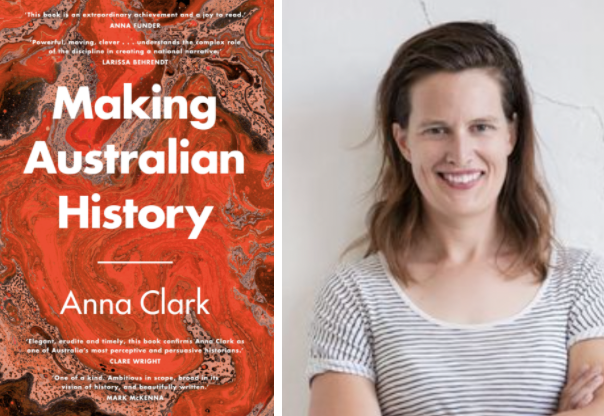
Anna Clark is an Australian Research Council Future Fellow in Public History at UTS and the author of Making Australian History, published this month by Penguin. Teaching the Nation, was published by Melbourne University Press in 2006 followed by History’s Children: History Wars in the Classroom (New South, 2008).

Impact: how to tell your extraordinary teaching story

Last week John Cole noted here that the current Highly Accomplished and Lead teachers (HALT) certification process is complex and demanding. Now Jill Willis and Leanne Crosswell discuss the support needed for Highly Accomplished and Lead teachers to tell their stories of impact

The rapid responses of teachers to continual changes in schools is evidence of teacher expertise. Every parent and grandparent knows and can tell a story about the positive impact of excellent teachers. Yet it can be challenging for teachers to represent their impact and expertise to others, especially if they are applying to be recognised as a certified Highly Accomplished and Lead teacher.

Making it easier for exceptional teachers who are masters of engaging students and igniting learning, to represent their evidence of impact was a focus of a recent study.

Highly Accomplished and Lead teachers from Independent Schools Queensland worked with researchers from the Queensland University of Technology to refine how they represented their widespread positive impact on students, colleagues and schools.

HALT certification relies on teachers presenting a portfolio of evidence, a valid way to represent the breadth of their broad and accomplished teaching. These exceptional teachers can readily identify evidence from their existing quality practices occurring in their day-to-day work.

Yet demonstrating impact in a portfolio is challenging as it is an unfamiliar writing genre for teachers. Teachers can be too busy doing the great work to spend time writing about it. The type of evidence for a play-based intervention in prep is not the same type of evidence for a digital formative assessment initiative in senior school.  These stories of impact are as diverse as the geographic, social and cultural contexts of Australian classrooms.

As John Cole notes in a recent AARE post, the current HALT certification process is complex and demanding. Teachers believe there needs to be widespread change in the ways that their professional expertise is recognised, so the effort of applying for certification is rewarded in tangible ways.

One way to support teachers to apply for certification has been to reframe the process as a supported professional learning approach. Independent Schools Queensland support the HALT certification process as an ongoing cycle of professional learning with regular workshops with other aspiring HALTs, school-based mentors and networking opportunities.

Our research previously showed that ISQ’s professional learning approach to national accreditation had positive ripple effects for involved teachers, their colleagues and schools.  The process was reported as professionally rewarding and renewing for these experienced teachers.

You don’t realise how valuable the standards are until you start actually measuring yourself against them or looking to improve in particular areas and then you realise, oh, this is actually a really beneficial thing to consider during your daily practice or yearly practice as a teacher.

(Teacher J)

My school was really supportive and they kept offering me opportunities to be involved in different things. So for me, it was a really positive experience…I met with my mentor every fortnight and she’s my direct supervisor and the head of the junior school. You don’t normally get that much time and attention from somebody who’s so busy and in charge of everything, so that was really good (Teacher K)

When school leaders encouraged groups of teaches to apply, or supported HALTs in tangible ways, it had a wide-spread positive impact throughout the school. Leaders reported that HALTs changed the conversations in school staffrooms, supported peer mentoring and connected teachers to broader school visions. HALTs were working as middle leaders initiating successful programs and peer learning for colleagues, mentoring new teachers, and leading in community and professional associations.

However, HALTs found one of the most challenging aspect of applying for certification to be how to write about their impact and evidence for others.

In the follow up research common features and principles were shared with applicants, to see if this support took some of the stress out of the application process. By analysing successful HALT portfolios, the research team identified some of the commonly used features in effectively telling stories of impact. The QUT team piloted sharing the principles in a workshop with applicants and sought their feedback after they were certified to find out what was most helpful. Emerging principles were validated against the literature and through feedback from assessors.

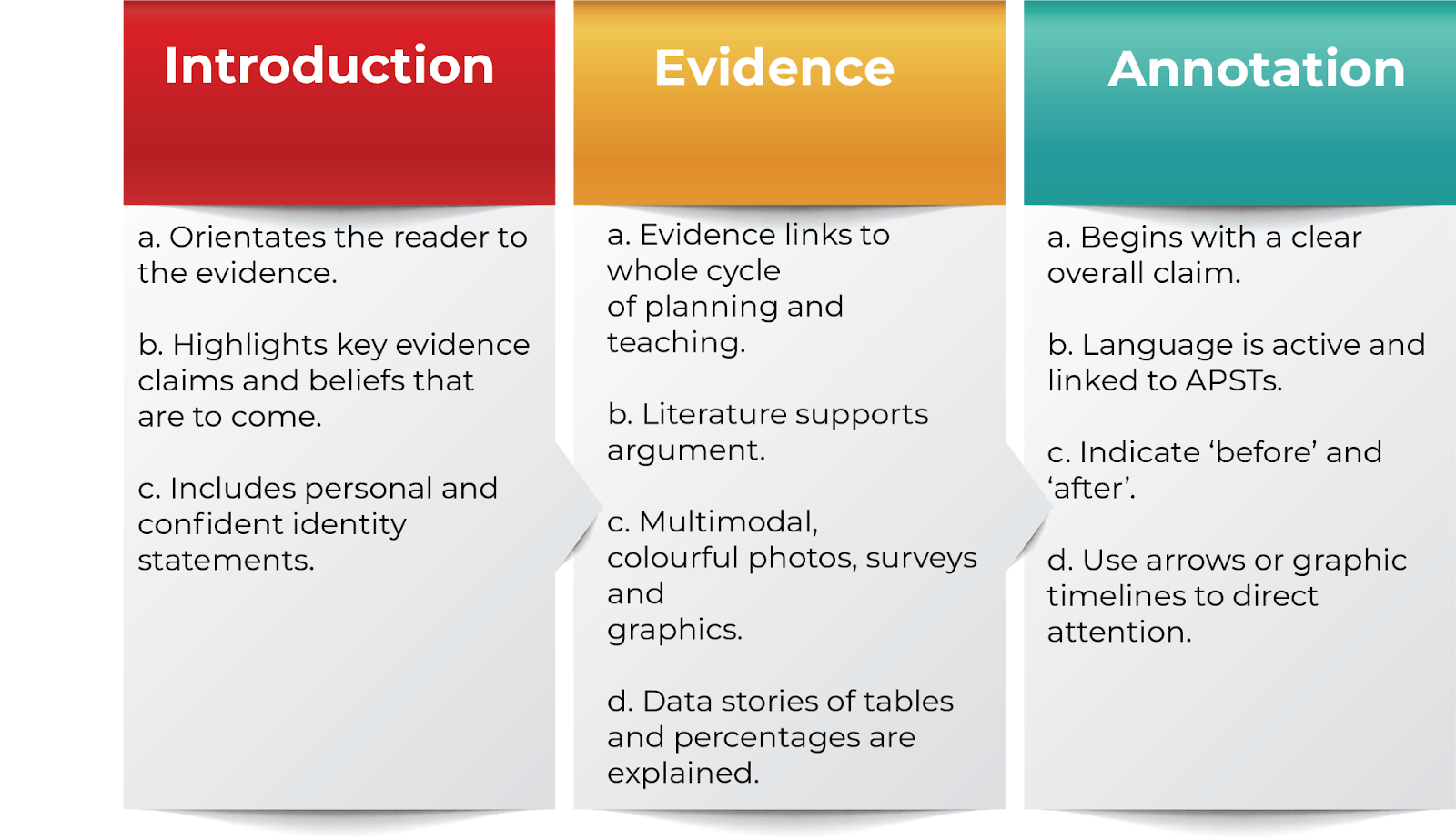
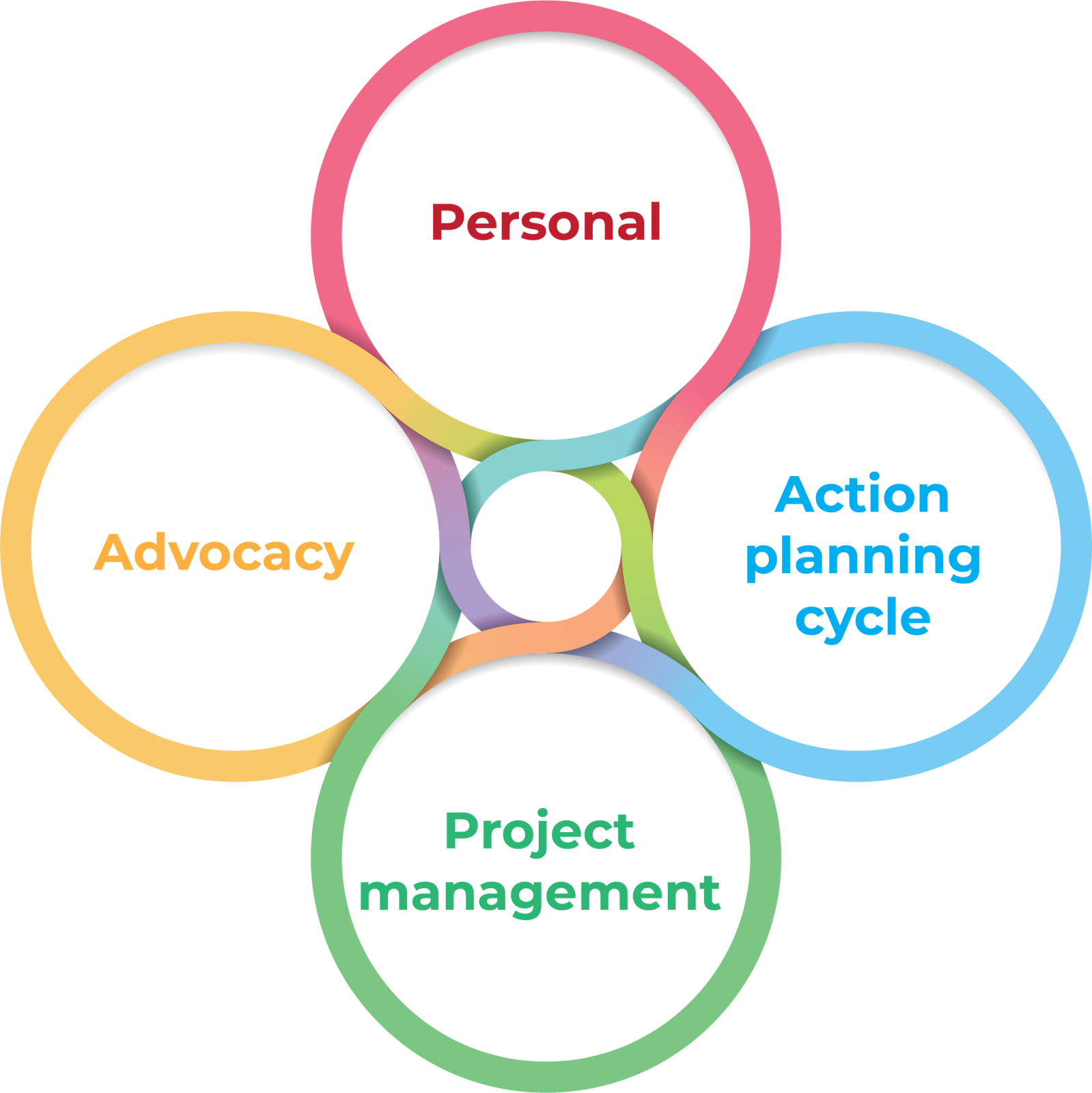
Firstly, it helped applicants to be aware of the four genres of stories of impact that commonly featured across portfolios. Personal stories were often about growth in knowledge and skill and may have started from a dilemma of practice. Action planning stories of impact were inquiries situated within practice or a team. Project management stories of evidence reflected delegated projects, while advocacy stories represented how teacher championed new initiatives or a specialisation within and beyond the school. While there will be other genres that are equally effective in telling an evidence story, having these as a starting point helped applicant teachers decide how to structure evidence clearly. (Left, figure 1: Four genres of evidence stories in portfolios)

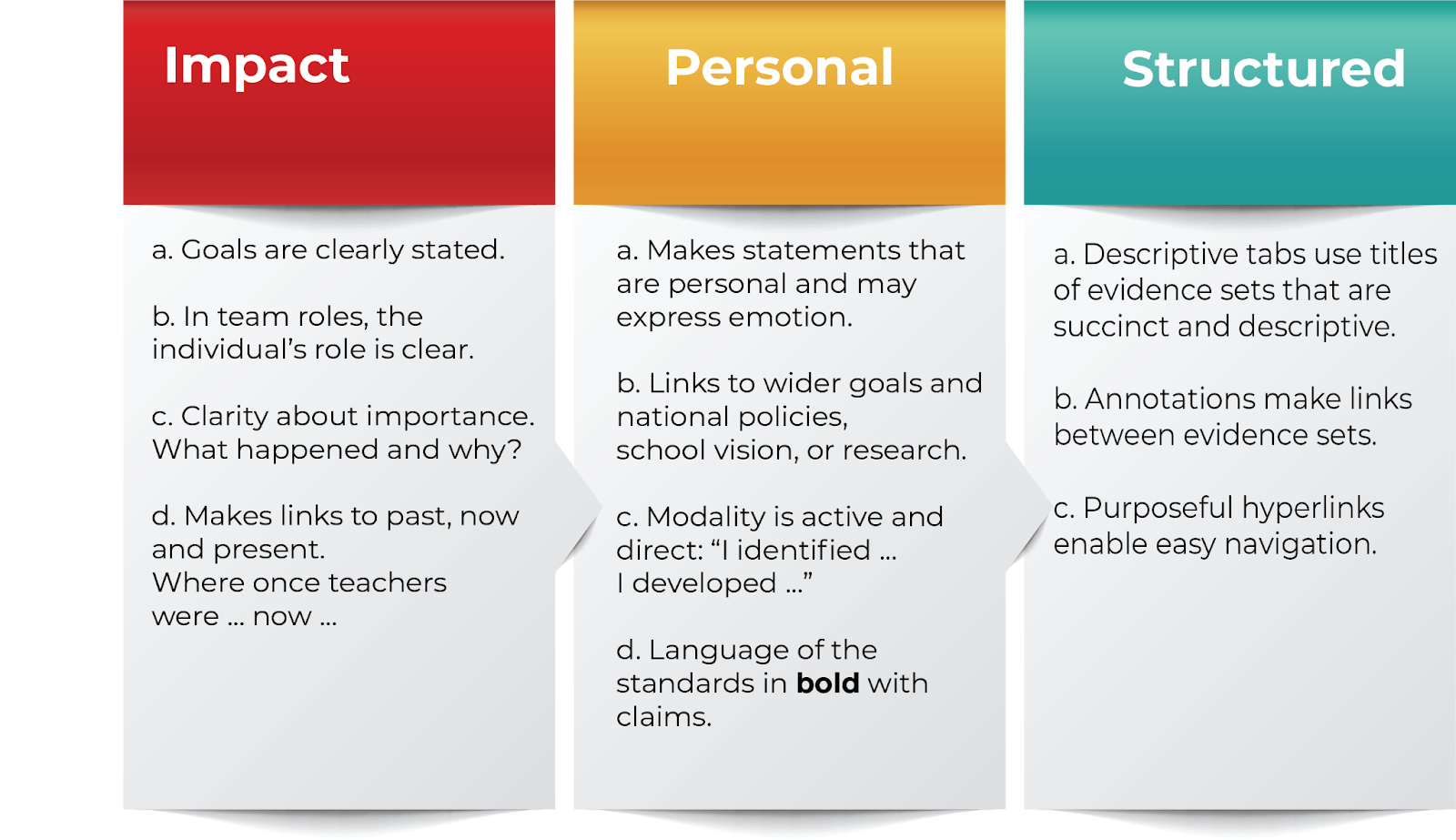
Secondly, professional learning about the how to make claims with evidence was highly valued by the applicants. Within the portfolio, easy to read stories of impact had some shared features. They made it easy for another person to see the decisions and actions of the expert teacher. Some of the key features of quality stories of evidence were summarised in figure 2.

Figure 2: High quality evidence features in portfolios

Some of the stress of writing about quality practice can be addressed through professional learning resources. Teachers should be supported to create evidence stories that celebrate the diversity of schools and learners, as understanding how to effectively represent professional stories of impact is still an emerging skill set within the profession. 

How many stories of impact are needed for certification is another question worth asking. We need to pay closer attention to the national certification picture and learn from the experiences of teachers and systems. 

Certifying bodies such as Independent Schools Queensland, the ACT Teacher Quality Institute are already working with HALTs to tailor the process to be a supportive professional learning opportunity.  There is potential for HALT certification to be both a recognition for the individual teacher, and a funded, strategic priority enabling the systemic and collective capacity building of teachers’ practices in their local contexts.

The nation’s Highly Accomplished and Lead Teachers are an untapped resource with huge potential to lead school and system improvement. Nationally there is more that can be done to find ways to support our expert teachers to be recognised.

A streamlined, and refined certification process is possible if we do as we ask our HALTs to do – reflect on and learn from the evidence.

We acknowledge that this research was conducted on the lands of the Turrbal and Yugara people. It was funded by Independent Schools Queensland, supported by Suzanne Jessen, Jo Wise and Anjulee Singh and the 2019 – 2020 Highly Accomplished and Lead Teacher applicants. The research team included Dr Rebecca Spooner-Lane, Dr Andrew Gibson and Dr Peter Churchward.


Dr Jill Willis is a researcher in educational assessment and evaluation in the Faculty of Creative Industries, Education, and Social Justice and the Centre for Inclusive Education at Queensland University of Technology, in Brisbane, Australia. She specialises in educational assessment and evaluation to understand how reflexive self-assessment informs personal agency and system change. She is chief investigator in current Linkage projects Thriving in Vertical Schools and Accessible Assessment. She tweets @DrJillWillis   

Dr Leanne Crosswell is a researcher in the fields of mentoring and  teacher resilience in the Faculty of Creative Industries, Education, and Social Justice at Queensland University of Technology, in Brisbane, Australia. Her research explores how professional learning including professional reflexivity, shapes teacher identity, resilience and agency.  Recent publications include, Quality Assuring Teachers for Resilience and Wellbeing.

Time, money, exhaustion: why early childhood educators will join the Great Resignation

As the Omicron virus leaves thousands of families without childcare, because hundreds of early childhood services have been forced to close, early childhood educators are in demand. Previously there was around 30% turnover in the sector, but a 2021 survey of 4000 educators revealed 73% planned to leave in the next three years.

A multinational study I am leading listened to 51 Australian educators who had a range of qualifications and positions in different types of services. Additional data was gathered from publicly available online forums in response to other research-based news articles I have published from the study.

The study has shed light on the hidden costs of being an educator in Australia, many of which have increased during COVID. Here are five hidden costs the educators revealed.

  1. Hidden cost of resources

Educators talked about the extra costs to buy resources for their service that were not reimbursed. An educator commented

‘Educators were pushed to provide high-quality education and care with a minimal budget, and the centre manager received a personal bonus for not spending different budgets. I spent over $4000 of my own money on resources, with not one cent reimbursed. There needs to be more control of private companies and how they treat educators’.

Publicly available forum posts from partners of educators revealed extra costs of outfits, props and craft materials some educators had to purchase themselves, then create them in their own time at home. These items were for special themed days, which help promote the services programs via posts to Facebook and apps for families. 

They reported that the children and staff posed in these costumes and props, which were popular on social media. These specified ‘days’ are often standard across private providers as they commodify education. One educator said the government should ‘Stop the privateers making their centres like Starbucks factories’

These hidden costs for educators are alarming, given the 2021 report that uncovered the $14 billion spent on the sector each year, 80% ($11.2 billion) of which is funded by taxpayers. In addition, a $292 million turnover was reported by the five biggest companies.

  1. Hidden identity and self-worth

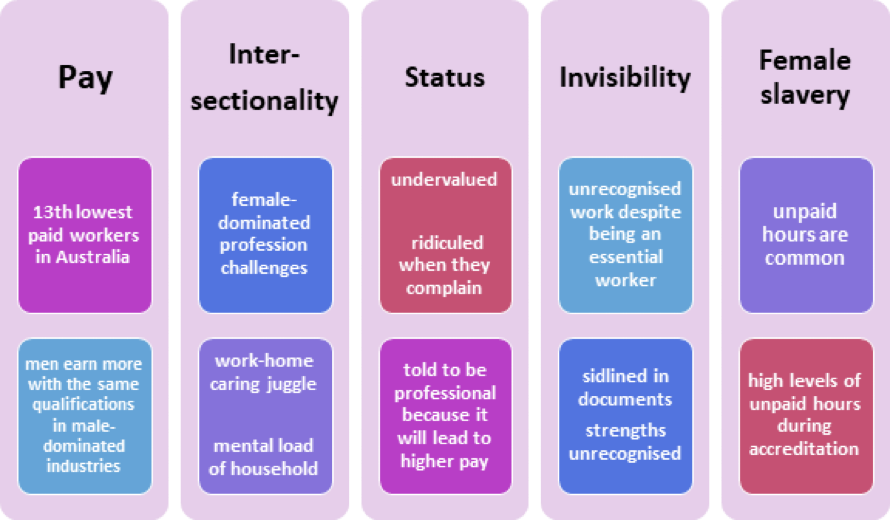
Educators revealed that despite being essential workers, they are essentially invisible and ignored. Invisibility is a feature of female-dominated professions, such as early childhood, where 91% of the workforce are female. 

Educators are sidelined in curriculum documents written by the Australian Children’s Education and Care Quality Authority (ACECQA). Their strengths and interests are not mentioned despite being a key feature of educators valued relationships with children and parents. 

Instead, the documents are filled with ways the educator should constantly reflect and improve themselves and their practice, highly valued practises in Western neoliberal nations. While professional reflection is important, it needs to be balanced with acknowledging the efforts, abilities and successes educators have. Instead, the documents instruct the educator to respect and work with the strengths and interests of the children, and the strengths of the parents.

The underlying message for educators is that they are never quite good enough, even when they are trying their best in a highly pressured work environment. Women are exposed to a similar mantra via the fashion and beauty industries as they sell the need to be prettier, taller, skinnier and more fashionable.

In this study, educators said governments should give educators ‘respect as professionals’ and ‘lift  the professional standing by increasing (the) pay of educators and promote the importance of early childhood education’.

Figure 1: Gender related issues in the early childhood sectoror
  1. Hidden relationship costs

The extra hours and stress educators were expected to do contributed to relationship stress at home, especially during accreditation. Educators commented that it was not sustainable and made them want to quit. They said

‘(My relationships were) strained due to fatigue.

More work at home meant less time with my partner.

It made me very stressed and overwhelmed.

I feel like at times I have no work-life balance’.

  1. Hidden unhappiness

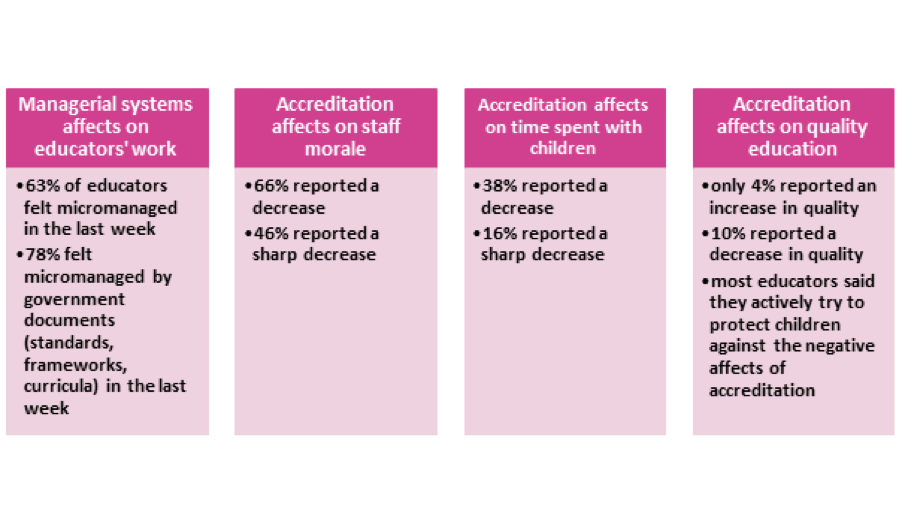
Other educators exposed the managerial systems that dominate their daily work meant they were drowning in paperwork, checklists, documentation and regulation. This caused unhappiness because they felt micromanaged through the government’s demands that require them to collect big data every day. 

They also said they felt micromanaged by the supervisors who completed these daily tasks in a time-pressured environment. One said, ‘I ended up resigning from my position as the top-down approach of management no longer agreed with my teaching philosophy’.

The system also reduced morale, especially during accreditation (Assessment and Rating) every three years. Only 4% of educators said accreditation improved the quality of education at their service, but most revealed it made staff and children unhappy. Accreditation also took them away from interacting with children, which is the key to quality education in early childhood services.

Realising the importance of these interactions, educators actively tried to protect the children against the harmful effects of accreditation (a system that was designed to improve quality). Unfortunately, this meant more work after hours because they had to take the paperwork home in order to teach the children.

Figure 2: The impacts of managerial systems in early childhood education
  1. Hidden hours 

Despite being the 13th lowest-paid workers in Australia, regular unpaid overtime is rife within the sector. The unpaid hours are extreme during accreditation, with 50% saying they worked after hours. 

Some reported being paid for only half of the hours they worked, even asking family members to provide unpaid help, revealing the extent of this modern-day slavery. Educators talked about the effect of accreditation on their personal relationships, saying

‘Stress was felt at home by my children and husband; this is why he came and helped at the centre so that I could stop being cranky and overworked at home’.

However, this  free labour is at odds with the million-dollar salaries of some CEOS and  handsome shareholder dividends in the biggest childcare companies. Australia has one of the highest rates of privatisation of childcare in the world. The 2021 report by Bigsteps into the sector uncovered:

‘Financialisation of ECEC has seen the worst excesses of Australian corporate culture including wage theft, aggressive tax avoidance and other misconduct creep into the sector. 

Despite receiving generous COVID relief payments and availing themselves of JobKeeper, four of the six largest for-profit ECEC providers paid no tax in 2020’. 

Hidden complications that stop reform

A significant reform of the sector is needed. However, reforming the industry is enormously complex because of the mismatched mess of funding and compliance shared between federal and state governments. This tangled web means it is more challenging to reduce costs for parents and improve wages because nobody takes responsibility.

Figure 3: Funding and regulation in Australian early childhood education and care

Another complicating factor is the mix of private, community and not for profit services. Educators are likely to be paid more in community and not for profit services, with 70-80% of their revenue spent on wages. However, as little as 54% is spent by privately-owned services. 

One educator called for ‘more control of private centres’ to reveal what they are doing. Educators showed their frustrations, saying

‘My options include selling out to the greedy large corporations where the directors and educators do not know their children or families. They get exceeding ratings because outsourced marketing gurus write up a perfect marketing plan’.

‘We are burnt out and are leaving the industry in droves because rather than having quality educators, we are getting pushed for quantity. Children are being seen as a commodity, and it needs to stop’.

Despite these problems, the Thrive by Five campaign continues to be a beacon of hope as they petition the government for significant reform. Even NSW Premier Domonic Perrottet has flagged the need for substantial reform, which could have major implications for all states and territories. 

When our governments plan for a better future, they could learn from an African proverb that reminds us that the best time to plant a tree is ten years ago, but the second best time is now. The best time for major childcare reform is right now, before we lose more of its most precious resources, our educators. 

Marg Rogers is a senior lecturer in the Early Childhood Education and Care program at the University of New England. Marg’s current research interests are about programming and resourcing parents and educators to build resilience and understanding in 2-5-year-olds from Australian Defence Force (ADF) families.

Towards a culture of inclusion: teaching to bell hooks

 “If we are to reach our people. All people, if we are to remain connected…we must understand that the telling of one’s story provides a meaningful example, a way for folks to identify and connect” 

bell hooks (2014, p. 77) 

The words of the incredible bell hooks, who died in December last year, remind me of the importance of sharing our stories and of their potential to bring about understanding, promote change and encourage new ways of thinking. Her work asked us to consider education as a “practice of freedom” one that could lead to a community for all, irrespective of our differences. 

Too often, students who experience disability are not part of this education. Their stories remain only of their difference, untold and unrecognized for their own uniqueness. Classrooms that continue to separate some students from others, denying the variation of our experience cannot help but deny the individuality of everyone. A practice that seems at odds with our teaching standards and in particular, “know students and how they learn”. Unless I missed the memo, this asks us as educators to be open to every student and to embrace the complexity of who they are, their culture, their language, their history and their disability. 

Research tells us that teachers, for the most part, support the idea of inclusion. Research also tells us that teachers who teach inclusively provide all students with rich learning environments. Finally, (yes, all things come in threes) research shows that inclusion benefits us academically, socially and economically. Young children in my study developed their creativity, self expression and spontaneous, imaginative play. Teachers learned to use drama and puppetry as tools to support inclusive practice, opening up the possibility for every child to be part of their learning story in a way that was uniquely their own. By observing the children, often through a puppet, teachers were able to gain an appreciation and insight about the children, particularly children with a disability.

My story speaks to this, it is a story that is inspired by children, children who showed adults that disability is natural. I happened to be at the right place, at the right time, having just piloted a school-based teacher professional learning program that placed me alongside a primary school teacher in a “collaborative” class. Collaborative being the terminology for a class that included children who did and did not experience disability. The response to the professional learning was incredibly positive, with teachers introduced to new ways of seeing, listening and knowing their students through the creative arts. The most powerful place to see was the playground, watching children that have never played together…play together. Los Angeles Unified School District asked me to become their Inclusion consultant.  

I continued to see, listen and soon know my students and their teachers. We communicated with drums, feathers, watercolors and tuille. We danced and made short films, films that told their story and the story of their teachers, teachers with strong opinions about the possibility of inclusion. Teachers’ beliefs about inclusion are formed from a variety of sources, including personal experience and teacher education, they are reinforced by schools, policy and society. Their beliefs are highly variable and may be inconsistent with their practice. For many teachers, a huge shift in thinking is required to become an inclusive teacher. I encourage my pre-service teachers and the teachers I work with in schools to consider the scope of disability, to think about anyone they know who has a disability, to share their stories of disability, to explore their attitudes, and how they were formed. We explore these ideas with image work, drama, with questions, visible thinking routines and by sharing our stories. Stories that become the foundation of our beliefs.

Inclusion appreciates our differences and considers this difference as natural and a resource in the classroom. Inclusion is not a choice, a place or a privilege. Inclusion is a way of thinking, a belief in the value and contribution of every student. Inclusion does not label students or place them in boxes. Inclusion is the story of every child, an education that is “practice of freedom”.  

 And again: “If we are to reach our people. All people, if we are to remain connected…we must understand that the telling of one’s story provides a meaningful example, a way for folks to identify and connect” 

bell hooks (2014, p. 77) 

Olivia Karaolis teaches across the School of Education and Social Work at Sydney University. She completed her research at USYD after working in the United States in the field of Early Childhood Education and Special Education. Her focus has been on creating inclusive communities through the framework of the creative arts.

Why the push for tremendous teachers ground to a HALT

For more than five years there has been a vision to put a Highly Accredited or Lead Teacher in every Australian school. That means every school would have a teacher certified at one of the top two tiers under the Australian Professional Standards for Teachers, working in class and working with staff every day. 

 AITSL chair Professor John Hattie is the greatest champion of this dream. His vision is to identify and value teacher expertise and impact and spread it to every corner of the country. In 2016 he fashioned the idea for Highly Accomplished and Lead Teachers (HALTs) as one of five goals to re-boot education in Australia.  

So, to fulfil the dream of HALT in every school, (based on the latest count from the Australian Bureau of Statistics) the nation would require 9542 certified teachers. Yet the reality is that only 891 educators have achieved certification since 2012 (2020 numbers). Every year about 100 teachers are certified by various state and territory authorities. 

But the gap, the gulf between the dream and the reality, is not closing.  

Promotion of HALT certification has been persistent and high profile. At various times $10,000 bonuses and study grants have been offered as incentives. AITSL has devoted significant slabs of the internet to promote the scheme and there’s an exclusive summit laid on for HALTs every year. The enduring promotion efforts are premised on the belief that the presence of a HALT improves a school’s learning outcomes, contributes to an increased culture of learning amongst staff and enables quality teaching to impact across the school (AITSL HALT Spotlight, 2018). 

A 2020 research program as part of a Master of Education (Research) study overseen by Edith Cowan University aimed to determine teacher attitudes about certification. The study worked with focus groups of secondary teachers from the independent system in the ACT to determine what teachers are considering when think about applying for HALT certification. Teachers said they were more likely to consider preparing their own application, if they believed:  

  • The entire teaching sector recognised the value of HALTs; 
  • Their own system and their own school supported teachers who were working towards HALT status; 
  • There were regular platforms to highlight the work of HALTs, and   
  • The application process was simpler. 

Based on the study, more Australian teachers are likely to consider certification if they feel it is truly national scheme. Currently not every state and system recognises HALTs – not across Victoria, not in Tasmania, and not in all of WA. In Queensland, there are specific requirements from each system. The idea that a teacher is certified as an expert practitioner in one state or one system – but not all – undermines the credibility of the entire scheme.  

Part of the credibility gap lies in inconsistent approaches regarding payment for certified HALTs. A patchwork of bonuses across systems and jurisdictions unpicks the credibility of certification. A consistent approach to rewards would provide a banner to show how Australia’s educational sector values and rewards expert teachers.  

Focus group participants were apprehensive about the application process to become a HALT. Uncertainty, misunderstanding and lack of trust surrounded this aspect of the HALT landscape during their discussions. These teachers believed preparing an application was complex, expensive and relied on opaque processes and procedures. Teachers said they would feel better about applying if the process was simpler, more open and less expensive. 

The focus group participants raised further questions – what do HALTs do, and why is it important? They felt specific and regular demonstrations of the impact of HALTs – how they bring ‘more’ to classes and schools – may help address the uncertainty about the value of HALTs. The respondents pointed to cross-school leadership and prescribed roles within schools as possible areas for public demonstrations of HALT impact, increasing the credibility of certification. 

HALT certification in 2022 seems to be a badge searching for a role.  While the label is promoted and presented as an elixir for each school, many teachers remain unconvinced about the value of the outcome. For the applicants each year who plan portfolios and curate evidence, who prepare to have their career judged and assessed – these efforts must be about more than a shiny badge. Systems to apply rigorous inspections and then identify expert teachers must provide outcomes greater than a smile and handshake, a framed certificate and an email signature block. Defining the purpose of certification, defining roles and career progressions for HALTs, and making HALT matter on the national stage are essential to make meaningful progress in the growth of HALT numbers. 

The ACT is one of the most consistent suppliers of certified teachers. On a pro-rata basis, it is a powerhouse, with 88 HALTs working in the territory’s 136 schools – 65 per cent of the way to securing a HALT in every school.  The ACT Teacher Quality Institute is the regulating authority for HALT certification and has developed a vibrant package to help expert teachers achieve HALT status. They have adopted a modular approach to application, spreading the workload over two years. They have provided exemplars and mentors for applicants. They have arranged for payment to be made over two years, rather than 10 months. Their efforts to make the application process much clearer and more direct are at an early stage, but they could provide important indicators to remove wider concerns. But the skepticism of ACT teachers participating in the study, who operate in an encouraging environment, suggest teachers in other areas may hold more serious apprehensions. 

Teacher concerns about applying as HALT were direct – “it’s too hard, it’s not relevant, I’m too busy, what’s the point anyway?” Without a clear direction of the value of certification, these questions remain unanswered. Certification may be recognised in pay, in promotions, in leadership roles, in community advocacy. The exact nature of that value is yet to be determined on a national scale. Gonski 2.0 recommended better career paths for teachers. Grattan Institute has provided a blueprint for making use of expert teachers. To encourage teachers to pursue certification, the nature of HALT certification has to provide more impact – for HALTs to do more, to lead more, and for the scheme to be more than just a badge. 

John Cole is a Highly Accomplished teacher from the ACT, first certified in 2013 and again in 2019. His research with Edith Cowan University was part of a Master of Education program, looking at teachers’ attitudes towards HALT certification.

Need reminding? Some of the best read blogs of 2021 and how you can help

Thank you to Mihajla Gavin and Meghan Stacey for kicking off the year on EduResearch Matters – on why we should want to avoid the Kansas model of dealing with COVID and staff shortages.

You too can contribute! Read on! Here are notes for contributors.

We published fabulous posts every single week across a range of topics last year and we really want to do the same this year. Didn’t get to write last year? Want to contribute? Pitch to me at [email protected].

The 2021 AARE blog of the year was principal and research student Paul Laing on the impact teaching shortages have on schools and learning, a devastating picture of what is happening in our schools; and now made worse by COVID.

Some of our posts were very newsy. They included a number of critiques of the former Minister for Education Alan Tudge, a plea to cancel the NSW Higher School Certificate and an array of posts on gender inequality in schools. There were a range of wonderful contributors, brand new PhD students, researchers, tutors to professors and professors emerita.

It is genuinely hard to choose the best because every single blog reveals new ideas and new thinking about education but I’ll just list our ten most read for 2021. So many others were excellent and please look at our comprehensive archive.

Here we go! 2021 top ten.

Paul Laing: ‘My teacher sucks’: how teacher shortages shatter learning.

Simon Crook: The amazing secrets of band six and what you should know

Simmone Pogorzelski, Susan Main and Janet Hunter: Decodable or predictablewhy reading curriculum developers must seize one

Carol Reid: Why we must abandon the 2021 HSC now

Brian Cambourne: A brief history of the Reading Wars

Viv Ellis: It’s anarchy in England – Australia’s ITE must now steer clear

Rachel Wilson: The government must know how to fix the teacher shortage. Why won’t it act now?

Naomi Barnes: Why Alan Tudge is on the history warpath

George Variyan: If you want gender justice, should you ban private boys’ schools?

Is the lecture dead?  Shirley Alexander, deputy vice-chancellor. University of Technology Sydney; Sarah O’Shea, director of the National Centre of Student Equity in Higher Education at Curtin University; Marcus O’Donnell, director, Cloud Learning Futures at Deakin University; Sally Male, chair in engineering education, University of Western Australia; and Amy Wong, research fellow at Queen’s University Belfast, formerly of the University of Queensland.

Thank you to all of you for making this such a lovely community, looking forward to hearing from you and a special thank you to Maralyn Parker without whom none of this would be possible (she still helps out!).

Jenna Price

Why your doctorate can make you feel like you’re drowning

This is not a cry for help. These aren’t my thoughts on the difficulties of managing money, time, kids, spouses, visas, conferences, the thesis, the job, or the dog, real as all these pressures clearly can be. Rather I want to share some of the impacts of early PhD studies on me, invite reflection, and offer a note of caution.

I am enjoying my doctoral studies more than any before it. I regarded my admission to the degree as a licence to read widely and write wildly. I’ve engaged with discourse from classical philosophy through neuroscience to behavioural biology, all through the lens of jurisprudential enquiry. I’m enthralled by it all. The possibility of realising nascent knowledge drives me forward. I feel accomplished when an idea reveals itself as a clear, sometimes seemingly novel, pure thought. If it does so at the right time it can manifest as a sentence or two which sparkles with satisfying clarity. Such is the evolution of a thesis, I hope. And a mind. 

My supervisors are quietly encouraging. Nevertheless, in their presence, I can feel woefully inadequate. I have said things to them that are just plain dumb, and other things just plain dumbly. An example of the latter kind was my remark that I found the PhD experience somewhat ‘destabilising’. When probed as to what I meant by that, I could offer nothing adequate. 

Where do we find a safe harbour?

Stumbling over the words of my attempt at an explanation, I muttered that everything was becoming less certain; I was less clear about what I knew, what I didn’t, and even about who, what and why I was. The global health pandemic didn’t wholly explain the phenomenon. No, I continued with deflating confidence, there was something in what I was reading, and in the process of learning itself, that was impacting me in ways I had simply not anticipated. I found it confronting. And I still do.

My research leads me to believe that our earliest hominin ancestors lived free of overt construct. They behaved first according to instinct and departed from it only when cognitive ability enabled them to believe that they had the choice to do otherwise. They resolved the existential problems with which they were confronted and, it seems in the process, transcended the objective fact of their entity as beings, to actually being. Our ancestors quite literally did ‘awaken’. I am left wondering if they did so in ways that I never have, can, or will. Thoreau said he felt as though he never did meet a person who was “quite awake”. It seems that, like me, he doubted that he was. His solution was Walden Pond.

There is perhaps an assumption that we, as modern humans, living as we do in this busy and sophisticated world, start from a position of self-awareness; with an understanding of what and who we are and the rules of our own existence. My doctoral studies suggest to me this isn’t so. I don’t understand very much at all. It is this knowledge, as much as any, that I can experience as destablising. 

Bertrand Russell validates what I feel. He wrote that philosophy ‘raises doubts’. It diminishes our feelings of certainty as to what things are. Russell regarded the doubt as liberating, enlarging our thoughts and freeing them “…from the tyranny of custom”. I agree. But when we are buffeted by those newly freed thoughts, encountered as part of the rigours of PhD study and life besides it, where do we find a safe harbour? 

I wonder if, more than any other course of study, the PhD doesn’t inherently involve breakage at some level, like a vase might as it smashes on a hard floor. For a time, there is only mess; scattered broken pieces that are disconnected from one another, such that the entity as a whole no longer exists (assuming that it ever did). Instead there are shards of sharp material that, if mishandled, will cause injury. The PhD candidate must confront that mess, all that ‘liberating doubt’, and try to understand what it represents. If the pieces are put back together so that something is (re)formed, better or differently understood, that is perhaps the true mark of a Doctor of Philosophy. But inherent in the journey, I think, is the possibility, and indeed the risk, that the vase will smash and that the candidate won’t be able to put it back together. It remains a broken mess which might never make sense again. Doubt prevails. 

Doubt doesn’t always feel liberating. It can be crippling, isolating, scarily confronting and personally challenging. Doubt is a frame of mind wherein feelings of being unsupported, anxious and depressed more easily surface, where we can feel deficient as researchers and our efforts pointless. We know that PhD candidates are susceptible to all these feelings, contributing to what Inger Mewburn has recently described as a “…frightening epidemic of mental health issues among PhD students.” No such epidemic has yet claimed me and one reason it hasn’t is because of my university. Increasingly I rely upon it as a space within which I can safely expose myself to ‘liberating doubt’. My supervisors are my ‘port of call’. For me at least these are important aspects of the value proposition of the university – it will provide me with the support I need to ‘break’, as it were, and then to try and reform. It will lessen the very real risks inherent in the process of my doing so. 

These are the risks about which I would caution new PhD candidates. They should be considered and reflected on more explicitly and universities could, I believe, lead and facilitate that discussion more than they do. A consequence of doing so might be candidates who are more resilient and better prepared to confront the all-pervasive and, yes, potentially destabilising doubts of the kind that go to the very core not only of who they are as researchers, but as persons. When properly supported within the educational setting of the university these same doubts are better able to become truly liberating and, in that form, are perhaps our best chance of moving toward that state of being “quite awake”. 

Richard Stewart is a practising lawyer in Melbourne and a confirmed PhD(Law) candidate at Southern Cross University. My research concerns the capacity for property law to be used as an agent for behavioural change. LinkedIn

One provocative question: what on earth does evidence-based really mean?

This post was written before Alan Tudge took leave from his position as the Minister for Education. But he’s not the only one to bang on about ‘evidence’ without really being clear what he means.

There can be little argument in wanting university Schools of Education to impart to their students, knowledge premised on systematically-acquired evidence. It is irrefutable that teacher educators want their students to leave university and enter the classroom confident in the delivery of best practices. However, the requirement for ‘evidence based-practice’ is in danger of becoming a political polemic in which knowledge may be obfuscated by ideology, rather than being the outcome of systematic investigation.  

Writing in The Australian,Paul Kelly ‘reflects’ on the then Federal Education Minister, Alan Tudge’s ‘drive’ to ensure universities impart, ‘…evidence-based practices such as phonics and explicit teaching instruction methodologies.’ The former Minister issues a warning that he will use, ‘the full leverage’ of the Federal Government’s $760m budget to insist, ‘…evidence-based practices are taught…’ in universities. Yet, the threat is based more on assumption that evidence-based practices are not being taught in our universities, than any substantial evidence that they are not. 

It is ironic the former Minister should argue for something on the basis of a lack of evidence. Aside from this point, questions arise around the nature of evidence the former Minister considers to be bona fide in relation to practice. This is an issue around which there is a distinct lack of clarity. The former Minister clearly states what he does not want, which includes: sociology and socio-cultural theory. His wish to see the demise of branches of thinking are questionable, given that it is usually dictatorial regimes that close down thought in their nation’s academies. He wants a tightly prescriptive curriculum for teacher education. In this respect, he appears to be following the Conservative administration of Boris Johnson in Britain, where a similar proposal has been tabled for English universities, resulting in some of the world’s top universities describing the plan as deeply flawed and having damaging consequences If Boris Johnson wants something and Oxford and Cambridge consider it fool-hardy, the weight of opinion surely tilts in favour the academies. 

The point remains as to the kind of ‘evidence’ upon which evidence-based practice is premised. What may pass as ‘evidence’ is not necessarily bona fide ‘knowledge’. All research, including educational research, involves knowledge that is acquired by means of rigorous, systematic investigation within clearly defined parameters. Even so, the outcomes of an investigation may be influenced by a number of factors, including: ontological perspective; the framing of the research questions; methodological approaches; analytical methods; researcher interpretation and the degree to which any funding body remains impartial. Ultimately, before it can take its place in the pantheon of evidence, research must be interrogated by means of independent peer-review and subsequently published in a highly respected discipline relevant journal. Even then, sometimes what may appear to be good evidence can prove to be disastrous in its outcomes. We do not know if the ‘evidence’ to which the former Minister refers, satisfies these requirements. What is certain is that the ‘evidence’ used by Paul Kelly to suggest universities are ‘failing’ their students and the nation’s schools, does not meet most of these standards of respected research. 

It was an Australian doctor, William McBride, who in 1961, published a letter in The Lancet, suggesting that thalidomide had negative consequences and drew attention to the possible fallacy of evidence. Randomised control trials (RCTs) of the drug in rats had proven effective for controlling for morning sickness, but it took observation of multiple cases to prove the drug was not fit for purpose. 

So, what kind of ‘evidence’ is being referred to by the former Minister when he rightly insists we need to ensure that pedagogy is evidence-based’. Is he referring to evidence derived from primary research, such as randomized control trials (RCTs) and observational studies; or secondary research, including systematic reviews of the research literature? The fact is there is no single type of evidence. It is generally recognised that different evidence types have different methodological strengths. At the pinnacle of the ‘hierarchy of evidence’, are systematic reviews, followed by RCTs, cohort studies and then case-controlled studies, case reports and finally expert opinion. Without identifying the type of evidence to which he refers, the former Minister, appears to resort to lay-opinion disguised as evidence. 

Without a clarity of thought, political policy, based on vague supposition, could lead to prescriptive measures that result in ‘damaging consequences’. As the thalidomide example cited above demonstrates, a single type of evidence is not always sufficient proof, and multiple types of evidence may be necessary to triangulate knowledge. Rather than denouncing certain disciplines of thought and prescribing others, perhaps the way forward is to systematically interrogate different types of evidence in order to evaluate their efficacy, as bona fide knowledge. The best way to do this is by means of teacher-academics and teacher-practitioners working collaboratively, across multiple settings, engaging in systematic research, and cross-referencing results. For this to happen, there needs to be a commitment by government to fund, not cut, educational research. Australia has some of the finest Schools of Education in the world; they are staffed by dedicated academics who want the best for their students and the best for the nation’s school children. What universities need is a knowledge-rich government, not political polemic that does not even reach the baseline of the ‘hierarchy of evidence’. 


Paul Gardner is a Senior Lecturer in the School of Education at Curtin University. He is also the United Kingdom Literacy Association’s Country Ambassador to Australia. Paul specialises in research around writer identity; compositional processes and pedagogy. He has written about process drama, EAL/D, multicultural education and collaborative learning. His work is premised upon inclusion and social justice.  Twitter @Paugardner

Do elite private boys’ school alumni have justice politics?

Featured Symposium at AARE 2021: Elite private boys’ schooling, feminism and gender justice: reimagining research in a post #me too world

On November 30 2021, while many of us were in paper sessions at the annual AARE conference, the findings of a review of workplace culture in parliament house were released. The review, led by Sex Discrimination Commissioner Kate Jenkins, was sparked by rape allegations made earlier this year by Brittany Higgins. The findings indicated that one in three people working in federal parliament has experienced some kind of sexual harassment there (Australian Human Rights Commission, 2021). What is also true is that a large number of MPs in the current parliament attended boys’ only schools, and recent revelations about the conduct of some boys in high fee-paying private boys’ schools have shone a negative light on them.

In September 2020, a year 12 muck-up day challenge at Sydney’s Shore school was made public which included such challenges as “spit on a homeless man”, “deck a stranger”, “sack whack a complete random walking past”, “get with someone below (age) 15”, and “get with an Asian chick”. In February 2021 Ms Chanel Contos, a former student at Kambala – an elite private girls’ school in Sydney – commenced a petition on social media for consent education to be taught earlier. This also attracted many testimonies from young women across the country regarding sexual assault from young men, many of whom attended elite private boys’ schools. 

A spotlight has therefore been focused on private boys’ schools and the male leaders they produce. All but two of Australia’s post war Prime Ministers (Bob Hawke and Julia Gillard) attended boys’ only schools, as did many men in the current parliamentary cabinet. Many of the men who attend boys’ only schools will come to occupy positions of significant privilege and power. There are crucial questions to be asked about the gender, class and race lessons being learnt by the young men attending such schools, and the way these travel with them as they come to occupy positions of influence in post-school life. Emeritus Professor Jane Kenway calls this the ‘misogyny pipeline’.

Published research shows us that such schools can be environments that are toxic for women teachers (Higham, 2018; Variyan, 2021) and indicates the sense of entitlement that can be fostered in such schools (Gaztambide-Fernández, Cairns & Desai, 2013). However it also indicates they are institutions that frequently engage in practices that are ostensibly about improving society and ameliorating justice (Kenway & Fahey, 2015). Indeed, how might these schools and their current and former students contribute to social justice rather than reproduce virulent forms of misogyny, classism and racism?

In response to such questions, AARE featured the research symposium Elite private boys’ schooling, feminism and gender justice: reimagining research in a post #me too world, at its annual conference. The symposium involved Drs Claire Charles and Lucinda McKnight, and Professor Amanda Keddie (Deakin University); Dr George Variyan (Monash University); Emeritus Professor Jane Kenway (Melbourne University); Professor Adam Howard (Colby College, USA), and Leanne Higham (LaTrobe University).

The symposium identified a range of challenges and opportunities for understanding questions of gender, class and race in elite private boys’ education both in Australia and the USA. A particular challenge identified was the ‘rules of entitlement’ that such schools implicitly teach their boys (Kenway). One such rule is that boys must know how to stay on top of all the hierarchies that matter. Given how strongly invested such schools, and their clients, are in hierarchies it was asked is it even possible to challenge this rule?

A key theme, in line with the conference title, was how we might re-imagine research in politically charged spaces, and in particular in/with elite private school boys and such schools’ alumni. Access to elite schooling for the purposes of research can be difficult. The symposium explored some different approaches to gaining insight into a culture where ‘what is part of the family stays with the family’. The schools were likened to a ‘secret brotherhood’ (Howard) where unsavoury are kept under a code of silence, although can sometimes be revealed to ‘insider’ researchers such as men who also attended elite boys’ schools, or by alumni who actively take up a more progressive justice politics. As part of re-imagining research in this space, the symposium also explored how researchers need to acknowledge their own positioning and investments (Charles, McKnight & Variyan).

A second theme was around how the schools themselves typically respond to revelations about their misogynistic cultures when they hit the media. Their crisis management techniques were identified. For example, they often respond by suggesting that such events are the result of a few ‘bad apples’ and are not representative of the broader culture or values of the school. A further strategy was their ‘dignified determination’ to address the issues. These defensive responses were described as a form of ‘misogyny masking’ (Kenway).

A key question, therefore, is how research, and the schools themselves, might address these problems. In particular, how research and teaching in elite private boys’ schools might seek to involve boys and men in working toward social justice. It is well established in research that involving men and boys in feminist projects can be a challenge yet one that is necessary if we are to change the status quo (Messner, Greenberg & Peretz, 2015). The symposium explored the discomfort and emotional intensities that boys and men often experience when they are invited to reflect on their complicity in perpetuating gender injustice (Keddie). It found that while such discomfort can be difficult, it is a necessary part of gender transformative work because you are dealing with personal violation. Such discomfort and emotions can be channelled in productive was for gender justice (Keddie). The role of researchers’ own relationships and emotions with regard to these schools was also explored (Charles, McKnight & Variyan).

In summary, recommendations arising from the symposium include the following:

·       That researchers continue to work with alumni from these schools to identify and further understand the factors that might assist some men to develop progressive justice politics both at school and later in life;

·       That further research is conducted into what may make elite private boys’ schools different from other elite schools that are co-educational or girls’ only schools, when it comes to addressing the problems outlined above;

·       That research and pedagogy continue to engage boys in working toward gender justice – including boys attending elite private boys’ schools.

Dr Claire Charles is a senior lecturer in the School of Education at Deakin University. Her research advances understanding of the justice politics of privileged young people in an unfair world.

Dr Charles pulled together this overview of research, including her own, presented at AARE201. The other authors are: Dr Lucinda McKnight is a senior lecturer in pedagogy and curriculum at Deakin University. She conducts award-winning research into curriculum design’s role in teacher identity, autonomy and professionalism, especially in English.  Dr George Variyan is a lecturer in Master of Educational Leadership in the Faculty of Education at Monash University. George’s engagement in research is based on a critically orientated sociology, which explores human agency in the relationship between education and society. Amanda Keddie is a Professor of Education at Deakin University. She leads the program: Children, Young People and their Communities within the REDI (Research for Educational Impact) Centre. Her research interests and publications are in the broad field of social justice and schooling. Professor Jane Kenway is an elected Fellow of the Academy of Social Sciences; Australia, Emeritus Professor at Monash University and Professorial Fellow at the University of Melbourne. Her research expertise is in educational sociology.  Adam Howard, Ed.D., is the Charles A. Dana Professor of Education and Chair of Education Program at Colby College, USA. Professor Howard’s research explores social class issues in education with a particular focus on privilege and elite education. Leanne Higham is a Lecturer in the School of Education at La Trobe University. A former secondary teacher, she is interested in the everyday practices of schooling and how these increase and enhance the capacities of those within schools, and/or limit and constrain them.

How the spirit of lockdown leaders prevailed in the crisis

This report is from the Educational Leadership SIG Symposium – Educational Leadership in crisis across Australia and New Zealand at #AARE2021, presented by Fiona Longmuir (Monash University) , Michelle Striepe & Christine Cunningham (Edith Cowan University), Sylvia Robertson (University of Otago) and David Gurr (University of Melbourne)

The experience of the pandemic is a significant and shared disruption and the ways that education has been led through crisis and uncertainty were explored in this symposium. 

Research has previously considered how educational leaders have guided their communities through crises of many descriptions and Michelle Striepe and Christine Cunningham first presented a scoping review that examined this prior body of work. They found that the evidence was limited and, as one would expect, covered a broad range of contexts and crises – earthquakes, bushfires, hurricanes as well as local crises such as unexpected deaths. The literature suggested that leading during a crisis is different and is tailored to the context and nature of the crisis (Hemmer & Elliff, 2020; Liou, 2015). 

Across this literature there was evidence that educational leadership during times of crisis involves: 

  • Leading responsively, instinctively and virtuously
  • Working through phases of reaction, management and recovery
  • Understanding the immediacy, urgency and complexity of the crisis and the resulting needs of the community.

From their review, emerged questions that were relevant to thinking about educational leadership through the COVID crisis. These are – 1) how we bound the concept of crisis, and the relationships between crises – for example, are we currently experiencing a health crisis within broader crises of environment and equity?  2) Do we see experiences of crisis as linear or are there constant cycles through phases of crisis that are influenced by the intensity of disruption? 3) How do culture, context and language shape experience of crisis?

The emergence, and persistence of the COVID-19 pandemic crisis since early 2020 has been different across the three locations of the studies shared in the symposium- Melbourne and Perth in Australia and Dunedin in New Zealand. 

From Perth, we heard about a large Independent school that experienced 17 days of lockdown early in 2020 and the work of a school leader who brought a risk management disposition to his work (Striepe & Cunningham). 

In New Zealand, Harry, the principal at the centre of the case, shared his rapid responses and attention to the hauora (health and wellbeing) of the community as the threat that the pandemic might arrive loomed for many months (Roberston). 

The Melbourne study reported on interviews with eight school leaders conducted in mid-2020, which was in-between two long lockdowns. Here, common messages emerged about the need for care for the entire school community and the importance of timely and clear communication (Longmuir).

From across our three contexts, and in reflecting on the review of crisis literature, we saw some commonalities and some areas that raised more questions. 

Inequity

The experiences of the pandemic were inequitable even within each school. Individual circumstances and situations came to the fore and leaders needed to understand and respond in supportive ways. Across our three locations, we noted that issues of social and economic advantage and disadvantage were important, and we know from emerging research across a broader range of contexts, that COVID-19 has laid bare the intensity and variety of inequalities, and the ways that education is involved in these.

Relational leadership

In most of our cases we noticed that the relational aspects of educational leadership came to the fore. It seemed that during a crisis, core purposes of human sociality were foregrounded – people cared about each other and educational leaders noticed a “coming together” of their communities in the face of the shared experience of adversity. 

Phases of crisis response 

The idea of phases of response was evident in the literature review and the factor of time is a really important one in any further thinking about how educational leaders have responded, managed and survived such an extended crisis. Reacting, responding and recovering stages were evident – but how has the rollercoaster of the pandemic experience blurred what might normally be thought of as a linear crisis journey through these stages

Crisis leadership practices

Many leadership practices that are thought to be important at any time were still identifiable in the work of the leaders we studied – what changed were the ways that these practices were combined in order to respond as needed for the unprecedented circumstances. 

In reflecting on some of the key messages across our research, Sylvia Robertson left us some important questions:

  • Are we seeing a shift from instructional leadership to a more relational approach with a social justice focus?
  • Has the pandemic highlighted equity issues to the extent that they cannot be ignored any longer?
  • Moving forward, will there be less concern with measurement of outcomes and greater focus on social inequities, care and innovation?

We agreed that the answers remain to be seen.

Fiona Longmuir lectures in Educational Leadership at Monash University and has over 20 years’ experience as a researcher and practising school leader. Her research interests include intersections between educational leadership and educational change with a particular focus on student voice and agency. She is working on projects investigating school leadership for social cohesion; leadership for unprecedented times; and student voice and agency in alternative educational settings. Find her on Twitter @LongmuirFiona and LinkedIn: https://www.linkedin.com/in/fionalongmuir/

References:

Hemmer, L., & Elliff, D. S. (2020). Leaders in action: The experiences of seven Texas superintendents before, during, and after Hurricane Harvey. Educational Management Administration & Leadership48(6), 964-985.

Liou, Y. H. (2015). School crisis management: A model of dynamic responsiveness to crisis life cycle. Educational Administration Quarterly51(2), 247-289.

Papers where some of the research is reported: 

Longmuir, F. (2021). Leading in lockdown: Community, communication and compassion in response to the COVID-19 crisis. Educational Management Administration & Leadership. https://doi.org/10.1177/17411432211027634

Striepe, M. and Cunningham, C. (2021), Understanding educational leadership during times of crises: a scoping review. Journal of Educational Administration, ahead-of-print. https://doi.org/10.1108/JEA-03-2021-0057